Loading...
Done
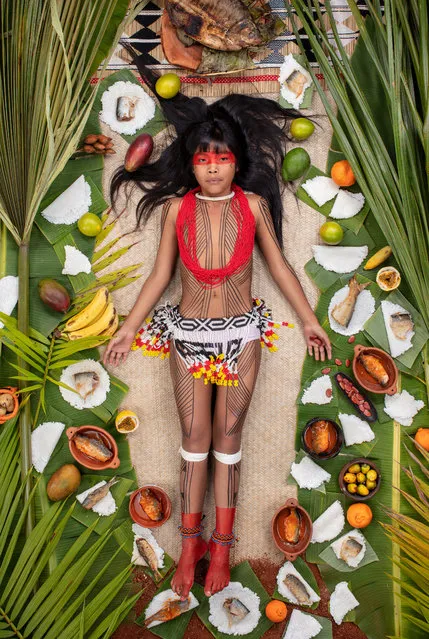
Kawakanih Yawalapiti, 9, Upper Xingu region of Mato Grosso, Brazil, 2018: Kawakanih lives with her tribe, the Yawalapiti, in Xingu national park, a preserve in the Amazon basin of Brazil. The Yawalapiti collect seeds to preserve species unique to their ecosystem, which lies between the rain forest and savannah. Kawakanih’s diet is simple, consisting mainly of fish, cassava, porridge, fruit and nuts. “It takes five minutes to catch dinner”, says Kawakanih. “When you’re hungry, you just go to the river with your net”. (Photo by Gregg Segal/The Guardian)

Photographer Gregg Segal travelled the world to document children and the food they eat in a week. Partly inspired by the increasing problems of childhood obesity, he tracked traditional regional diets as yet unaffected by globalisation, and ironically, found that the healthiest diets were often eaten by the least well off. (Photo by Gregg Segal/The Guardian)
Details
03 Jul 2019 00:03:00
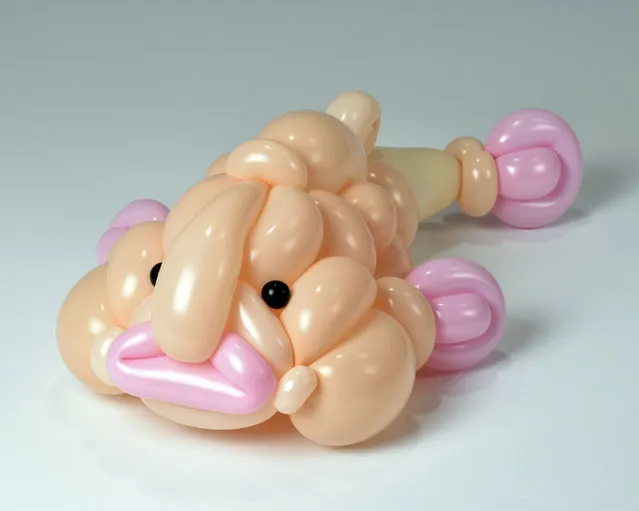
Blobfish by Masayoshi Matsumoto. (Photo by Masayoshi Matsumoto/Caters News Agency)

A Japanese artist is making a name for himself by creating animal sculptures out of balloons. Masayoshi Matsumoto, 29, has thus far created a wide range of intricate figures from the animal kingdom. Here: Blobfish by Masayoshi Matsumoto. (Photo by Masayoshi Matsumoto/Caters News Agency)
Details
01 Oct 2019 00:03:00
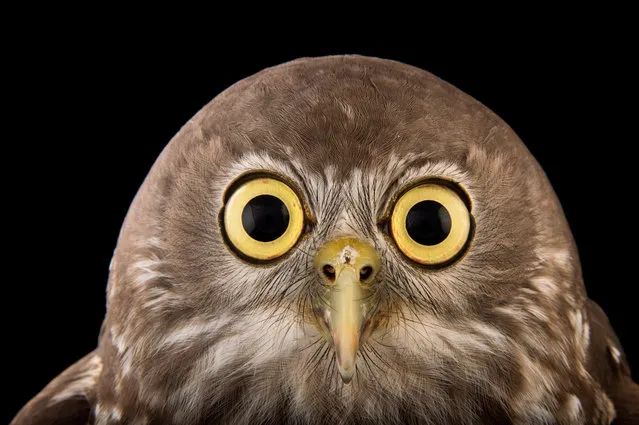
The National Geographic Photo Ark is a travelling exhibition of photographer Joel Sartore’s quest to create a photo archive of biodiversity around the world. So far, Sartore has captured studio portraits of more than 6,000 species – a number that he hopes to double. On 1 July, the ark will open at Melbourne zoo – the first time it has been exhibited in the southern hemisphere. More than 50 portraits will be on display, including many of Australian endangered animals being protected by programs at the zoo itself. These captions have been edited from text supplied by Melbourne zoo. Here: Barking owl. So-named because its call sounds like a barking dog, these birds are native to Australia, Indonesia and Papua New Guinea. In Victoria they are listed as an endangered species, and in 2003 there were estimated to be fewer than 50 breeding pairs. The main threat to the species in Victoria is loss of habitat, especially large trees with hollows in which they can nest and on which many of their prey depend. Apart from a bark, they may utter a chilling scream when they feel threatened. (Photo by Joel Sartore/National Geographic Photo Ark/The Guardian)

The National Geographic Photo Ark is a travelling exhibition of photographer Joel Sartore’s quest to create a photo archive of biodiversity around the world. So far, Sartore has captured studio portraits of more than 6,000 species – a number that he hopes to double. On 1 July, the ark will open at Melbourne zoo – the first time it has been exhibited in the southern hemisphere. More than 50 portraits will be on display, including many of Australian endangered animals being protected by programs at the zoo itself. These captions have been edited from text supplied by Melbourne zoo. Here: Barking owl. (Photo by Joel Sartore/National Geographic Photo Ark/The Guardian)
Details
01 Jul 2017 07:45:00
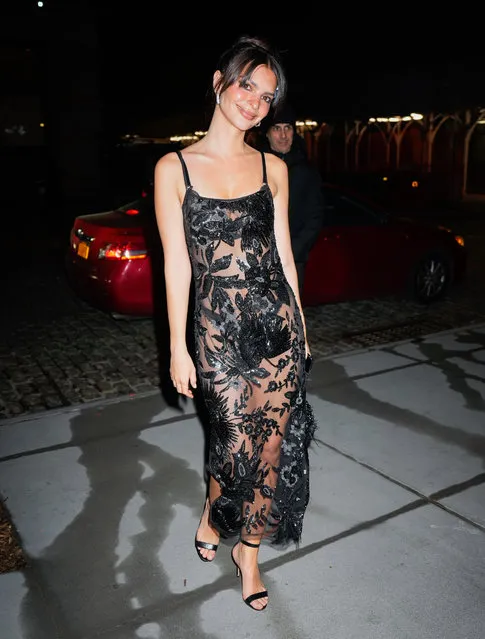
American model Emily Ratajkowski are spotted arriving to the La Ligne dinner at the Hotel Barriere Fouquet in New York City on February 8, 2023. (Photo by The Image Direct)

American model Emily Ratajkowski are spotted arriving to the La Ligne dinner at the Hotel Barriere Fouquet in New York City on February 8, 2023. (Photo by The Image Direct)
Details
16 Feb 2023 04:20:00
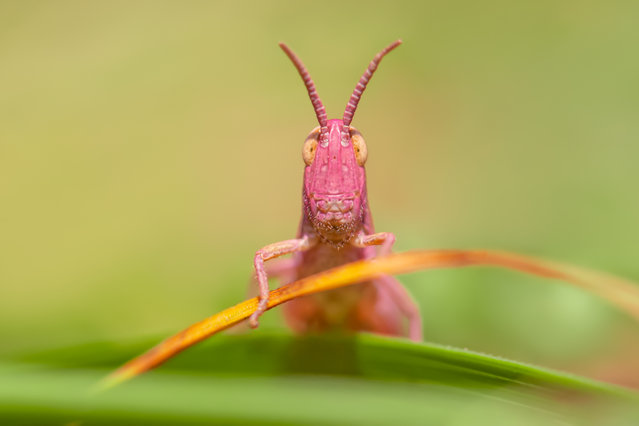
A rare grasshopper shines bright against its leafy background in North Holland, Netherlands in the first decade of October 2024. The insects are usually brown or green but turn pink due to a genetic mutation. (Photo by Roeselien Raimond/Media Drum Images)

A rare grasshopper shines bright against its leafy background in North Holland, Netherlands in the first decade of October 2024. The insects are usually brown or green but turn pink due to a genetic mutation. (Photo by Roeselien Raimond/Media Drum Images)
Details
09 Feb 2025 04:34:00
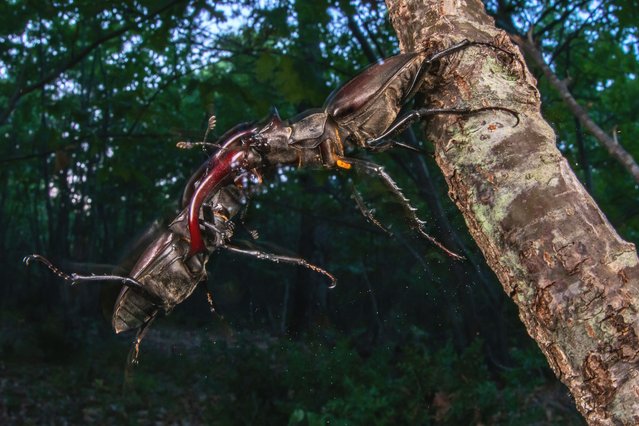
Combat between two male stag beetles, Italy, 2022. During the mating season, male stag beetles (Lucanus cervus) go into a frenzy, with lively but harmless clashes, in which bigger males often have the advantage over smaller ones due to their impressive mandibles. Longer larval development and genetic traits can increase the size of some individuals, but all saproxylic beetles are threatened by poor forest management, logging and dead wood removal to “clean” the forest. (Photo by Iacopo Nerozzi)

Combat between two male stag beetles, Italy, 2022. During the mating season, male stag beetles (Lucanus cervus) go into a frenzy, with lively but harmless clashes, in which bigger males often have the advantage over smaller ones due to their impressive mandibles. Longer larval development and genetic traits can increase the size of some individuals, but all saproxylic beetles are threatened by poor forest management, logging and dead wood removal to “clean” the forest. (Photo by Iacopo Nerozzi)

Details
20 Jul 2025 03:15:00
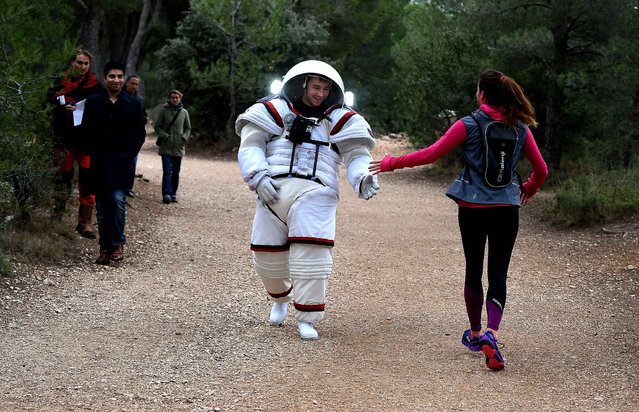
Aeronautics and Space engineer at France's Compagnie Maritime d'Expertises, or Comex, Arnaud Prost (C) meets with a jogger as he tests on the ground the “Gandolfi 2” underwater training suit for spacewalk, on January 20, 2016 in the calanques region (rocky inlets) of Marseille. The underwater training suit “Gandolfi 2”, developed with the European Space Agency (ESA), is designed for training astronauts underwater to simulate space gravity for the astronaut's extravehicular activities (EVAs). (Photo by Boris Horvat/AFP Photo)

Aeronautics and Space engineer at France's Compagnie Maritime d'Expertises, or Comex, Arnaud Prost (C) meets with a jogger as he tests on the ground the “Gandolfi 2” underwater training suit for spacewalk, on January 20, 2016 in the calanques region (rocky inlets) of Marseille. The underwater training suit “Gandolfi 2”, developed with the European Space Agency (ESA), is designed for training astronauts underwater to simulate space gravity for the astronaut's extravehicular activities (EVAs). (Photo by Boris Horvat/AFP Photo)
Details
23 Jan 2016 13:41:00
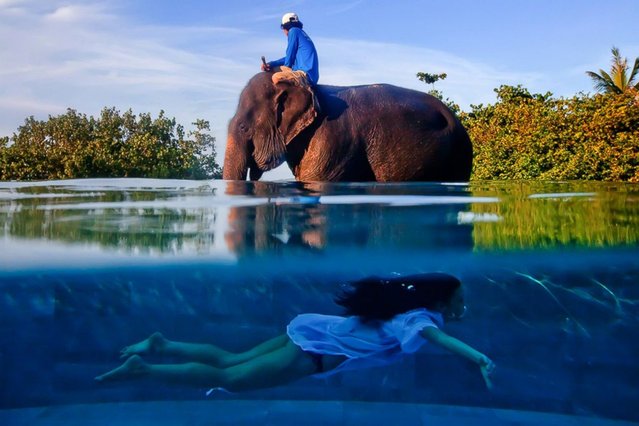
Phuket, Thailand. The girl is in the pool, which is higher than the land, and the elephant is on the land behind the pool. The photographer used an underwater bag to get a half submerged image. (Photo by Justin Mott)

Phuket, Thailand. The girl is in the pool, which is higher than the land, and the elephant is on the land behind the pool. The photographer used an underwater bag to get a half submerged image. (Photo by Justin Mott)
Details
20 Jul 2014 10:56:00