Loading...
Done
Fighting Infections (single image) | Fighting Pandemic by Sudipto Das. “It’s exhausting. A tram conductor in Kolkata, India, wears protective clothing from head to toe even in the heat of a summer afternoon. This was when restrictions were easing after India’s first Covid-19 lockdown – public transport was running, but staff were advised to suit up like this. We’ve all grown used to saluting the efforts of healthcare workers, but plenty of other people in public-facing jobs have performed gruelling duties too to keep people safe”. (Photo by Sudipto Das/Wellcome Photography Prize 2021)

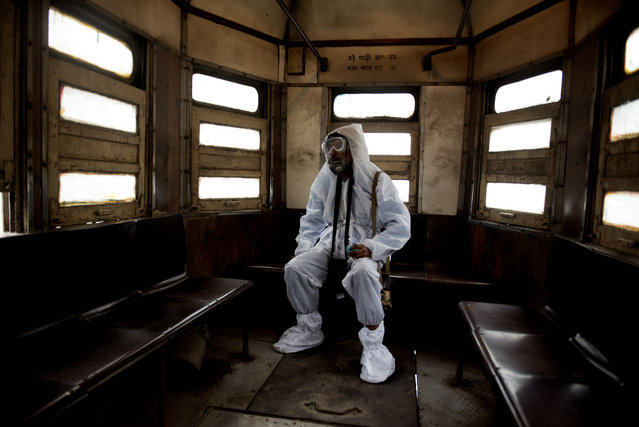
Fighting Infections (single image) | Fighting Pandemic by Sudipto Das. “It’s exhausting. A tram conductor in Kolkata, India, wears protective clothing from head to toe even in the heat of a summer afternoon. This was when restrictions were easing after India’s first Covid-19 lockdown – public transport was running, but staff were advised to suit up like this. We’ve all grown used to saluting the efforts of healthcare workers, but plenty of other people in public-facing jobs have performed gruelling duties too to keep people safe”. (Photo by Sudipto Das/Wellcome Photography Prize 2021)
Details
29 Jun 2021 09:49:00
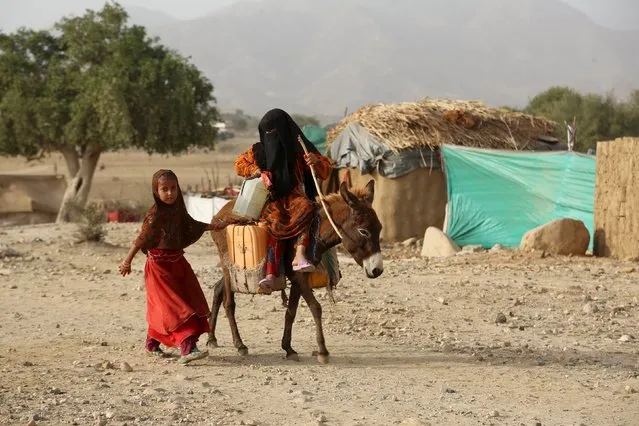
A girl rides a donkey as another walks by at the Shawqaba camp for internally displaced people who were forced to leave their villages by the war in Yemen's northwestern province of Hajjah March 12, 2016. In northwest Yemen, one of the poorest countries in the Middle East, about 400 families uprooted by the war have been stuck in the Shawqaba camp in Hajjah province for the past year. Residents live in poorly built huts that protect them neither from summer heat nor winter cold in a camp that lacks the most basic services. (Photo by Abduljabbar Zeyad/Reuters)

A girl rides a donkey as another walks by at the Shawqaba camp for internally displaced people who were forced to leave their villages by the war in Yemen's northwestern province of Hajjah March 12, 2016. In northwest Yemen, one of the poorest countries in the Middle East, about 400 families uprooted by the war have been stuck in the Shawqaba camp in Hajjah province for the past year. Residents live in poorly built huts that protect them neither from summer heat nor winter cold in a camp that lacks the most basic services. (Photo by Abduljabbar Zeyad/Reuters)
Details
09 Apr 2016 13:16:00
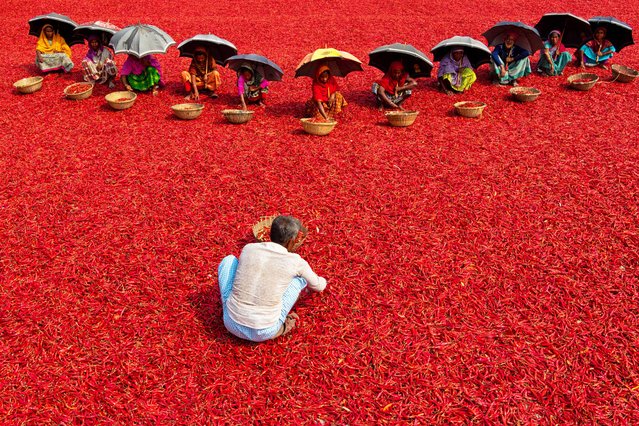
Rows of workers shelter under umbrellas from the scorching heat as they painstakingly sort through a red carpet of millions of chilli peppers in Bogra, Bangladesh on October 3, 2023. They sort the rotten and broken chilli peppers out to separate the poor quality ones which won't sell. In a line, the pickers who are paid less than £3 for a 10-hour shift slowly move forward with their baskets to separate the bad from the good after the chilies have been dried in the sun for a week. The dried & sorted chillies are then packaged and taken to the local market where they are brought mainly by companies to be made into chilli powder. The workers sort them in a warm environment, with temperatures reaching up to 45°C. More than 5,000 people work in almost 100 chilli farms in the Bogra district of Bangladesh to supply local spice companies with chillies for their recipes. Known as “Lal Morich” to the locals, chilli peppers are a major part of Bengali cuisine and are used as part of a combination of spices for various meat dishes, including chicken and beef. (Photo by Joy Saha/Rex Features/Shutterstock)

Rows of workers shelter under umbrellas from the scorching heat as they painstakingly sort through a red carpet of millions of chilli peppers in Bogra, Bangladesh on October 3, 2023. They sort the rotten and broken chilli peppers out to separate the poor quality ones which won't sell. In a line, the pickers who are paid less than £3 for a 10-hour shift slowly move forward with their baskets to separate the bad from the good after the chilies have been dried in the sun for a week. (Photo by Joy Saha/Rex Features/Shutterstock)
Details
21 Oct 2023 04:04:00
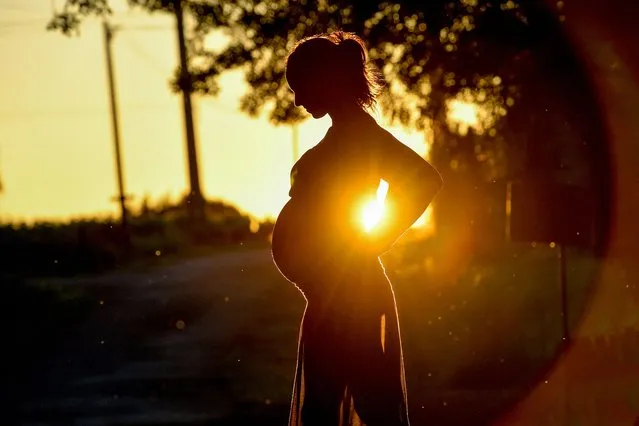
A pregnant woman poses on June 19, 2018 in Vertou, western France. France had an estimated population of 68.4 million by January 1, 2024, representing a further year-on-year increase of 0.3 percent, limited by a marked drop in the birth rate, the INSEE national statistics bureau of France reported on January 16, 2024. In 2023, 678,000 babies were born in France, 6.6 percent fewer than the previous year, the lowest number of births in any year since 1946. Over the same period, there were 631,000 deaths, down 6.5 percent on 2022, a year marked by the consequences of the Covid-19 pandemic and episodes of extreme heat. (Photo by Loic Venance/AFP Photo)

A pregnant woman poses on June 19, 2018 in Vertou, western France. France had an estimated population of 68.4 million by January 1, 2024, representing a further year-on-year increase of 0.3 percent, limited by a marked drop in the birth rate, the INSEE national statistics bureau of France reported on January 16, 2024. In 2023, 678,000 babies were born in France, 6.6 percent fewer than the previous year, the lowest number of births in any year since 1946. Over the same period, there were 631,000 deaths, down 6.5 percent on 2022, a year marked by the consequences of the Covid-19 pandemic and episodes of extreme heat. (Photo by Loic Venance/AFP Photo)
Details
27 Feb 2024 07:29:00
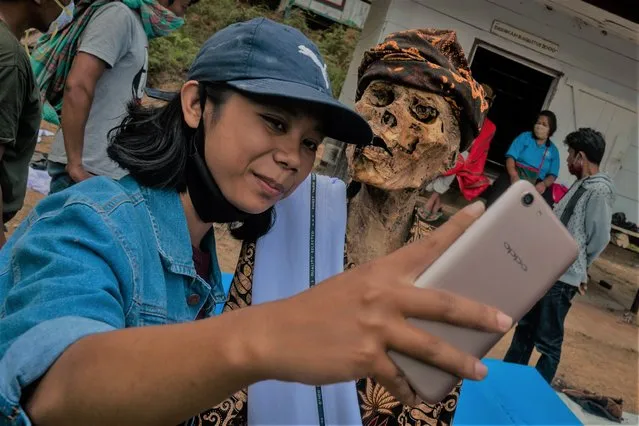
Iin Arensia taking a selfie with his grandfather preserved body Ne Potta during a traditional ritual called “Manene” in Panggala, Nort Toraja, South Sulawesi, Indonesia, Tuesday, August 25th 2020. (Photo by Hariandi Hafid/ZUMA Wire/Rex Features/Shutterstock)

Iin Arensia taking a selfie with his grandfather preserved body Ne Potta during a traditional ritual called “Manene” in Panggala, Nort Toraja, South Sulawesi, Indonesia, Tuesday, August 25th 2020. (Photo by Hariandi Hafid/ZUMA Wire/Rex Features/Shutterstock)
Details
27 Aug 2020 00:03:00
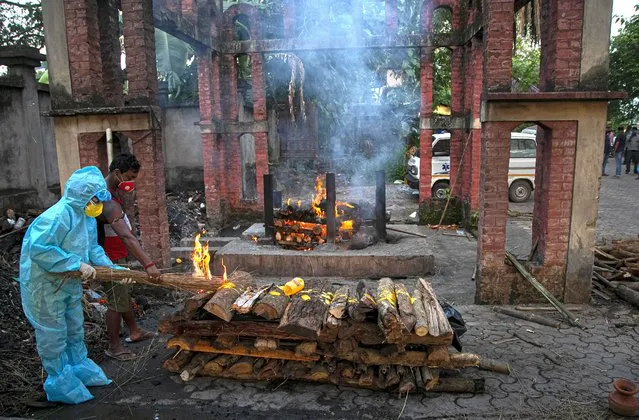
An Indian woman performs rituals near the body of her husband who died of COVID-19 in Gauhati, India, Monday, September 28, 2020. India’s confirmed coronavirus tally has reached 6 million cases, keeping the country second to the United States in number of reported cases since the pandemic began. (Photo by Anupam Nath/AP Photo)

An Indian woman performs rituals near the body of her husband who died of COVID-19 in Gauhati, India, Monday, September 28, 2020. India’s confirmed coronavirus tally has reached 6 million cases, keeping the country second to the United States in number of reported cases since the pandemic began. (Photo by Anupam Nath/AP Photo)
Details
07 Oct 2020 00:01:00
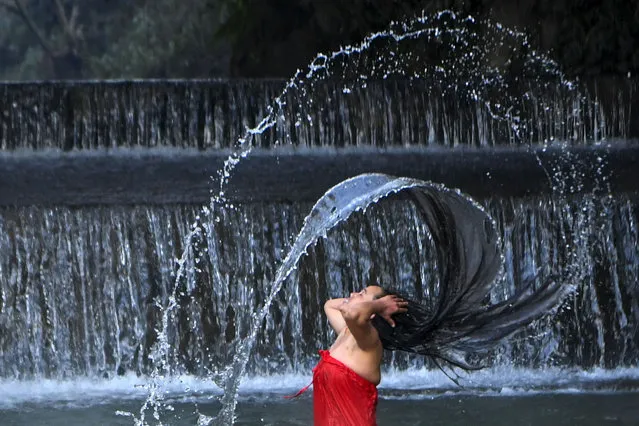
A Hindu devotee bathes in the Shali River during the Swasthani Brata Katha festival, marked with auspicious bathing in water bodies hoping for a prosperous life and conjugal happiness, on the outskirts of Kathmandu on January 28, 2021. (Photo by Prakash Mathema/AFP Photo)

A Hindu devotee bathes in the Shali River during the Swasthani Brata Katha festival, marked with auspicious bathing in water bodies hoping for a prosperous life and conjugal happiness, on the outskirts of Kathmandu on January 28, 2021. (Photo by Prakash Mathema/AFP Photo)
Details
01 Mar 2021 08:42:00
Somalis remove the body of a man killed in a blast in the capital Mogadishu, Somalia Saturday, October 14, 2017. (Photo by Farah Abdi Warsameh/AP Photo)

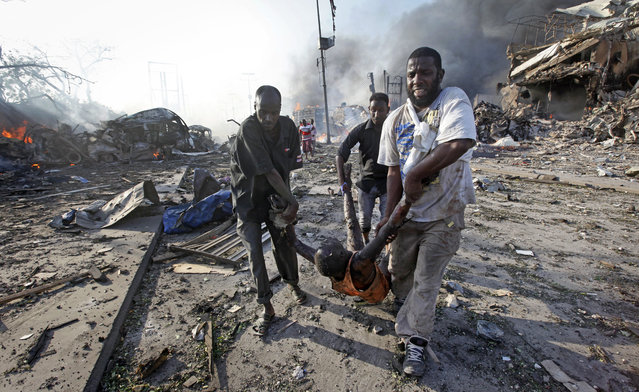
Somalis remove the body of a man killed in a blast in the capital Mogadishu, Somalia Saturday, October 14, 2017. A huge explosion from a truck bomb has killed at least 20 people in Somalia's capital, police said Saturday, as shaken residents called it the most powerful blast they'd heard in years. (Photo by Farah Abdi Warsameh/AP Photo)
Details
16 Oct 2017 08:57:00