Loading...
Done
Norwegian Trolls By Ivar Rodningen Part 2

Some people think of trolls as nothing but savage beast, yet others realize that beneath their rock-hard skin hides a gentle kind heart. Ivar Rodningem is one of the people who knows the true nature of trolls. Though these creatures look unruly, it is just the way they were born. Trolls come in all shapes and sizes. Some are small, some are large, and some are simply enormous. They help each other out, though elders tend to be loners, preferring the company of their own thoughts to anybody else. You shouldn’t run for your life if you ever meet a troll, though we wouldn’t recommend pestering them, as they are mighty strong, even the little ones.


See also:Part 1
Details
07 Mar 2015 12:05:00
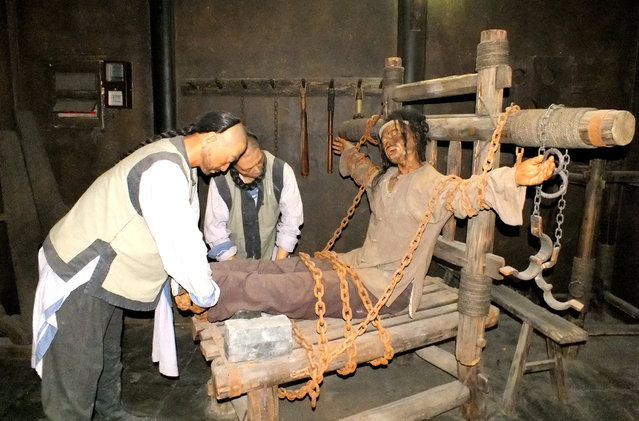
Wax figures with torture instrument named “torture-rack” are seen on October 25, 2014 in Huai'an, Jiangsu province of China. The exhibition, which opened last year at an educational center in the eastern city of Huai'an, includes reenactments of prisoners being hung over a fire, flayed and being tortured on what is known as a “Tiger Bench” – pictured above – a Qing dynasty (1644-1912) device that contorted victims' legs and arms in high pressure positions that could break bones or tear apart joints. (Photo by ChinaFotoPress)

Organizers of an exhibition of ancient instruments of torture in Huai'an, Jiangsu province, have suggested that children, heart disease patients and people with high blood pressure stay away because of the vivid depictions of shocking cruelty. The exhibition has more than 200 instruments of torture on display in the 50,000-square-meter exhibition halls of a restored ancient building. Wax figures, along with sound and light techniques, are incorporated for scary effect. The local government said the exhibition is for tourists and historians to research ancient torture practices. (Photo by ChinaFotoPress)
Details
29 Oct 2014 12:22:00
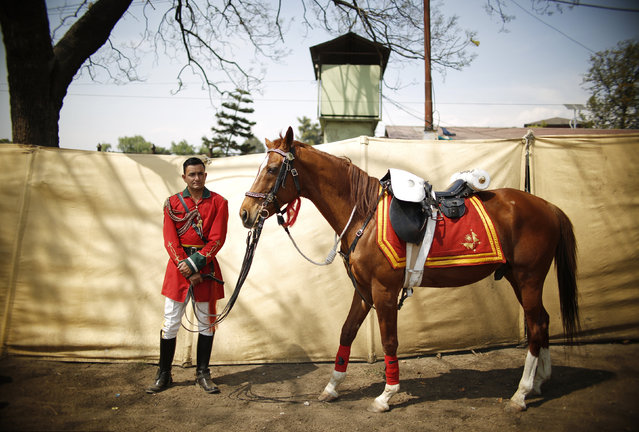
A Nepalese army solder stand next to a horse during the “Ghodejatra” Horse Race festival, which is organised by the Nepal Army, in Kathmandu, Nepal, April 7, 2016. Ghode Jatra, the horse racing festival of Nepal, celebrated on the New Moon day of mid March or early April is among the important celebrations of the Kathmandu Valley. exists a tree in the South-East part of the Tundikhel where Gurumapa supposed to be resides. (Photo by Navesh Chitrakar/Reuters)

A Nepalese army solder stand next to a horse during the “Ghodejatra” Horse Race festival, which is organised by the Nepal Army, in Kathmandu, Nepal, April 7, 2016. Ghode Jatra, the horse racing festival of Nepal, celebrated on the New Moon day of mid March or early April is among the important celebrations of the Kathmandu Valley. Grand horse parade including various acrobatic style of shows are performed by Nepal military at Tundikhel-a fenced parade ground located in the heart of Kathmandu city. (Photo by Navesh Chitrakar/Reuters)
Details
08 Apr 2016 14:33:00
Brazilian tattoo artist Michel Praddo, also known as Diabao or Human Satan, and his wife Carol Praddo, known as Mulher Demonia or Demon Woman, take a picture with a fan at the beach shore in Praia Grande, Brazil on August 18, 2021. Despite his frightening image, Prado says he has a good heart. His wife Carol Prado, 36, who is known as Demon Woman, also altered her body to fit the image. The Sao Paulo-based couple have undergone their most extreme modifications during the last five years. (Photo by Carla Carniel/Reuters)

Brazilian tattoo artist Michel Praddo, also known as Diabao or Human Satan, and his wife Carol Praddo, known as Mulher Demonia or Demon Woman, take a picture with a fan at the beach shore in Praia Grande, Brazil on August 18, 2021. (Photo by Carla Carniel/Reuters)
Details
24 Aug 2021 08:10:00
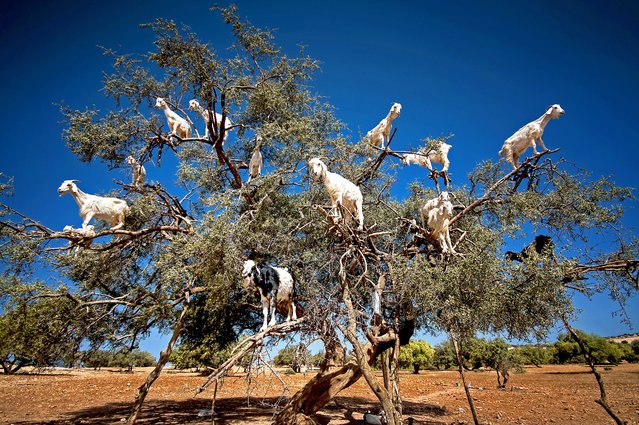
These goats threw caution to the wind and scaled this Argan tree right to the very top, even balancing on the most unsturdy of branches. It looks like a bit of a baa-lancing act, but the goats hooves are perfectly adapted to climbing the trees, where they graze on the Argan fruit. Amateur photographer Burak Senbak, 51, took these photos whilst travelling through Morocco in July 2016. Burak is originally from Turkey and works as a mechanical engineer, but has pursued his passion for photography for 10 years. Intrigued by the sight of goats in a tree, Burak couldnt resist the opportunity to take some photos, and said the goats proved a perfect subject. (Photo by Burak Senbak/Caters News)

These goats threw caution to the wind and scaled this Argan tree right to the very top, even balancing on the most unsturdy of branches. It looks like a bit of a baa-lancing act, but the goats hooves are perfectly adapted to climbing the trees, where they graze on the Argan fruit. Amateur photographer Burak Senbak, 51, took these photos whilst travelling through Morocco in July 2016. Burak is originally from Turkey and works as a mechanical engineer, but has pursued his passion for photography for 10 years. Intrigued by the sight of goats in a tree, Burak couldnt resist the opportunity to take some photos, and said the goats proved a perfect subject. (Photo by Burak Senbak/Caters News)
Details
27 Aug 2017 07:00:00
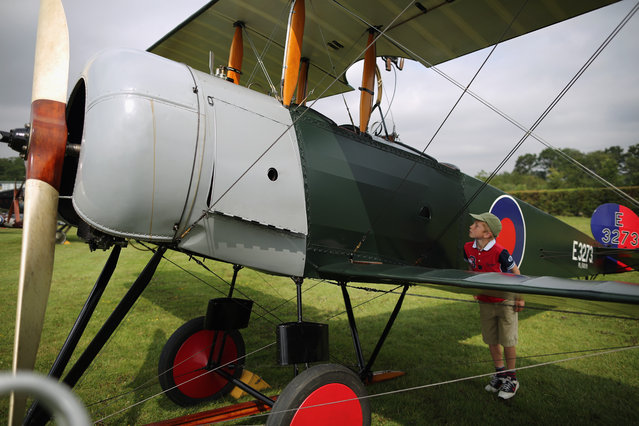
Aviation enthusiast Patrick Wilson 8, from Wetherby looks at  an Avro 504 k at “The Shuttlesworth Collection” at Old Warden on July 21, 2014 in Biggleswade, England. Of the 55,000 planes that were manufactured by the Royal Army Corps (RAC) during WWI, only around 20 remain in airworthy condition. (Photo by Dan Kitwood/Getty Images)

Aviation enthusiast Patrick Wilson 8, from Wetherby looks at an Avro 504 k at “The Shuttlesworth Collection” at Old Warden on July 21, 2014 in Biggleswade, England. Of the 55,000 planes that were manufactured by the Royal Army Corps (RAC) during WWI, only around 20 remain in airworthy condition. Six of these belong to The Shuttleworth Collection at Old Warden, Bedfordshire, making it the most complete collection of original airworthy WWI aircraft in the world. Amongst the collection is the SE5a. The SE5a is a single seater fighter aircraft. It is an original biplane designed by the Royal Aircraft Factory, with its engine built by Wolseley Motors Ltd, and it was issued to 84 Squadron in November 1918. The National Archive in Kew has recently verified that the plane saw action in France with 84 Squadron the day before Armistice, November 10, 1918. (Photo by Dan Kitwood/Getty Images)
Details
23 Jul 2014 10:00:00
Handler Jorge Garcia-Bengochea holds Honor, a miniature therapy horse from Gentle Carousel Miniature Therapy Horses, as they visit with patients at the Kravis Children's Hospital at Mount Sinai in the Manhattan borough of New York City, March 16, 2016. (Photo by Mike Segar/Reuters)

Handler Jorge Garcia-Bengochea holds Honor, a miniature therapy horse from Gentle Carousel Miniature Therapy Horses, as they visit with patients at the Kravis Children's Hospital at Mount Sinai in the Manhattan borough of New York City, March 16, 2016. Some of the most powerful medicine delivered to young patients at Mount Sinai Hospital in New York on Wednesday came in a package less than 32 inches tall and with a tail. Honor, a 10-month-old colt with Gentle Carousel Miniature Therapy Horses, trotted into the hearts of dozens of children and teens being treated at the Manhattan hospital. (Photo by Mike Segar/Reuters)
Details
18 Mar 2016 11:51:00
A mudlark uses a torch to look for items on the bank of the River Thames in London, Britain June 06, 2016. Mudlarking is believed to trace its origins to the 18th and 19th century, when scavengers searched the Thames' shores for items to sell. These days, history and archaeology fans are the ones hoping to find old relics such as coins, ceramics, artifacts or everyday items from across centuries. They wait for the low tide and then scour specific areas of exposed shores. "If you're in a field you could be out all day long, with the river you're restricted to about two or three hours," mudlark Nick Stevens said. While many just use the naked eye for their searches, others rely on metal detectors for which a permit from the Port of London Authority is needed. Digging also requires consent. (Photo by Neil Hall/Reuters)

A mudlark uses a torch to look for items on the bank of the River Thames in London, Britain June 06, 2016. Mudlarking is believed to trace its origins to the 18th and 19th century, when scavengers searched the Thames' shores for items to sell. These days, history and archaeology fans are the ones hoping to find old relics such as coins, ceramics, artifacts or everyday items from across centuries. their finds with the Portable Antiquities Scheme. Any item over 300 years old must be recorded. (Photo by Neil Hall/Reuters)
Details
27 Aug 2016 10:43:00