Loading...
Done
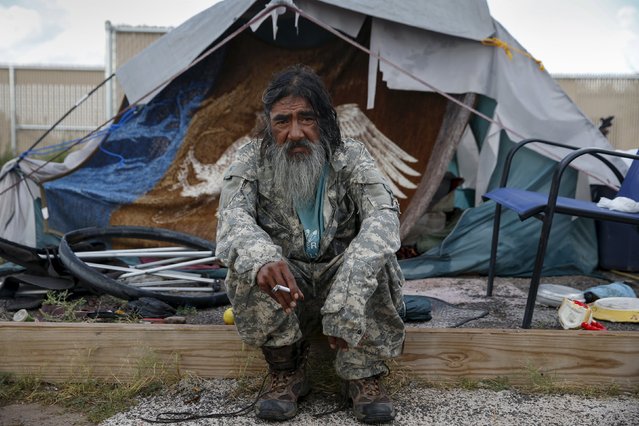
Daniel J. Wabsey, a 58-year-old war veteran, sits outside his tent at Camp Hope in Las Cruces, New Mexico October 6, 2015. “I've been traveling for 35 or 38 years. Getting inside would take a while to get used to. I just want to be able to eat, sleep and be safe. We all get along and understand in Camp Hope. We've all been there. With common sense you can survive out here”, Wabsey said. Camp Hope describe themselves as an “alternative transitional living project for the homeless”. Around 50 people live at the camp. (Photo by Shannon Stapleton/Reuters)

Daniel J. Wabsey, a 58-year-old war veteran, sits outside his tent at Camp Hope in Las Cruces, New Mexico October 6, 2015. “I've been traveling for 35 or 38 years. Getting inside would take a while to get used to. I just want to be able to eat, sleep and be safe. We all get along and understand in Camp Hope. We've all been there. With common sense you can survive out here”, Wabsey said. Camp Hope describe themselves as an “alternative transitional living project for the homeless”. Around 50 people live at the camp. (Photo by Shannon Stapleton/Reuters)
Details
19 Dec 2015 08:05:00
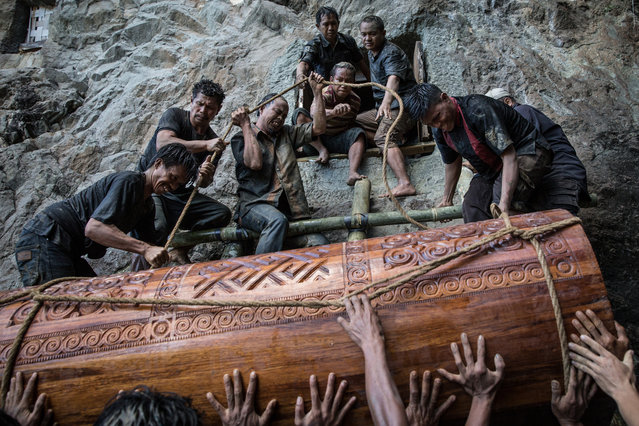
It is said that Torajans are people who “live to die”. For this Indonesian ethnic group, funerals are such extravagant events that they sometimes attract tourists. Families can postpone burials years (and the deceased are considered sick and hosted at home until the funeral) until the family can raise enough money and gather as many relatives as possible. And then it’s a jubilant multiday social event with a parade, dances and animal sacrifices. Agung Parameswara photographed these funerary practices when he traveled to South Sulawesi province, where the Torajans live. But often, their funeral isn’t the last time the dead are seen. In August, crypts are opened, coffins are slid back out and bodies delicately unsheathed. This tender ritual is known as Ma’Nene, which is customarily performed every few years. (Photo by Agung Parameswara/The Washington Post)

It is said that Torajans are people who “live to die”. For this Indonesian ethnic group, funerals are such extravagant events that they sometimes attract tourists. Families can postpone burials years (and the deceased are considered sick and hosted at home until the funeral) until the family can raise enough money and gather as many relatives as possible. And then it’s a jubilant multiday social event with a parade, dances and animal sacrifices. Agung Parameswara photographed these funerary practices when he traveled to South Sulawesi province, where the Torajans live. (Photo by Agung Parameswara/The Washington Post)
Details
06 Oct 2016 09:15:00
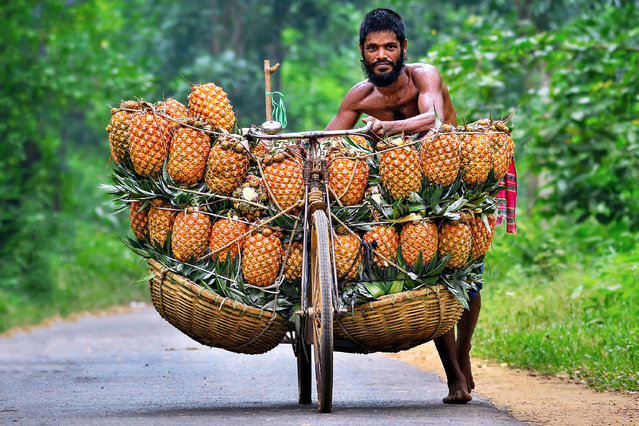
Cyclists desperately try to keep their heavily-laden bicycles upright as they arrive at a market with baskets full of pineapples on August 23, 2018. The men travel up to 12 and a half miles with two baskets tied to the sides of their bikes, carrying between 50 and 100 pineapples to sell. Each of the bicycles is so heavily laden with fruit it is impossible for the men to actually ride their bikes, instead having to walk alongside them. When they arrive at the market place in Madhupur, Bangladesh, buyers will pay up to 30 Taka for a pineapple – the equivalent of around 28 pence. (Photo by Abdul Momin/Solent News & Photo Agency UK)

Cyclists desperately try to keep their heavily-laden bicycles upright as they arrive at a market with baskets full of pineapples on August 23, 2018. The men travel up to 12 and a half miles with two baskets tied to the sides of their bikes, carrying between 50 and 100 pineapples to sell. Each of the bicycles is so heavily laden with fruit it is impossible for the men to actually ride their bikes, instead having to walk alongside them. When they arrive at the market place in Madhupur, Bangladesh, buyers will pay up to 30 Taka for a pineapple – the equivalent of around 28 pence. (Photo by Abdul Momin/Solent News & Photo Agency UK)
Details
21 Sep 2018 00:03:00


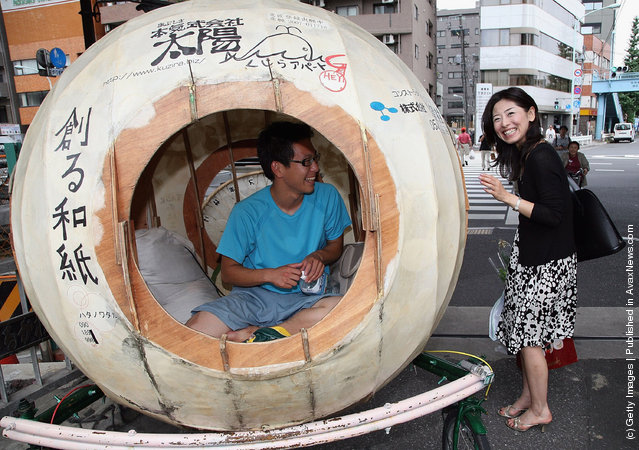
Gohei Hayashi of Kyoto University is seen in side his movable eco and healing house, “Kujira (Whale) House” July 21, 2007 in Tokyo, Japan. The house is made from Japanese paper, bamboo and tatami mat. Hayashi has travelled 500 km from Japan's ancient city, Kyoto to Tokyo with his eco house to promote his house which can be placed both out inside and outside to provide a private space. The Kujira house is available at the price of 800,000 yen (roughly US$6600). (Photo by Koichi Kamoshida/Getty Images)
Details
23 May 2011 06:45:00
A woman rides a horse through the biannual Stow Horse Fair in the town of Stow-on-the-Wold, southern England on October 24, 2019. (Photo by Oli Scarff/AFP Photo)

A woman rides a horse through the biannual Stow Horse Fair in the town of Stow-on-the-Wold, southern England on October 24, 2019. The Stow Horse Fair has attracted Gypsy and Traveller people from all over the country to the Cotswold town every May and October since 1476. (Photo by Oli Scarff/AFP Photo)
Details
26 Oct 2019 00:03:00
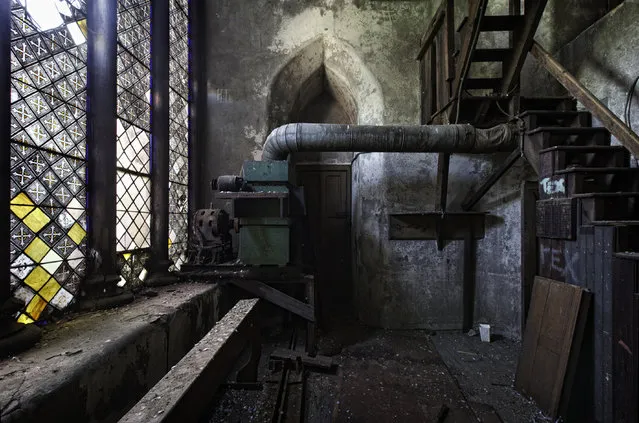
St. Boniface Church, Philadelphia Pa. (Photo by Matthew Christopher/Caters News)

“These are the stunning images of some of Americas most breathtaking churches – all of which are abandoned. Matthew Christopher travels around the United States taking shots of its most beautiful decaying wonders. He shot those in his churches series in Philadelphia, Pennsylvania, where he works as a photographer and lecturer. Matthew’s fascination with such abandoned spaces started when he was a child when he enjoyed looking at artwork set in buildings that have since decayed”. – Caters News. Photo: St. Boniface Church, Philadelphia Pa. (Photo by Matthew Christopher/Caters News)
Details
10 Aug 2014 10:23:00
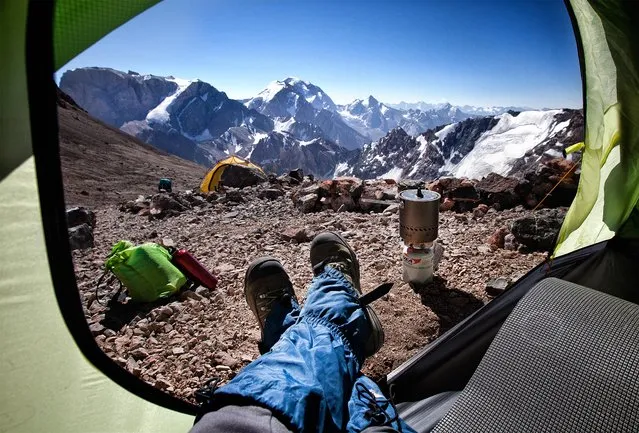
Chimtarga. (Photo by Caters News/Oleg Grigoriev)

“A happy camper has shown he has the world at his feet by capturing a series of breath-taking mountain views from his tent. Russian Photographer Oleg Grigoriev, 35, travels with little more than a tent and his camera taking snaps of the mountainous terrain of central Asia and Eastern parts of Europe. The adventurous lawyer, who lives in Ukraine, started camping in remote mountainous areas in 2007 but only came up with the concept of photographing views from his tent after a memorable trip to the Fann Mountains of Tajikistan”. – Caters News
Details
14 Sep 2014 11:00:00
Buddhist pilgrim family from Sichuan. (Photo by Tom Carter/The Atlantic)

Nine years ago, Tom Carter traveled from San Francisco to China, responding to a job posting that turned out to be a scam. He managed to find another job as a teacher, and saved enough money to embark on a 56,000 km trip through all of China's 33 provinces that lasted two years. Carrying a camera – just a a 4-megapixel point-and-shoot – Carter captured some amazing images of the widely varying landscape, people, and architecture across the nation. Photo: Buddhist pilgrim family from Sichuan. (Photo by Tom Carter via The Atlantic)
Details
12 Mar 2013 14:19:00