Loading...
Done
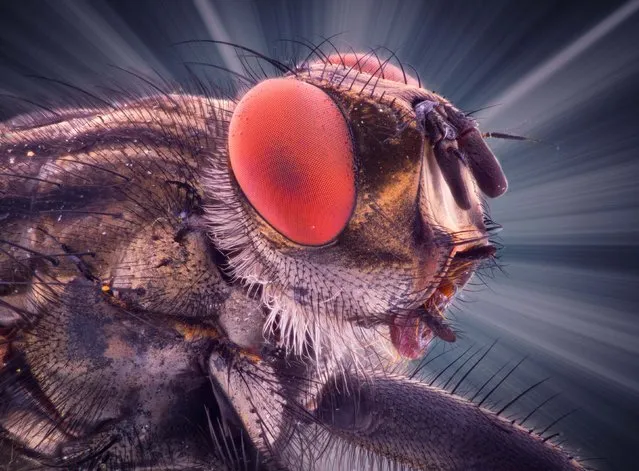
House Fly. (Photo by Kutub Uddin/Caters News)

“Creepy crawlies have become stunning examples of the natural world in these incredible close-up pictures. Photographer Kutub Uddin, 28, snapped the tiny creatures in a forest near his home of Bognor Regis over the course of the summer. Taken in close-up using special macro lenses and filters, he managed to turn house flies, damsel flies and wasps into gorgeous jeweled works of art. Kutub said: “I found the bugs in the forest near where I live when I was taking pictures”. – Cater News
Details
01 Sep 2014 10:29:00
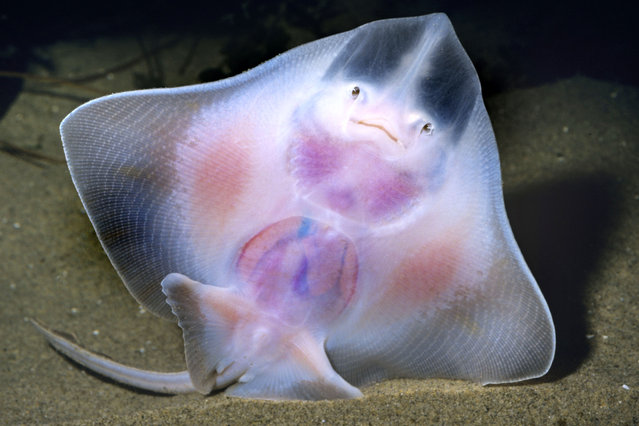
Thornback Skate. (Photo by Ken Lucas/Caters News)

“They're some of the most intriguing and complex creatures on the planet but they really do have nothing to hide – because theyre totally see-through. Transparent animals – creatures with clear glass-like skin – can be found all over the world but their very existence is still shrouded in mystery. The fascinating organisms verge on the invisible and their translucent skin often helps them elude predators”. – Caters News. Photo: Thornback Skate. (Photo by Ken Lucas/Caters News)
Details
04 Sep 2014 08:37:00
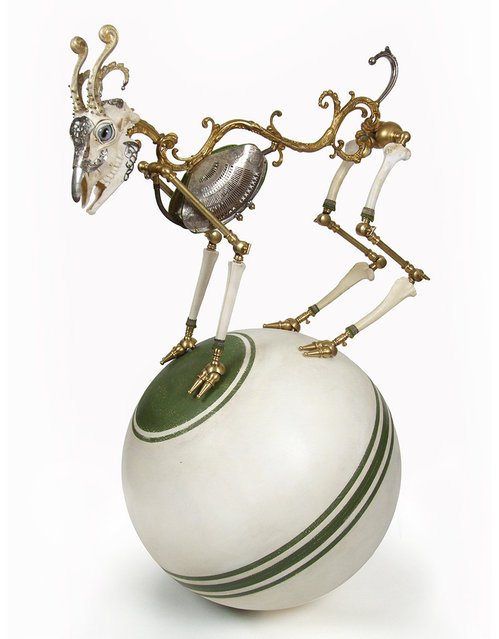
Sculpture By Jessica Joslin

More great and peculiar work from Chicago based sculptor Jessica Joslin. Joslin assembles her hybrid creatures from objects found in obscure junk shops, flea markets, attics, taxidermy supply houses, specialty hardware distributors…or even just walking through the woods. “Miniature machine bolts, springs and couplings comprise anatomical structures. Many of the beasts have hidden movements: a spring loaded beak, snapping jaws, jointed legs and adjustable tails. Some creatures are free-standing but have mechanisms to allow for movement or multiple positions.”
Details
03 Nov 2013 14:28:00
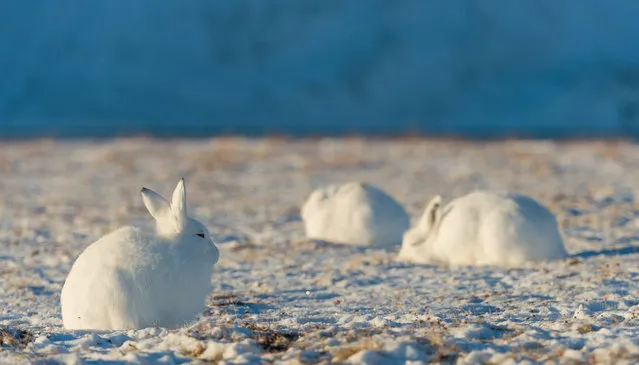
Arctic Hare

The arctic hare, or polar rabbit, is a species of hare which is adapted largely to polar and mountainous habitats. The arctic hare survives with a thick coat of fur and usually digs holes in the ground or under snow to keep warm and sleep. Arctic hares look like rabbits but have shorter ears, are taller when standing, and, unlike rabbits, can thrive in cold climates. They can travel together with many other hares, sometimes huddling with dozens or more, but are usually found alone, taking, in some cases, more than one partner. The arctic hare can run up to 60 kilometres per hour (40 mph). Its predators include the arctic wolf, arctic fox, and ermine.
Details
17 Mar 2014 13:56:00
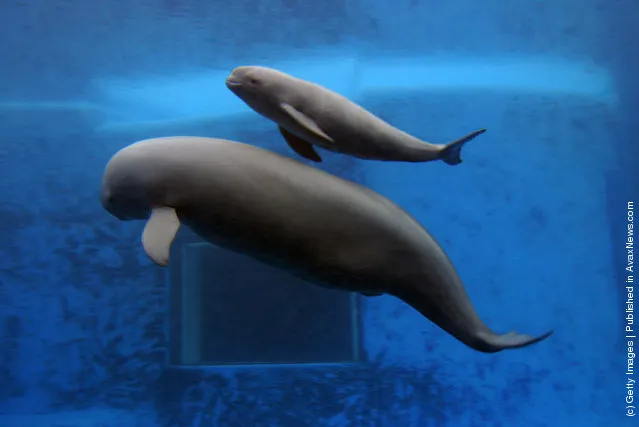
A newly born Yangtze finless porpoise (top) swims with his mother at the Hydrobiology Institute of the Chinese Academy of Sciences

“The finless porpoise (Neophocaena phocaenoides) is one of six porpoise species. In the waters around Japan, at the northern end of its range, it is known as the sunameri. A freshwater population found in the Yangtze River in China is known locally as the jiangzhu or «river pig»”. – Wikipedia

Photo: A newly born Yangtze finless porpoise (top) swims with his mother at the Hydrobiology Institute of the Chinese Academy of Sciences on June 3, 2007 in Wuhan of Hubei Province, China. (Photo by China Photos/Getty Images)
Details
20 Feb 2012 12:23:00
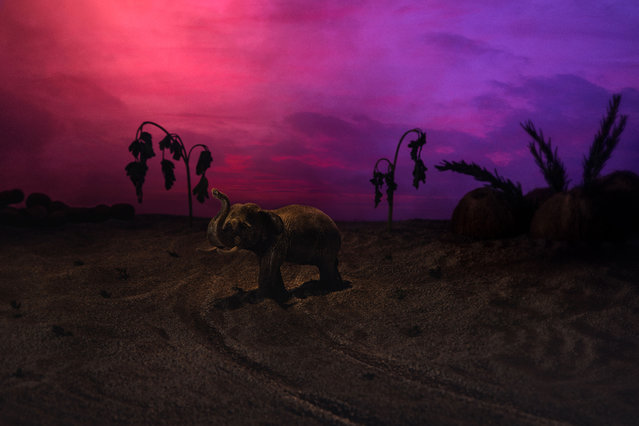
An elephant with plants of parsley, rosemary, tamarind and coconut boulders. (Photo by Julia Wimmerlin/Caters News)

If you think you are looking at stunning sunset safari photographs, think again. From a herd of elephants trailing the savanna at sunset to a crocodile hungrily engulfing a baby impala, amazingly these clever pictures are actually made using nothing but props, toy animals and vegetables. Julia Wimmerlin has always dreamed of going on safari and found a way to channel her dream in a seriously creative way. Here: An elephant with plants of parsley, rosemary, tamarind and coconut boulders. (Photo by Julia Wimmerlin/Caters News)
Details
29 Mar 2016 11:36:00
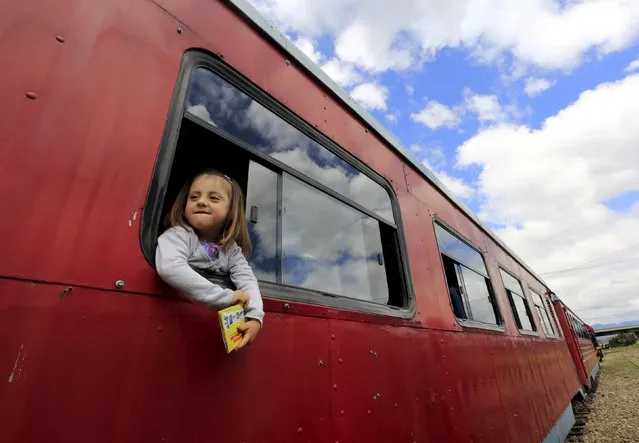
A girl looks out from the window of a “La Sabana” tourist train in La Caro March 1, 2015. (Photo by Jose Miguel Gomez/Reuters)

A girl looks out from the window of a “La Sabana” tourist train in La Caro March 1, 2015. The “La Sabana” tourist train that runs through the capital was founded by Eduardo Rodriguez, a railway engineer. Rodriguez has worked on Colombia's railway system his whole life and now, with an air of nostalgia, transports thousands of tourists in renovated steam locomotives that he fixes in Bogota's Central Station which dates back to 1913. (Photo by Jose Miguel Gomez/Reuters)
Details
23 Apr 2015 11:30:00
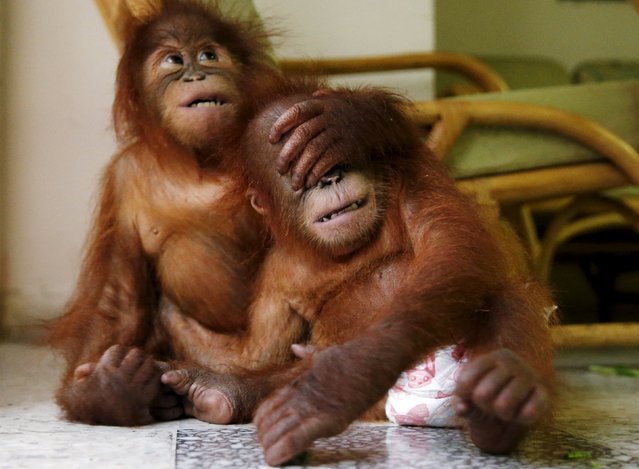
Two baby orangutans play with each other at the wildlife department in Kuala Lumpur, Malayasia, October 19, 2015. (Photo by Olivia Harris/Reuters)

Two baby orangutans play with each other at the wildlife department in Kuala Lumpur, Malayasia, October 19, 2015. The Malaysian wildlife department in July seized two baby Sumatran orangutans, found in duffel bags, from traffickers who were attempting to sell them to buyers in Malaysia. According to local media, the orangutans will be returned to Medan, Indonesia on Tuesday. The illegal wildlife trade is estimated to be $8 billion a year worldwide, according to TRAFFIC, a wildlife trade monitoring network. (Photo by Olivia Harris/Reuters)
Details
22 Oct 2015 08:05:00