Loading...
Done
A Shinto priest prays to the dedicated dolls during the Festival of Repayment of Kindness at Dairoku-tensakaki Shrine in Tokyo, Saturday, May 16, 2015. (Photo by Eugene Hoshiko/AP Photo)

A Shinto priest prays to the dedicated dolls during the Festival of Repayment of Kindness at Dairoku-tensakaki Shrine in Tokyo, Saturday, May 16, 2015. Traditionally, it is believed that the dolls can give good health and happiness to children by absorbing sickness and ill fate. The dolls are then sacrificed during the festival after they have protected their young owners. (Photo by Eugene Hoshiko/AP Photo)
Details
18 May 2015 12:33:00
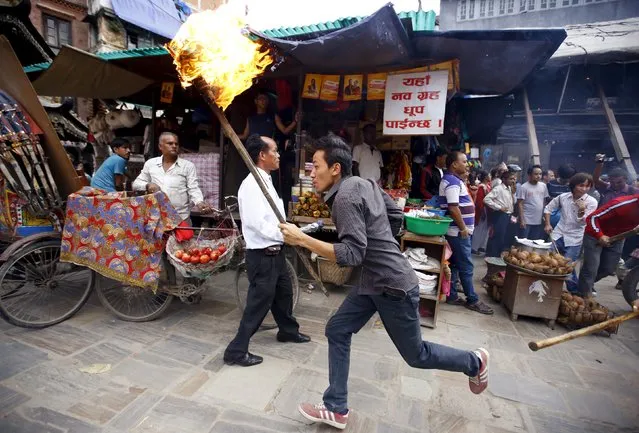
A protester holding a torch runs past police (not pictured) trying to stop the protesters from marching in a rally organised by a 30-party alliance led by a hardline faction of former Maoist rebels, who are protesting against the draft of the new constitution, in Kathmandu August 15, 2015. (Photo by Navesh Chitrakar/Reuters)

A protester holding a torch runs past police (not pictured) trying to stop the protesters from marching in a rally organised by a 30-party alliance led by a hardline faction of former Maoist rebels, who are protesting against the draft of the new constitution, in Kathmandu August 15, 2015. The group says that the draft is not inclusive and does not protect the rights of the marginalised and underprivileged groups in the country. (Photo by Navesh Chitrakar/Reuters)

Details
16 Aug 2015 13:24:00
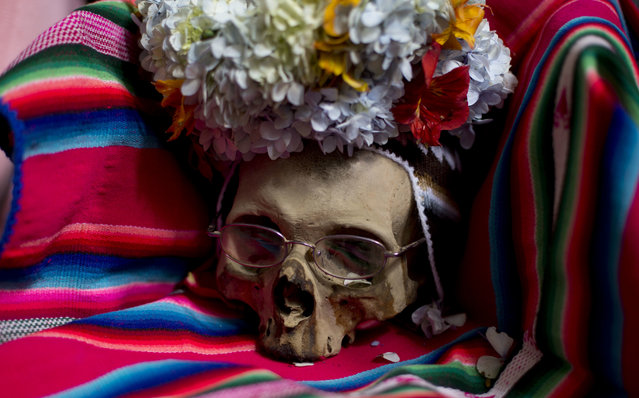
A  decorated human skull or “natitas”, sits on a blanket inside the Cementerio General chapel, during the Natitas Festival celebrations, in La Paz, Bolivia, Tuesday, November 8, 2016. (Photo by Juan Karita/AP Photo)

A decorated human skull or “natitas”, sits on a blanket inside the Cementerio General chapel, during the Natitas Festival celebrations, in La Paz, Bolivia, Tuesday, November 8, 2016. The “natitas” are cared for and decorated by faithful who use them as amulets believing they serve as protection, the tradition marks the end of the Catholic All Saints holiday, but is not recognized by the Catholic church. (Photo by Juan Karita/AP Photo)
Details
09 Nov 2016 06:25:00
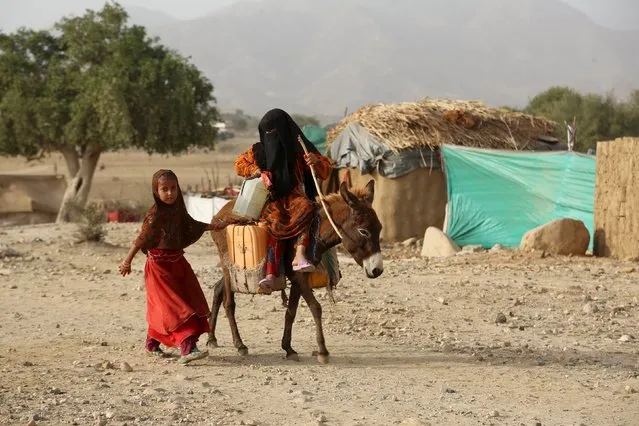
A girl rides a donkey as another walks by at the Shawqaba camp for internally displaced people who were forced to leave their villages by the war in Yemen's northwestern province of Hajjah March 12, 2016. In northwest Yemen, one of the poorest countries in the Middle East, about 400 families uprooted by the war have been stuck in the Shawqaba camp in Hajjah province for the past year. Residents live in poorly built huts that protect them neither from summer heat nor winter cold in a camp that lacks the most basic services. (Photo by Abduljabbar Zeyad/Reuters)

A girl rides a donkey as another walks by at the Shawqaba camp for internally displaced people who were forced to leave their villages by the war in Yemen's northwestern province of Hajjah March 12, 2016. In northwest Yemen, one of the poorest countries in the Middle East, about 400 families uprooted by the war have been stuck in the Shawqaba camp in Hajjah province for the past year. Residents live in poorly built huts that protect them neither from summer heat nor winter cold in a camp that lacks the most basic services. (Photo by Abduljabbar Zeyad/Reuters)
Details
09 Apr 2016 13:16:00
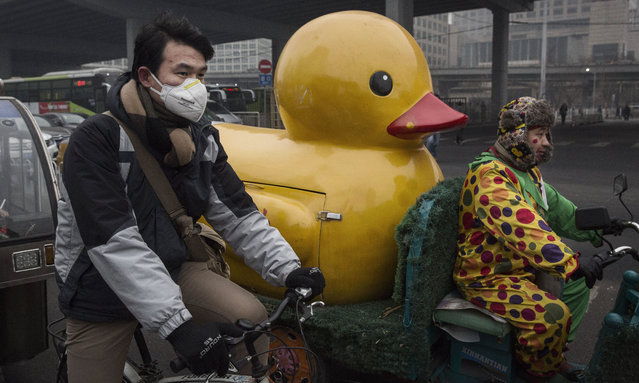
A Chinese man wears a mask to protect against pollution as he waits at a red light while commuting to work in heavy smog on December 8, 2015 in Beijing, China. The Beijing government issued a 'red alert' for the first time since new standards were introduced earlier this year as the city and many parts of northern China were shrouded in heavy pollution. (Photo by Kevin Frayer/Getty Images)

A Chinese man wears a mask to protect against pollution as he waits at a red light while commuting to work in heavy smog on December 8, 2015 in Beijing, China. The Beijing government issued a 'red alert' for the first time since new standards were introduced earlier this year as the city and many parts of northern China were shrouded in heavy pollution. Levels of PM 2.5, considered the most hazardous, crossed 400 units in Beijing, lower than last week, but still nearly 20 times the acceptable standard set by the World Health Organization. The governments of more than 190 countries are meeting in Paris to set targets on reducing carbon emissions in an attempt to forge a new global agreement on climate change. (Photo by Kevin Frayer/Getty Images)
Details
11 Dec 2015 08:01:00
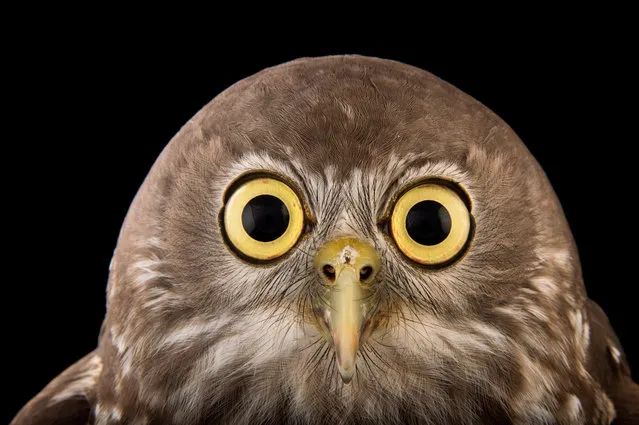
The National Geographic Photo Ark is a travelling exhibition of photographer Joel Sartore’s quest to create a photo archive of biodiversity around the world. So far, Sartore has captured studio portraits of more than 6,000 species – a number that he hopes to double. On 1 July, the ark will open at Melbourne zoo – the first time it has been exhibited in the southern hemisphere. More than 50 portraits will be on display, including many of Australian endangered animals being protected by programs at the zoo itself. These captions have been edited from text supplied by Melbourne zoo. Here: Barking owl. So-named because its call sounds like a barking dog, these birds are native to Australia, Indonesia and Papua New Guinea. In Victoria they are listed as an endangered species, and in 2003 there were estimated to be fewer than 50 breeding pairs. The main threat to the species in Victoria is loss of habitat, especially large trees with hollows in which they can nest and on which many of their prey depend. Apart from a bark, they may utter a chilling scream when they feel threatened. (Photo by Joel Sartore/National Geographic Photo Ark/The Guardian)

The National Geographic Photo Ark is a travelling exhibition of photographer Joel Sartore’s quest to create a photo archive of biodiversity around the world. So far, Sartore has captured studio portraits of more than 6,000 species – a number that he hopes to double. On 1 July, the ark will open at Melbourne zoo – the first time it has been exhibited in the southern hemisphere. More than 50 portraits will be on display, including many of Australian endangered animals being protected by programs at the zoo itself. These captions have been edited from text supplied by Melbourne zoo. Here: Barking owl. (Photo by Joel Sartore/National Geographic Photo Ark/The Guardian)
Details
01 Jul 2017 07:45:00
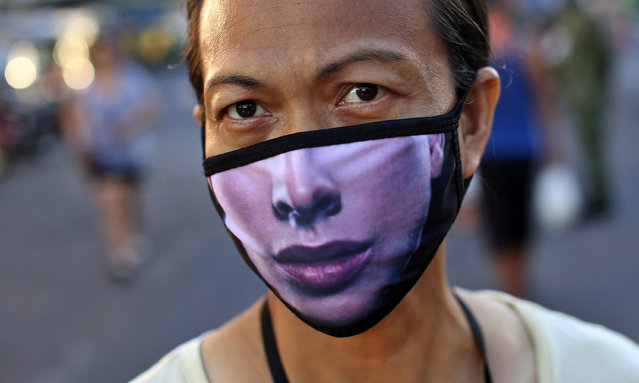
A Filipino woman wears a mask to try and protect against the spread of coronavirus in Malate district, Manila City on March 24, 2020. The Philippines has taken drastic measures to combat the spread of Covid-19. The entire country is under strict quarantine and the army is on the streets to monitor compliance. According to official figures, there are 462 positive cases and 33 dead in the Philippines, but it is thought that thousands of cases remain undetected due to lack of resources in a country where millions of people have no access to health care. In the poorest and most crowded areas, it’s almost impossible to adhere to the physical distancing required during quarantine. (Photo by Alejandro Ernesto/The Guardian)

A Filipino woman wears a mask to try and protect against the spread of coronavirus in Malate district, Manila City on March 24, 2020. The Philippines has taken drastic measures to combat the spread of Covid-19. The entire country is under strict quarantine and the army is on the streets to monitor compliance. According to official figures, there are 462 positive cases and 33 dead in the Philippines, but it is thought that thousands of cases remain undetected due to lack of resources in a country where millions of people have no access to health care. In the poorest and most crowded areas, it’s almost impossible to adhere to the physical distancing required during quarantine. (Photo by Alejandro Ernesto/The Guardian)
Details
08 Apr 2020 00:01:00
Mayu adjusts Koiku’s kimono, as Koiku wears a protective face mask while posing for a photograph, before they work at a party where they will entertain with other geisha at Japanese luxury restaurant Asada in Tokyo, Japan, June 23, 2020. The coronavirus pandemic has made Tokyo's geisha fear for their centuries-old profession as never before. Though the number of geisha - famed for their witty conversation, beauty and skill at traditional arts - has been falling for years, they were without work for months due to Japan's state of emergency and now operate under awkward social distancing rules. Engagements are down 95 percent, and come with new rules: no pouring drinks for customers or touching them even to shake hands, and sitting 2 meters apart. Masks are hard to wear with their elaborate wigs, so they mostly don't. “I was just full of anxiety”, said Mayu, 47. “I went through my photos, sorted my kimonos ... The thought of a second wave is terrifying”. (Photo by Kim Kyung-Hoon/Reuters)

Mayu adjusts Koiku’s kimono, as Koiku wears a protective face mask while posing for a photograph, before they work at a party where they will entertain with other geisha at Japanese luxury restaurant Asada in Tokyo, Japan, June 23, 2020. (Photo by Kim Kyung-Hoon/Reuters)
Details
23 Jul 2020 00:03:00