Loading...
Done
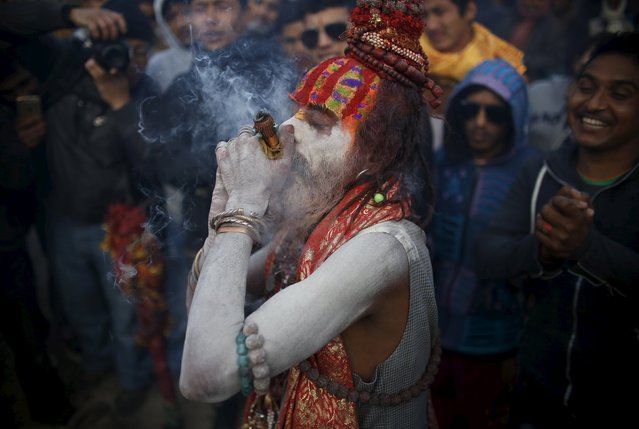
A Hindu holy man, or sadhu, smeared with ashes smokes marijuana in a chillum during the Shivaratri festival on the premises of Pashupatinath Temple in Kathmandu, Nepal, March 7, 2016. Hindu holy men from Nepal and India come to this temple to take part in the Maha Shivaratri festival. Celebrated by Hindu devotees all over the world, Shivaratri is dedicated to Lord Shiva, and holy men mark the occasion by praying, smoking marijuana or smearing their bodies with ashes. (Photo by Navesh Chitrakar/Reuters)

A Hindu holy man, or sadhu, smeared with ashes smokes marijuana in a chillum during the Shivaratri festival on the premises of Pashupatinath Temple in Kathmandu, Nepal, March 7, 2016. Hindu holy men from Nepal and India come to this temple to take part in the Maha Shivaratri festival. Celebrated by Hindu devotees all over the world, Shivaratri is dedicated to Lord Shiva, and holy men mark the occasion by praying, smoking marijuana or smearing their bodies with ashes. (Photo by Navesh Chitrakar/Reuters)
Details
08 Mar 2016 13:46:00
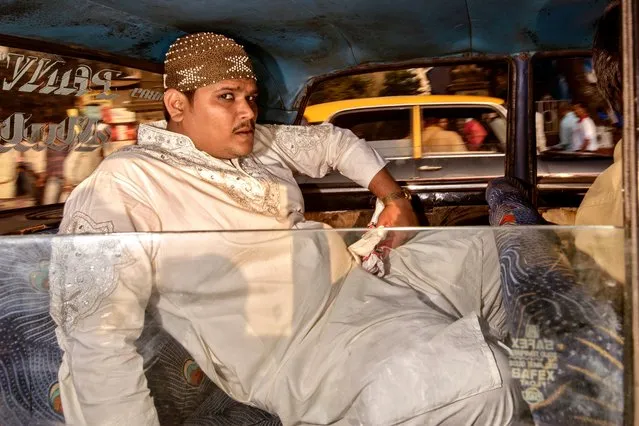
“I’m not scared of breaking the fourth wall”, Wallace has said of the photos where the subject is clearly aware of him taking the shot. “If they are looking at you in a photograph most photographers will think, oh, that’s not a good image. (But) people like to be involved and in the picture. You can see what they are thinking, see them talking”. (Photo by Dougie Wallace/The Guardian)

In Dougie Wallace’s photos of Mumbai taxis, the chatter, yelling, and constant horns of the city are almost audible. A selection of his images is on show at Gayfield Creative Spaces, Edinburgh, as part of the Retina photography festival until 30 July. For four years, the Glasgow-born Wallace focused his photos on one kind of taxi in particular: the Premier Padmini, a 1960s workhorse painted in black and yellow. Locally known as “Kaali-Peeli”, there were once more than 60,000 of them in the Indian city. But thanks to laws restricting pollution, the cars now are fast disappearing from Mumbai’s streets. (Photo by Dougie Wallace/The Guardian)
Details
13 Jul 2016 13:50:00
Kaw-Claa, a Tlingit native woman in full potlatch dancing costume, 1906. (Photo by Case & Draper/Buyenlarge/Getty Images)

Kaw-Claa, a Tlingit native woman in full potlatch dancing costume, 1906. (Photo by Case & Draper/Buyenlarge/Getty Images)
Details
11 Jan 2017 14:42:00
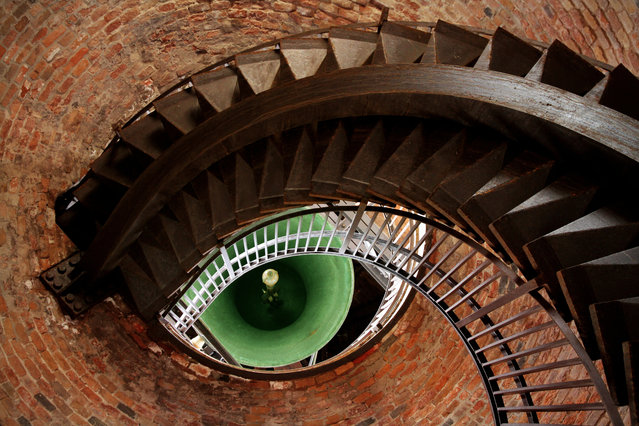
“Eye of the Tower” by Mehmet Yasa; Verona, Italy. “The staircase and the bell looks like an eye. Architecture can fascinate us in many ways”. (Photo by Mehmet Yasa/Art of Building Photography Awards 2017)

“Eye of the Tower” by Mehmet Yasa; Verona, Italy. “The staircase and the bell looks like an eye. Architecture can fascinate us in many ways”. (Photo by Mehmet Yasa/Art of Building Photography Awards 2017)
Details
12 Dec 2017 06:41:00
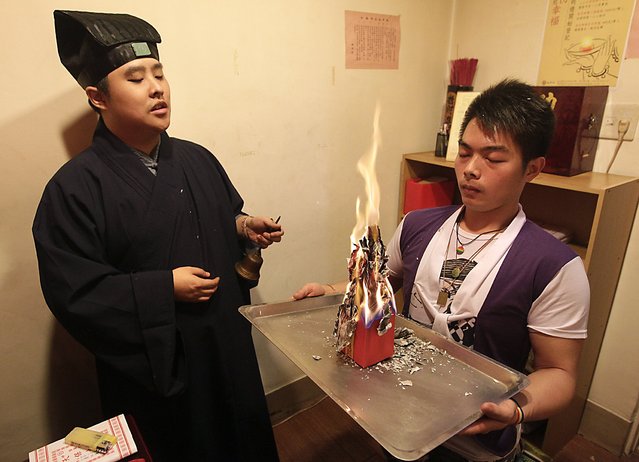
Lu Wei-ming (L), priest of the Wei-ming temple, and a worshipper burn a Taoist paper amulet during a prayer ritual at the temple in New Taipei city January 8, 2015. The shrine, down a narrow alleyway in a bustling district of the city, is dedicated to a deity who has watched over homosexuals for four centuries. (Photo by Pichi Chuang/Reuters)

Lu Wei-ming (L), priest of the Wei-ming temple, and a worshipper burn a Taoist paper amulet during a prayer ritual at the temple in New Taipei city January 8, 2015. The shrine, down a narrow alleyway in a bustling district of the city, is dedicated to a deity who has watched over homosexuals for four centuries. Priest Lu founded the temple in 2006, at a time gays were excluded from most religious ceremonies. (Photo by Pichi Chuang/Reuters)
Details
21 Jan 2015 13:06:00
Children stand in a boat at the banks of the polluted Yamuna River during a dust haze as they wait to give a ride to worshippers in New Delhi during World Environment Day June 5, 2010. (Photo by Reinhard Krause/Reuters)

Children stand in a boat at the banks of the polluted Yamuna River during a dust haze as they wait to give a ride to worshippers in New Delhi during World Environment Day June 5, 2010. (Photo by Reinhard Krause/Reuters)
Details
10 Oct 2014 12:50:00
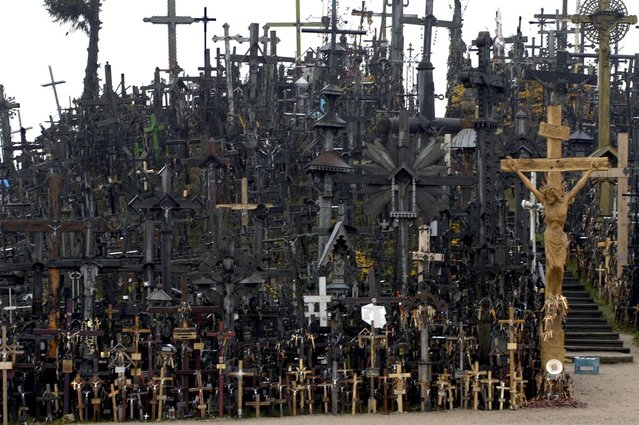
In 1831 an unsuccessful uprising against the Russian czar left many rebels dead. Relatives of the dead rebels, with no bodies to bury, instead left crosses, according to the Daily Mail. (Photo by Richard Gardner/Rex USA)

The phenomenon of the Hill of Crosses in northern Lithuania began when people started leaving crosses there hundreds of years ago – and continues to this day. These photos of a hill covered in crosses show the amazing sight it has become. Photo: In 1831 an unsuccessful uprising against the Russian czar left many rebels dead. Relatives of the dead rebels, with no bodies to bury, instead left crosses, according to the Daily Mail. (Photo by Richard Gardner/Rex USA)
Details
06 Jun 2013 09:56:00
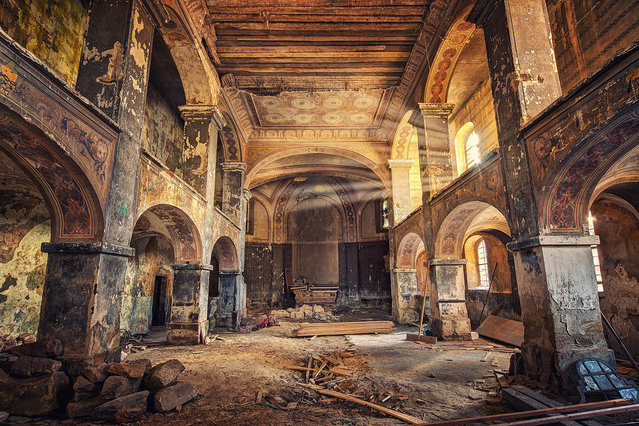
The Church of All Saints. (Photo by Matthias Haker/Caters News)

These illuminating images show the crumbling remains of some of the worlds places of worship. The shots include golden chapels, overgrown synagogues and eerily silent rooms that were once used for prayer. They were visited by Matthias Haker, a 31-year-old photographer from Potsdam, Germany. Adding to the general intrigue of his images, Matthias never discloses the location of a shot – not even the town, country or continent. Here: The Church of All Saints. (Photo by Matthias Haker/Caters News)
Details
29 Apr 2016 11:32:00