Loading...
Done
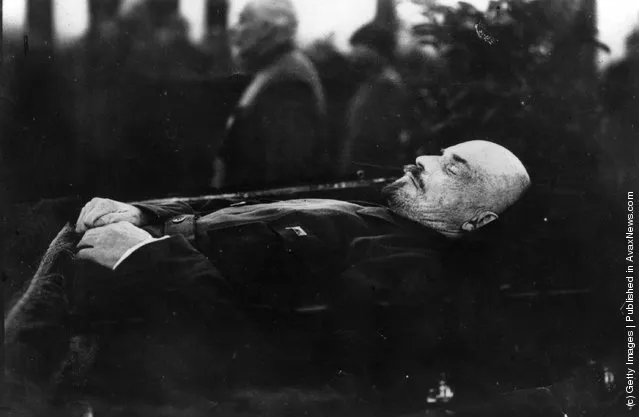
1924:  Vladimir Ilyich Lenin lying in state in the Kremlin

Photo: Vladimir Ilyich Lenin (1870 – 1924) lying in state in the Kremlin. (Photo by Hulton Archive/Getty Images). 1924

Important! For the same article in Russian language click here.

Something quite intriguing is happening within Russian-speaking internet during the last few – should you type a fully academic inquiry (at least, according to Russian academic requirements) in national search engines for "Lenin's mausoleum" – the first thing you get (even in top 10 searches) is website pages talking about black magic and occult. Website authors view this construction differently, but unconditionally agree on one thing: the mausoleum of the "leader of the world proletariat” – the essence of a magical artifact, a sort of “energy vampire”. It was built with a certain purpose: to drain the energy out of miserable Soviet citizens on one hand; and to poison the anthroposphere of one-sixth part of the earth with its vibes (the exact territory that was occupied by the former Soviet Union), depriving the Russian people of will to resist on the other hand. Complete nonsense? No doubt. Nevertheless, an intriguing one. Well, probably because some oddities do exist in mausoleum's history. These oddities are the thing we are going to discuss this time. First, let me refresh you memory on the subject.
Details
16 Oct 2011 11:27:00
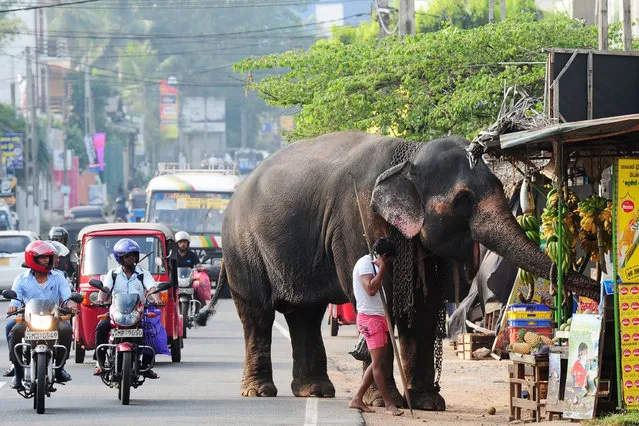
A Sri Lankan elephant, accompanied by his mahout, browse through a roadside fruit stall in Colombo on January 19, 2015. The Sri Lankan elephant is listed as endangered by the International Union for Conservation of Nature (IUCN) as the population has declined by at least 50 percent over the last three generations, with the species threatened by habitat loss, degradation and fragmentation. (Photo by Lakruwan Wanniarachchi/AFP Photo)

A Sri Lankan elephant, accompanied by his mahout, browse through a roadside fruit stall in Colombo on January 19, 2015. The Sri Lankan elephant is listed as endangered by the International Union for Conservation of Nature (IUCN) as the population has declined by at least 50 percent over the last three generations, with the species threatened by habitat loss, degradation and fragmentation. (Photo by Lakruwan Wanniarachchi/AFP Photo)
Details
23 Jan 2015 13:21:00
A plane belonging to U.S. missionary group Agape Flights burns after it was set on fire during protests demanding that the government of Prime Minister Ariel Henry do more to address gang violence including constant kidnappings, in Les Cayes, Haiti on March 29, 2022. (Photo by Duples Plymouth/Reuters)

A plane belonging to U.S. missionary group Agape Flights burns after it was set on fire during protests demanding that the government of Prime Minister Ariel Henry do more to address gang violence including constant kidnappings, in Les Cayes, Haiti on March 29, 2022. (Photo by Duples Plymouth/Reuters)
Details
05 May 2022 05:18:00
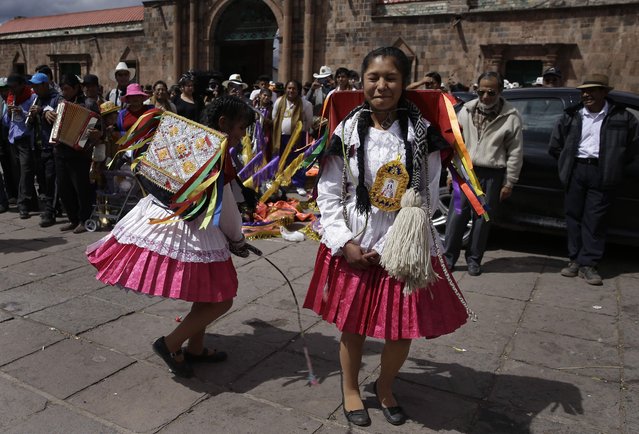
In this Sunday, August 5, 2018 photo, a dancer winces in pain as she is whipped by a fellow dancer in an adaptation of the Inca warrior dance known as “Kachampa”, during celebrations honoring Our Lady of Copacabana, in Cuzco, Peru. (Photo by Martin Mejia/AP Photo)

In this Sunday, August 5, 2018 photo, a dancer winces in pain as she is whipped by a fellow dancer in an adaptation of the Inca warrior dance known as “Kachampa”, during celebrations honoring Our Lady of Copacabana, in Cuzco, Peru. (Photo by Martin Mejia/AP Photo)
Details
10 Aug 2018 00:01:00
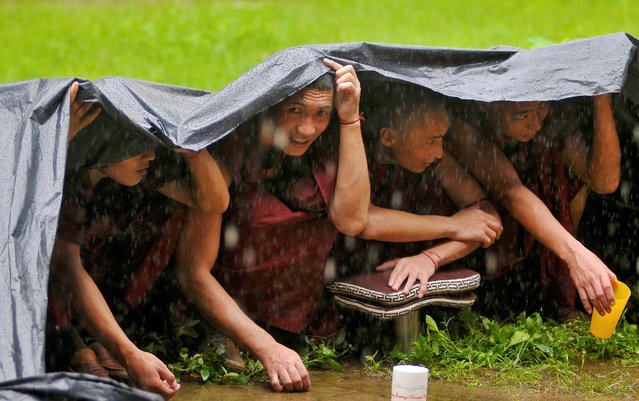
Buddhist monks take shelter under a tarpaulin sheet to protect themselves from the rain as they attend the birthday celebrations of the Tibetan spiritual leader the Dalai Lama (unseen) at Drepung Loseling Monastery in Mundgod, in the southern state of Karnataka, India, July 6, 2016. (Photo by Abhishek N. Chinnappa/Reuters)

Buddhist monks take shelter under a tarpaulin sheet to protect themselves from the rain as they attend the birthday celebrations of the Tibetan spiritual leader the Dalai Lama (unseen) at Drepung Loseling Monastery in Mundgod, in the southern state of Karnataka, India, July 6, 2016. (Photo by Abhishek N. Chinnappa/Reuters)
Details
07 Jul 2016 11:23:00
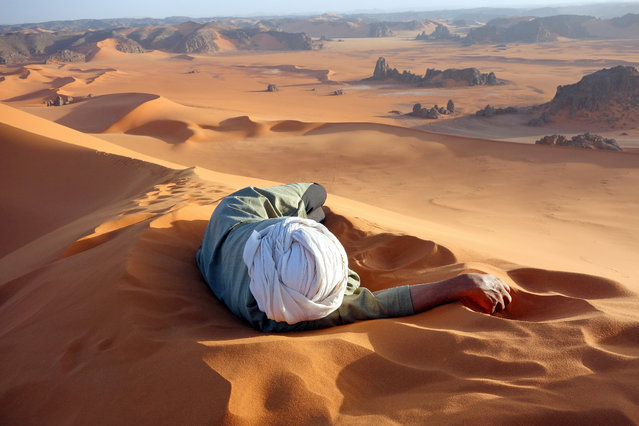
“A Well Earned Rest in the Sahara”. This photo of Moussa Macher, our Tuareg guide, was taken at the summit of Tin-Merzouga, the largest dune (or erg) in the Tadrat region of the Sahara desert in southern Algeria. Moussa rested while waiting for us to finish our 45-minute struggle to the top. Photo location: Summit of Tin-Merzouga, Tadrat, Tassili N'Ajjer National Park, Algeria. (Photo and caption by Evan Cole/National Geographic Photo Contest)

Merit Prize Winner: “A Well Earned Rest in the Sahara”. This photo of Moussa Macher, our Tuareg guide, was taken at the summit of Tin-Merzouga, the largest dune (or erg) in the Tadrat region of the Sahara desert in southern Algeria. Moussa rested while waiting for us to finish our 45-minute struggle to the top. It only took ten minutes of rolling, running, and jumping to get back down. The Tadrat is part of the Tassili N'Ajjer National Park World Heritage area, famous for its red sand and engravings and rock paintings of cattle, elephants, giraffes, and rhinos that lived there when the climate was milder. Photo location: Summit of Tin-Merzouga, Tadrat, Tassili N'Ajjer National Park, Algeria. (Photo and caption by Evan Cole/National Geographic Photo Contest)
Details
01 Aug 2014 11:38:00
Men eat oranges from a push cart along a road as a vehicle travels past them in Karachi January 22, 2015. (Photo by Akhtar Soomro/Reuters)

Men eat oranges from a push cart along a road as a vehicle travels past them in Karachi January 22, 2015. (Photo by Akhtar Soomro/Reuters)
Details
26 Jan 2015 12:17:00
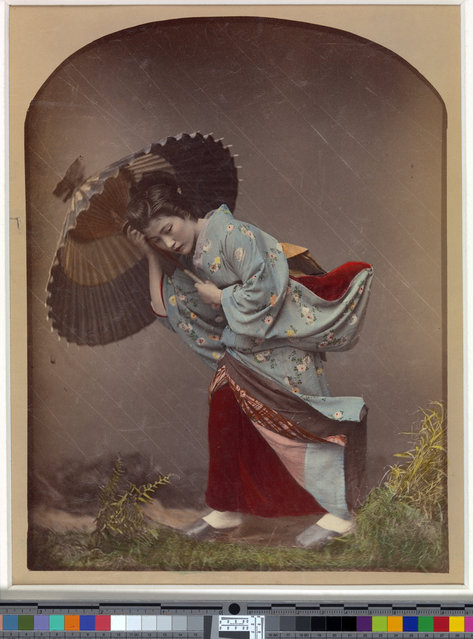
“Woman with Umbrella in Rain” by Raimund von Stillfried. Artist: Kusakabe Kimbei (Japanese, 1841–1934), 1870s. (Photo courtesy of The Metropolitan Museum of Art)

“Woman with Umbrella in Rain” by Raimund von Stillfried. Artist: Kusakabe Kimbei (Japanese, 1841–1934), 1870s. Commercial photography studios in Meiji-era Japan were renowned for the subtlety and refinement of their coloring techniques. This hand-tinted image of a young woman caught in a heavy rainstorm achieved its naturalistic effect by knitting together multiple strands of artifice: the greenery in the foreground was a studio prop; the flaps of the kimono were suspended by thin wires to create the impression of a strong wind; and long, diagonal marks were made on the negative to suggest streaks of rain. (Photo courtesy of The Metropolitan Museum of Art)
Details
12 May 2013 10:13:00