Loading...
Done
Daily Life in Tokyo by Photographer Tatsuo Suzuki. (Photo by Tatsuo Suzuki)

“Born in 1965 at Tokyo, living at Tokyo. Starting shooting since 2008. 2011: 1x Photo Awards Honorable Mention (Street). 2012: Black and White Spider Awards 2nd Place (Portrait), Honorable Mention (Fashion); PX3 Gold Awards (Press); Israel Harvanism Street Contest 1st Place. 2013: Urban Picnic Street Contest Top30 Finalist; PX3 3rd Place (Portrait), Gold (Portrait - Personality), Gold (Press - People/Personality); Photolux + PhotoVogue Photo Contest 1st Place. 2014: Sony World Photography Awards Commended (Smile Category)”. – Tatsuo Suzuki. Photo: “Spring”. (Photo by Tatsuo Suzuki)
Details
13 Apr 2014 10:19:00
The Ivanpah Solar Electric Generating System is seen in an aerial view on February 20, 2014 in the Mojave Desert in California near Primm, Nevada. (Photo by Ethan Miller/Getty Images)

The Ivanpah Solar Electric Generating System is seen in an aerial view on February 20, 2014 in the Mojave Desert in California near Primm, Nevada. The largest solar thermal power-tower system in the world, owned by NRG Energy, Google and BrightSource Energy, opened last week in the Ivanpah Dry Lake and uses 347,000 computer-controlled mirrors to focus sunlight onto boilers on top of three 459-foot towers, where water is heated to produce steam to power turbines providing power to more than 140,000 California homes. (Photo by Ethan Miller/Getty Images)
Details
14 Apr 2014 11:01:00
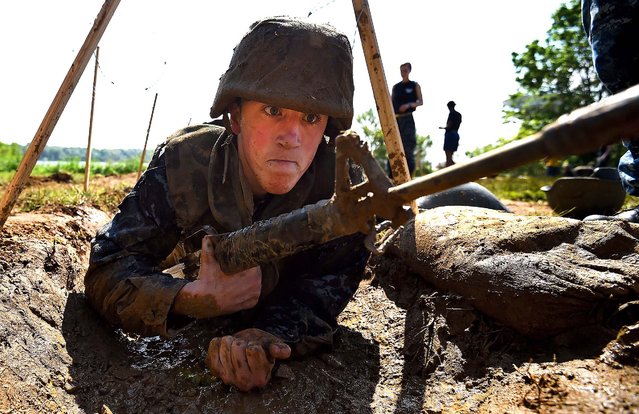
A member of the United States Naval Academy freshman class crawls through trenches at the wet and sandy station during the annual Sea Trials training exercise at the U.S. Naval Academy on May 13, 2014 in Annapolis, Maryland. (Photo by Patrick Smith/Getty Images)

A member of the United States Naval Academy freshman class crawls through trenches at the wet and sandy station during the annual Sea Trials training exercise at the U.S. Naval Academy on May 13, 2014 in Annapolis, Maryland. For 14 hours, the United States Naval Academy freshman class, also known as Plebes, worked as a team to complete many grueling physical and mental challenges that help prepare them for real-world experiences and reinforce leadership, bonds, trust, and teamwork. Of the challenges, they endured: a two-mile regimental run, ground fights, water tactics, aquatics challenges, and survival skills, amongst many others. (Photo by Patrick Smith/Getty Images)
Details
14 May 2014 07:52:00
Football players help an injured player off the field during training at the Evergrande International Football School near Qingyuan in Guangdong Province. (Photo by Kevin Frayer/Getty Images)

Young Chinese football players help an injured player off the field during training at the Evergrande International Football School on June 12, 2014 near Qingyuan in Guangdong Province, China. The sprawling 167-acre campus is the brainchild of property tycoon Xu Jiayin, whose ambition is to train a generation of young athletes to establish China as a football powerhouse. The school is considered the largest football academy in the world with 2400 students, more than 50 pitches and a squad of Spanish coaches through a partnership with Real Madrid. (Photo by Kevin Frayer/Getty Images)
Details
18 Jun 2014 12:56:00
Young girls take ballet lessons at the New Dreams dance studio in the Luz neighborhood known to locals as Cracolandia (Crackland) in Sao Paulo, Brazil, August 14, 2015. (Photo by Nacho Doce/Reuters)

Young girls take ballet lessons at the New Dreams dance studio in the Luz neighborhood known to locals as Cracolandia (Crackland) in Sao Paulo, Brazil, August 14, 2015. For the young girls learning to jump and plie, the dance studio provides a way forward and out of the difficult environment they have grown up in. Brazil is one of the world's highest consuming countries of crack cocaine, and Cracolandia, or “Crack Land”, located in the outskirts of Sao Paulo, is one of the most intense and brutal hubs. (Photo by Nacho Doce/Reuters)
Details
18 Aug 2015 13:59:00
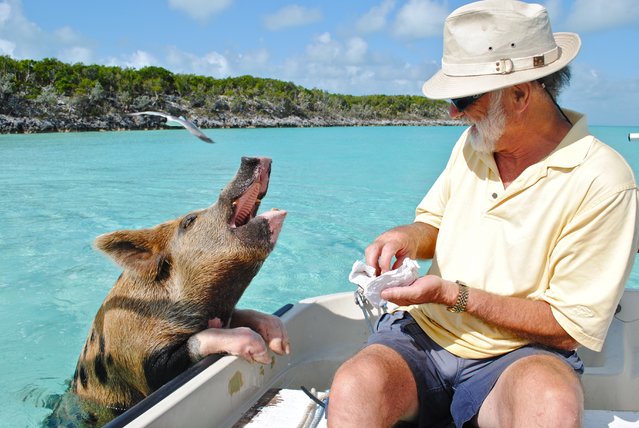
“So you're on a boat in Bahamas and then this pig swims by begging for food”. (Photo and caption by Lisa Larsen/Public Domain)

The Bahamas, the Commonwealth nation of hundreds of islands roughly the size of Connecticut and with population of just a bit over Anaheim, is known for its crystal waters and pristine beaches. This is possibly one of the world’s most beautiful havens of nature, yet people are coming here to see pigs. It is unclear when the pigs first appeared on Exuma Island or where they come from. There’s talk about a daring escape from a shipwreck, or sailors releasing the swine on purpose. In all probability, there were no pigs on this tropical paradise before European settlers came, so their mere presence is the work of human. The intriguing feat of nature, however, is that this population of pigs developed a fine aptitude for swimming. Here: “So you're on a boat in Bahamas and then this pig swims by begging for food”. (Photo and caption by Lisa Larsen/Public Domain)
Details
03 Sep 2015 11:53:00
Larissa Neto, a muse of the Unidos da Tijuca Samba School, poses as she wears a carnival dress in Sao Goncalo near Rio de Janeiro, Brazil, February 3, 2016. (Photo by Ricardo Moraes/Reuters)

Larissa Neto, a muse of the Unidos da Tijuca Samba School, poses as she wears a carnival dress in Sao Goncalo near Rio de Janeiro, Brazil, February 3, 2016. Rio de Janeiro's carnival parades are known the world over for the glitz and glamour, high-tech allegorical floats and shimmering bodies, which battle it out each year for the championship title. Each school is fronted by the Queen of the Drums, who dances alongside the raging percussion, and her court of sparkling, sculpted dancers known as “muses”. (Photo by Ricardo Moraes/Reuters)
Details
05 Feb 2016 10:52:00
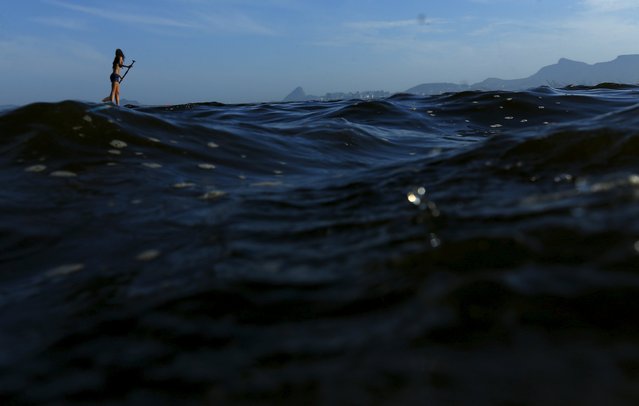
A girl paddles on her stand-up board on the waters of Guanabara bay at Bica beach in Rio de Janeiro Brazil, January 10, 2016. (Photo by Ricardo Moraes/Reuters)

A girl paddles on her stand-up board on the waters of Guanabara bay at Bica beach in Rio de Janeiro Brazil, January 10, 2016. Few features capture the beauty, or the problems, of one of the world's most dramatic urban landscapes like Guanabara Bay - the finger-like inlet that forms the shoreline and harbor for Rio de Janeiro. The bay, which carves into southeast Brazil from the Atlantic Ocean, literally gave Rio its name when Portuguese mariners mistook it for a “rio”, or “river”. Four centuries later, the bay is preparing to welcome another sort of seafarer – Olympic sailors, who will navigate the bay when the 2016 Rio Olympics kick off in August. (Photo by Ricardo Moraes/Reuters)
Details
28 Apr 2016 12:13:00