Loading...
Done
A baby dives as his mother holds on tightly during a water baby class in Odessa, Ukraine on August 6, 2016. (Photo by Andrey Nekrasov/Barcroft Images)

A baby dives as his mother holds on tightly during a water baby class in Odessa, Ukraine on August 6, 2016. (Photo by Andrey Nekrasov/Barcroft Images)
Details
08 Aug 2016 10:53:00
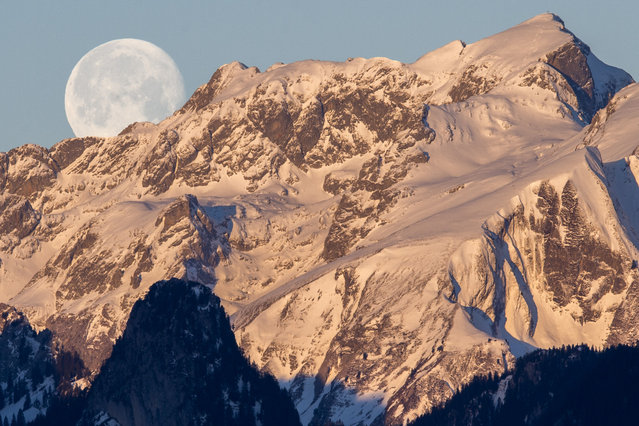
The waning moon is setting over the mountain “Les Cornettes de Bise” located at the border of the Haute-Savoie and the Valais canton of Switzerland in the Chablais Alps, photographed from Glutieres, January 7, 2015. (Photo by Anthony Anex/EPA)

The waning moon is setting over the mountain “Les Cornettes de Bise” located at the border of the Haute-Savoie and the Valais canton of Switzerland in the Chablais Alps, photographed from Glutieres, January 7, 2015. (Photo by Anthony Anex/EPA)
Details
15 Apr 2015 12:53:00
Businesswoman and vendor Sonia Maria Paypay sells clothing at a stand at the commercial zone of Gamarra in Lima, April 16, 2015. (Photo by Mariana Bazo/Reuters)

Businesswoman and vendor Sonia Maria Paypay sells clothing at a stand at the commercial zone of Gamarra in Lima, April 16, 2015. (Photo by Mariana Bazo/Reuters)
Details
22 Apr 2015 09:50:00
1st prize in the People Observed Portraits Stories category. Carla Kogelman, the Netherlands. The photo shows Hannah and Alena, two sisters living in the rural village of Merkenbrechts, Austria. (Photo by Carla Kogelman/World Press Photo)

1st prize in the People Observed Portraits Stories category. Carla Kogelman, the Netherlands. The photo shows Hannah and Alena, two sisters living in the rural village of Merkenbrechts, Austria. (Photo by Carla Kogelman/World Press Photo)
Details
16 Feb 2014 12:34:00
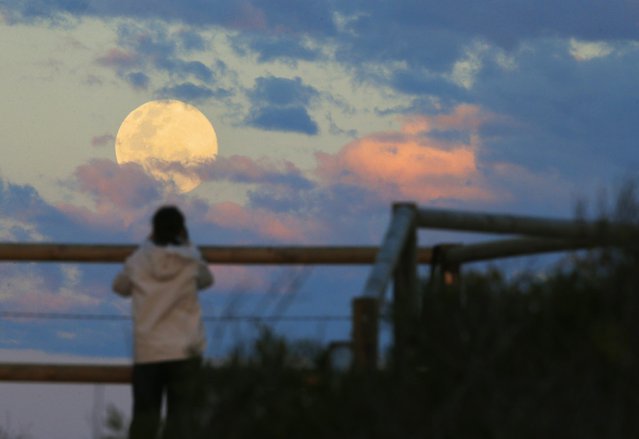
Sydney resident Virginia Maddock watches the supermoon rise off the Sydney beachside suburb of Wanda, August 10, 2014. The astronomical event occurs when the moon is closest to the Earth in its orbit, making it appear much larger and brighter than usual. (Photo by Jason Reed/Reuters)

Sydney resident Virginia Maddock watches the supermoon rise off the Sydney beachside suburb of Wanda, August 10, 2014. Sunday’s moon was at its closest approach to Earth, appearing bigger and brighter than any other moon this year. The moon was 221,765 miles away and looked 16 percent larger and 30 percent brighter than usual. (Photo by Jason Reed/Reuters)
Details
11 Aug 2014 11:50:00
Miley Cyrus broke onto the scene as “Hannah Montana” in 2006. Since the show ended, she’s been desperate to shed the Disney image, first with “Can’t Be Tamed” in 2010, then with open marijuana use and twerking on Robin Thicke’s crotch in 2013. (Photo by Getty Images)

Miley Cyrus broke onto the scene as “Hannah Montana” in 2006. Since the show ended, she’s been desperate to shed the Disney image, first with “Can’t Be Tamed” in 2010, then with open marijuana use and twerking on Robin Thicke’s crotch in 2013. (Photo by Getty Images)
Details
24 Jul 2014 13:06:00
Bikini Contest in Daytona Beach, Florida’s Atlantic coast, circa 1980s. (Photo by Evan Hurd/Sygma/Sygma via Getty Images)

Bikini Contest in Daytona Beach, Florida’s Atlantic coast, circa 1980s. (Photo by Evan Hurd/Sygma/Sygma via Getty Images)
Details
15 Apr 2018 00:05:00
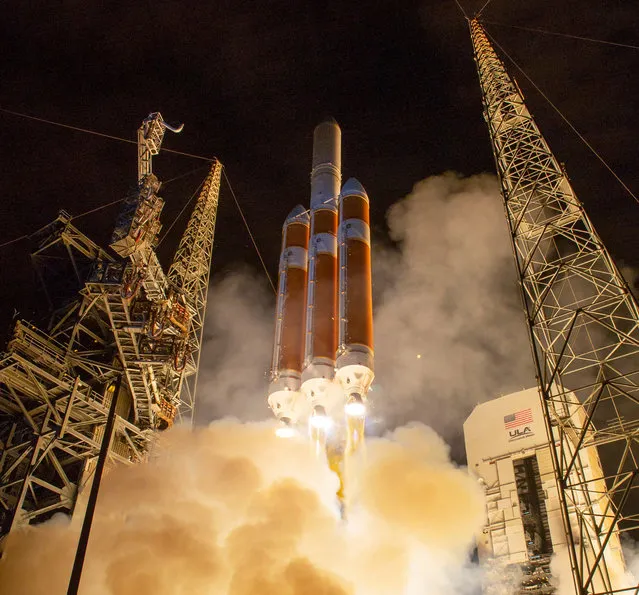
A handout photo made available by the NASA shows the United Launch Alliance Delta IV Heavy rocket launches NASA's Parker Solar Probe to touch the Sun, from Launch Complex 37 at Cape Canaveral Air Force Station, Florida, USA, 12 August 2018. Parker Solar Probe is humanity’s first-ever mission into a part of the Sun’s atmosphere called the corona. Here it will directly explore solar processes that are key to understanding and forecasting space weather events that can impact life on Earth. (Photo by Bill Ingalls/EPA-EFE/NASA)


A handout photo made available by the NASA shows the United Launch Alliance Delta IV Heavy rocket launches NASA's Parker Solar Probe to touch the Sun, from Launch Complex 37 at Cape Canaveral Air Force Station, Florida, USA, 12 August 2018. Parker Solar Probe is humanity’s first-ever mission into a part of the Sun’s atmosphere called the corona. Here it will directly explore solar processes that are key to understanding and forecasting space weather events that can impact life on Earth. (Photo by Bill Ingalls/EPA-EFE/NASA)
Details
13 Aug 2018 07:26:00