Loading...
Done
A Naga Sadhu or Hindu holy man adjusts the beads around his neck ahead of the first Shahi Snan at “Kumbh Mela” or the Pitcher Festival, in Haridwar, India, March 10, 2021. (Photo by Anushree Fadnavis/Reuters)

A Naga Sadhu or Hindu holy man adjusts the beads around his neck ahead of the first Shahi Snan at “Kumbh Mela” or the Pitcher Festival, in Haridwar, India, March 10, 2021. (Photo by Anushree Fadnavis/Reuters)
Details
15 Mar 2021 10:15:00
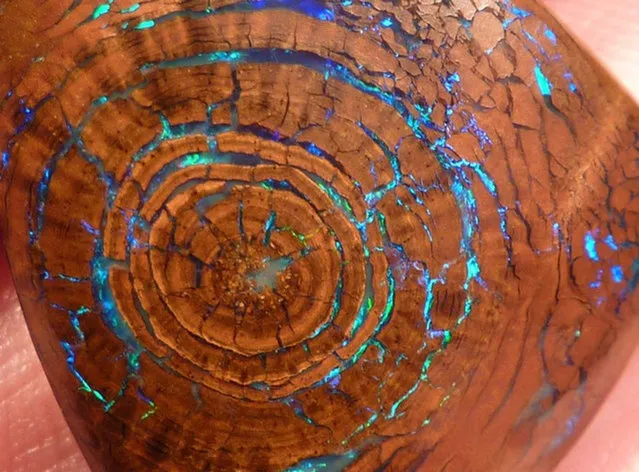
Rare Opalized Wood Metallic Greens

There is an endless bounty of eye-catching gemstones throughout the world and this spectacular boulder opal is one unique beauty that looks like a shimmering crystal encased in a tree fossil. Its opalescent sheen seeps through the cracks of the seemingly wooden rings in lustrous hues of emerald green and aqua blue. Like something out of a fairy tale, the triangular piece radiates through an organic pattern mimicking the growth rings of tree.
Details
17 Nov 2013 13:45:00
People walk during a polluted day in Shenyang, Liaoning province, March 31, 2016. (Photo by Reuters/Stringer)

People walk during a polluted day in Shenyang, Liaoning province, March 31, 2016. (Photo by Reuters/Stringer)
Details
18 Apr 2016 10:12:00
Commuters watch after their train was blocked by leftist activists at a railway station during a nationwide general strike against the policies of the central government in Kolkata on March 28, 2022. (Photo by Dibyangshu Sarkar/AFP Photo)

Commuters watch after their train was blocked by leftist activists at a railway station during a nationwide general strike against the policies of the central government in Kolkata on March 28, 2022. (Photo by Dibyangshu Sarkar/AFP Photo)
Details
05 Apr 2022 05:26:00
Thousands of bright yellow silkworm cocoons are dried in huge clay bowls in the village of Hong Ly, northern Vietnam in July 2022. Silk fibres are produced by silkworms when they spin themselves into a cocoon on their journey to becoming a silkmoth. The ultra-soft fibres are harvested from the cocoon in their raw state by being boiled in hot water. (Photo by Prabu Mohan/Solent News)

Thousands of bright yellow silkworm cocoons are dried in huge clay bowls in the village of Hong Ly, northern Vietnam in July 2022. Silk fibres are produced by silkworms when they spin themselves into a cocoon on their journey to becoming a silkmoth. The ultra-soft fibres are harvested from the cocoon in their raw state by being boiled in hot water. (Photo by Prabu Mohan/Solent News)
Details
31 Jul 2022 05:59:00
Vendors wait for customers at a wholesale vegetable market in Dhaka on September 4, 2022. (Photo by Munir Uz Zaman/AFP Photo)

Vendors wait for customers at a wholesale vegetable market in Dhaka on September 4, 2022. (Photo by Munir Uz Zaman/AFP Photo)
Details
28 Oct 2022 05:04:00


“Snowflake (c. 1964 – November 24, 2003) was an albino gorilla. He was the only known albino gorilla so far, and the most popular resident of the Barcelona Zoo in Catalonia, Spain. Originally named Nfumu Ngui in Fang language ("white gorilla") by his captor, he was then nicknamed Floquet de Neu (Catalan for little snowflake) by his keeper Jordi Sabater Pi. On his arrival to Barcelona where he was given an official reception by the then Mayor of Barcelona, Josep Maria de Porcioles, in November 1966, he was called Blancanieves (“Snow White”) in the newspaper Tele/Exprés. But he became famous with the name given to him by Sabater when National Geographic Magazine featured him on the main page in March 1967, with the English name Snowflake. This name spread among the press (Stern, Life, Paris-Match) and was later translated to Spanish as Copito de Nieve. Sabater himself called the gorilla Floquet or Copi, and in the later years Nfumu. The asteroid 95962 Copito, discovered by Catalan astronomer J. Manteca, is named in his honour”.

Details
07 Mar 2011 15:50:00
Thor Heyerdahl with a model of the balsa raft Kon Tiki

“Thor Heyerdahl (October 6, 1914, Larvik, Norway – April 18, 2002, Colla Micheri, Italy) was a Norwegian ethnographer and adventurer with a background in zoology and geography. He became notable for his Kon-Tiki expedition, in which he sailed 8,000 km (4,300 miles) by raft from South America to the Tuamotu Islands. All his expeditions are shown in the Kon-Tiki Museum, Oslo”. – Wikipedia

Photo: Norwegian anthropologist Thor Heyerdahl with a model of the balsa raft “Kon-Tiki” on which he drifted 4,300 miles from Peru to the Tuamotu Islands, proving his theory that Polynesia could originally have been populated by South Americans. (Photo by Express/Express/Getty Images). 1950
Details
09 Aug 2011 11:05:00