
24 Dec 2012 10:19:00,post received
0 comments

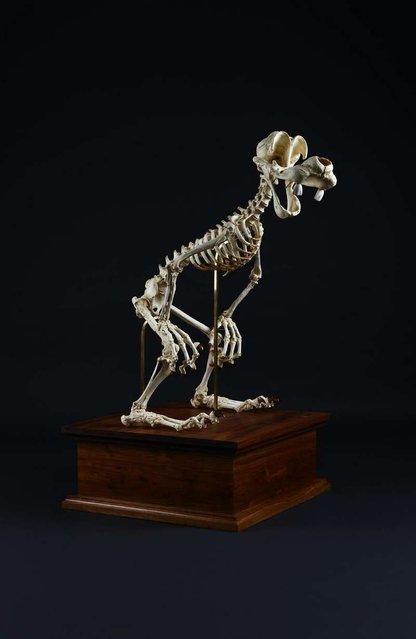
Korean artist Hyungkoo Lee has created a series (Homo Animatus) of works featuring skeletal representations of familiar cartoon characters. He uses resin, aluminum sticks, stainless steel wires, springs, and oil paint. If you look closely, you will see the bones of our favorite childhood friends like Canis Latrans Animatus (Wile E. Coyote), Geococcyx Animatus (Roadrunner), Lepus Animatus (Bugs Bunny), Felis Catus Animatus (Tom), Mus Animatus (Jerry), Anas Animatus (Donald Duck) and his three nephews, Animatus H, D and L ( Huey, Dewey and Louie)
06 May 2013 12:42:00,post received
0 comments

A boy looks back while he and another boy play on a Syrian military tank, destroyed during fighting with the Rebels, in the Syrian town of Azaz, on the outskirts of Aleppo, Sunday, September 2, 2012. (Photo by Muhammed Muheisen/AP Photo)
05 Nov 2014 12:13:00,post received
0 comments

A fog bow is a similar phenomenon to a rainbow; however, as its name suggests, it appears as a bow in fog rather than rain. Because of the very small size of water droplets that cause fog—smaller than 0.05 millimeters (0.0020 in)—the fog bow has only very weak colors, with a red outer edge and bluish inner edge.
05 Oct 2013 11:09:00,post received
0 comments

Boxing is a sport more often associated with brute violence than with aesthetics. But photographer Howard Schatz has turned thuggish fighters into the subjects of extraordinary portraits showing the beautiful side of pugilism. The stunning pictures, collected in a new book, took six years to capture as Mr Schatz sought to investigate every aspect of the controversial sport.
24 Dec 2013 13:05:00,post received
0 comments
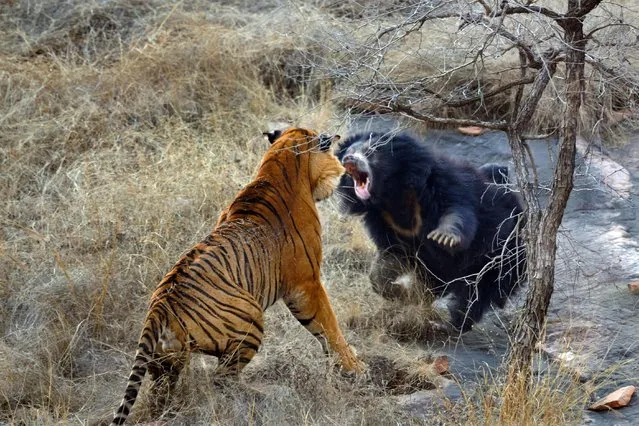
It's not often that two ferocious tigers have to beat a hasty retreat from a confrontation. But it seems that the wrath of a mother bear protecting two cubs on her back was more than enough to scare this pair off. Wildlife photographer Aditya Singh captured the encounter during a visit to Ranthambore Tiger Reserve in Rajasthan, India.
24 Jan 2014 09:11:00,post received
0 comments
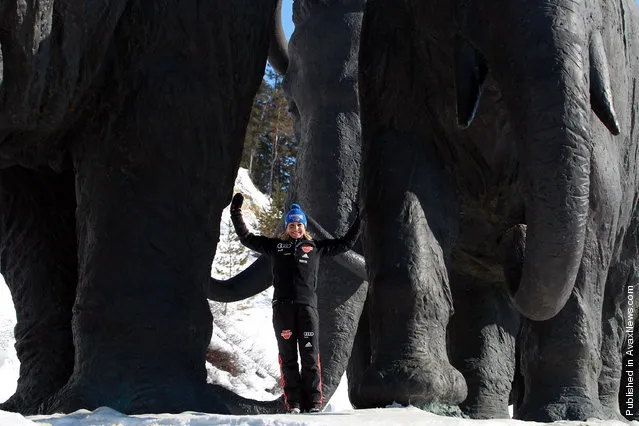
Magdalena Neuner poses in front of mammoth figures during a photocall of the German Biathlon Woman Team at the Archeopark on March 10, 2011 in Khanty-Mansiysk, Russia. On the territory of Archeopark are mammoth sculptural compositions, made of bronze. Mammoths lived in Ugra 70-10 thousand years ago and were members of the Pleistocene, or also called 'the mammoth fauna. The growth figures exceed the natural factor 2-3 times.
10 Mar 2011 14:09:00,post received
0 comments

AKB48 perform during the MTV Video Music Aid Japan at Makuhari Messe on June 25, 2011 in Chiba, Japan. (Photo by Koki Nagahama/Getty Images)
26 Jun 2011 09:45:00,post received
0 comments