Loading...
Done
England’s Natasha Hunt pours champagne into the mouth of Zoe Aldcroft as she holds the trophy after England beat Canada 33-13 in the Women’s Rugby World Cup final at Twickenham in London on September 27, 2025. England became world champions on Saturday in front of 81,885 spectators at Twickenham’s Allianz Stadium, while overall 444,465 tickets were sold during the tournament. (Photo by Garry Bowden/ProSport/Rex Features/Shutterstock)

England’s Natasha Hunt pours champagne into the mouth of Zoe Aldcroft as she holds the trophy after England beat Canada 33-13 in the Women’s Rugby World Cup final at Twickenham in London on September 27, 2025. England became world champions on Saturday in front of 81,885 spectators at Twickenham’s Allianz Stadium, while overall 444,465 tickets were sold during the tournament. (Photo by Garry Bowden/ProSport/Rex Features/Shutterstock)
Details
09 Oct 2025 04:12:00
A youth in a mask takes part in Chinese Lunar New Year celebrations in La Paz, Bolivia, Sunday, January 26, 2025. (Photo by Juan Karita/AP Photo)

A youth in a mask takes part in Chinese Lunar New Year celebrations in La Paz, Bolivia, Sunday, January 26, 2025. (Photo by Juan Karita/AP Photo)
Details
15 Jun 2026 12:00:00
A member of the pro-government “red shirt” movement attacks a Buddhist monk outside the National Anti-Corruption Commission office in Nonthaburi province, on the outskirts of Bangkok March 24, 2014. Members of the movement attacked the monk after he shouted complaints to the group blocking a road near the National Anti-Corruption Commission. (Photo by Chaiwat Subprasom/Reuters)

A member of the pro-government “red shirt” movement attacks a Buddhist monk outside the National Anti-Corruption Commission office in Nonthaburi province, on the outskirts of Bangkok March 24, 2014. Members of the movement attacked the monk after he shouted complaints to the group blocking a road near the National Anti-Corruption Commission. (Photo by Chaiwat Subprasom/Reuters)
Details
29 Mar 2014 13:50:00
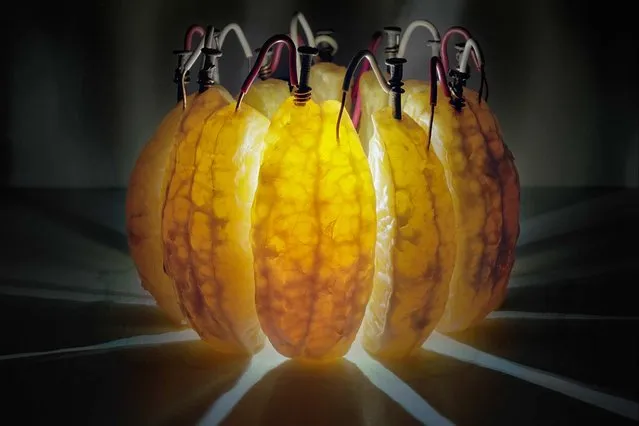
Wedges of an orange generate enough current and electrical juice – 3.5 volts – to power an LED. The fruit’s citric acid helps electrons flow from galvanized nails to copper wire in this 14-hour exposure. This image was published in September’s Visions of Earth, a trio of photos that appear in each issue of National Geographic. (Photo by Caleb Charland/National Geographic)

Wedges of an orange generate enough current and electrical juice – 3.5 volts – to power an LED. The fruit’s citric acid helps electrons flow from galvanized nails to copper wire in this 14-hour exposure. This image was published in September’s Visions of Earth, a trio of photos that appear in each issue of National Geographic. (Photo by Caleb Charland/National Geographic)
Details
06 Jan 2014 12:09:00
An erotic danser picks up fake 2-dollar bills during a private dance with a Yakuza customer in a strip tease bar in Kabukicho, a bar which is controlled by the ODO family – 2010. (Photo and caption by Anton Kusters)

The Belgian photographer Anton Kusters spent two years photographing the Yakuza, Japan’s most notorious gang. He returned with some amazing images that he made into a book called “Odo Yakuza Tokyo”. (Odo means “the way of the cherry blossom” and is the credo of the Yakuza family he followed. Photo: An erotic danser picks up fake 2-dollar bills during a private dance with a Yakuza customer in a strip tease bar in Kabukicho, a bar which is controlled by the ODO family – 2010. (Photo and caption by Anton Kusters)
Details
31 Aug 2014 08:42:00
Winner of the National Park Foundation's photo contest; Honorable Mention: Fan Favorite. Grand Canyon National Park, Arizona. Three friends enjoy sunrise over the Grand Canyon. (Photo by Peter Blanchard)

Winner of the National Park Foundation's photo contest; Honorable Mention: Fan Favorite. Grand Canyon National Park, Arizona. Three friends enjoy sunrise over the Grand Canyon. (Photo by Peter Blanchard)
Details
02 May 2014 09:23:00
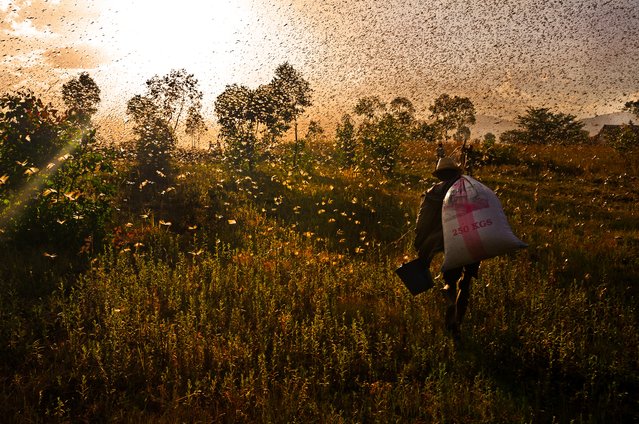
“Locusts & Men”. Oppression, interaction, collaboration. In the life cycle of nature nothing is lost, but the coexistence of different species is sometimes difficult. In Madagascar periodically returns the archaic antagonism between man and the migratory locust, in a circle of life where the two species are looking for space and food for their survival. Photo location: Madagascar, 2013. (Photo and caption by Michele Martinelli/National Geographic Photo Contest)

“Locusts & Men”. Oppression, interaction, collaboration. In the life cycle of nature nothing is lost, but the coexistence of different species is sometimes difficult. In Madagascar periodically returns the archaic antagonism between man and the migratory locust, in a circle of life where the two species are looking for space and food for their survival. At the end of the day a man walks home carrying on his shoulders the heavy bag which contains the locusts captured during the day. The insects provide nutritious meals for the man and his family. Photo location: Madagascar, 2013. (Photo and caption by Michele Martinelli/National Geographic Photo Contest)

ATTENTION! All pictures are presented in high resolution. To see Hi-Res images – just TWICE click on any picture. In other words, click small picture – opens the BIG picture. Click BIG picture – opens VERY BIG picture.
Details
03 Dec 2013 10:59:00
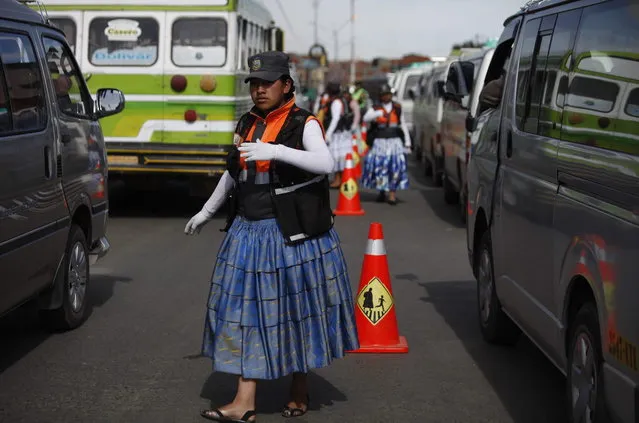
In this December 3, 2013 photo, an Aymara woman cops directs traffic on the streets of El Alto, Bolivia. The women wear the bright petticoats and shawls of indigenous women in the Andes, called cholitas in Bolivian slang, the main difference being that instead of bowler hats they wear khaki green police-style caps. Some don fluorescent traffic vests. (Photo by Juan Karita/AP Photo)

“This city in Bolivia's highlands has hired Aymara women dressed in traditional multilayered Andean skirts and brightly embroidered vests to work as traffic cops and bring order to its road chaos. About 20 of the “traffic cholitas” have been trained to direct cars and buses in El Alto, a teeming, impoverished sister city of La Paz in Bolivia's Andes mountains”. – El Alto via Associated Press. Photo: In this December 3, 2013 photo, an Aymara woman cops directs traffic on the streets of El Alto, Bolivia. The women wear the bright petticoats and shawls of indigenous women in the Andes, called cholitas in Bolivian slang, the main difference being that instead of bowler hats they wear khaki green police-style caps. Some don fluorescent traffic vests. (Photo by Juan Karita/AP Photo)
Details
25 Dec 2013 10:48:00