Loading...
Done
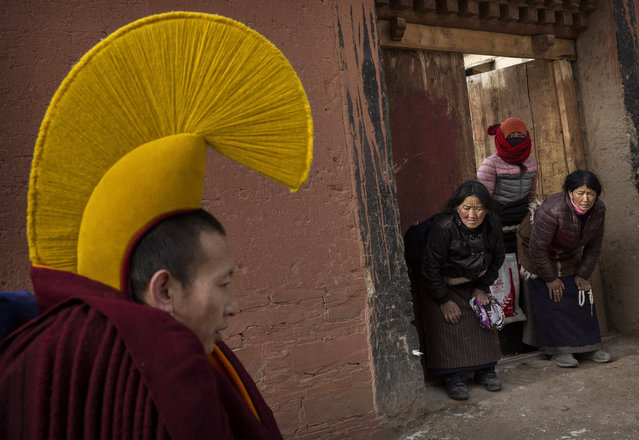
Devotees bow to a passingTibetan Buddhist monk on his way to take part in a special prayer during Monlam or the Great Prayer rituals on March 5, 2015 at the Labrang Monastery, Xiahe County, Amdo, Tibetan Autonomous Prefecture, Gansu Province, China. (Photo by Kevin Frayer/Getty Images)

Devotees bow to a passingTibetan Buddhist monk on his way to take part in a special prayer during Monlam or the Great Prayer rituals on March 5, 2015 at the Labrang Monastery, Xiahe County, Amdo, Tibetan Autonomous Prefecture, Gansu Province, China. Labrang Monastery is one of the six great monasteries of the Gelug school of Tibetan Buddhism and one of the largest outside of the Tibetan Autonomous Region. Monlam, the most important prayer event for many Tibetans was banned during the Cultural Revolution in China but once again in recent years it is celebrated in many areas. (Photo by Kevin Frayer/Getty Images)
Details
14 Mar 2015 14:37:00
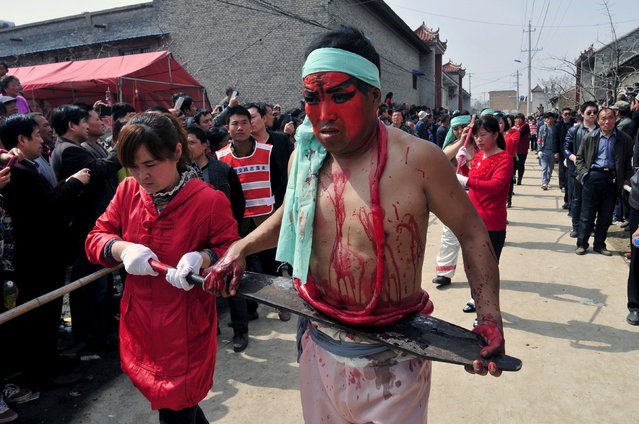
A folk performer (front R) with make-up and props takes part in a “Blood Shehuo” parade, during a performance in Linyi county, Shanxi province March 21, 2015. “Shehuo” is the common name of Chinese traditional activities consisting of folk performances in northern China. The "Blood Shehuo" performers use make-up and props to re-enact scenes of horror in classic Chinese novels like Water Margin. (Photo by Reuters/Stringer)

A folk performer (front R) with make-up and props takes part in a “Blood Shehuo” parade, during a performance in Linyi county, Shanxi province March 21, 2015. “Shehuo” is the common name of Chinese traditional activities consisting of folk performances in northern China. The “Blood Shehuo” performers use make-up and props to re-enact scenes of horror in classic Chinese novels like Water Margin. (Photo by Reuters/Stringer)
Details
23 Mar 2015 10:33:00
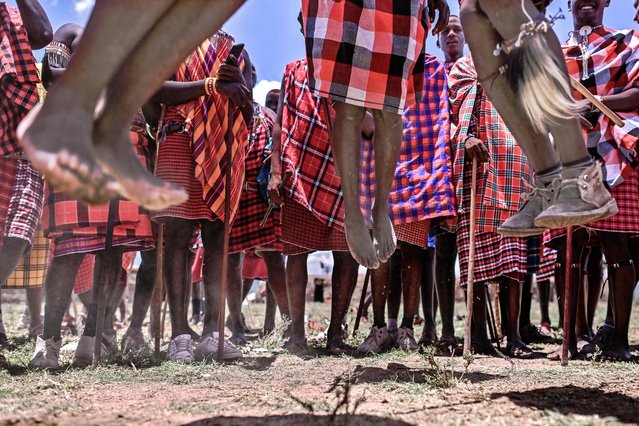
Men from the Kenyan Maasai tribe perform a traditional jumping-ritual among fellow members of a common age-set as they observe a rite of passage to mark the transition of an age-set to cultural junior elder from Moran (Maasai for warrior age-set) at a manyatta or traditional homestead built specifically for the ceremony near Lemek town within the Masai-Mara National Reserve ecosystem in Narok county February 27, 2021. (Photo by Tony Karumba/AFP Photo)

Men from the Kenyan Maasai tribe perform a traditional jumping-ritual among fellow members of a common age-set as they observe a rite of passage to mark the transition of an age-set to cultural junior elder from Moran (Maasai for warrior age-set) at a manyatta or traditional homestead built specifically for the ceremony near Lemek town within the Masai-Mara National Reserve ecosystem in Narok county February 27, 2021. (Photo by Tony Karumba/AFP Photo)
Details
23 Mar 2021 09:13:00
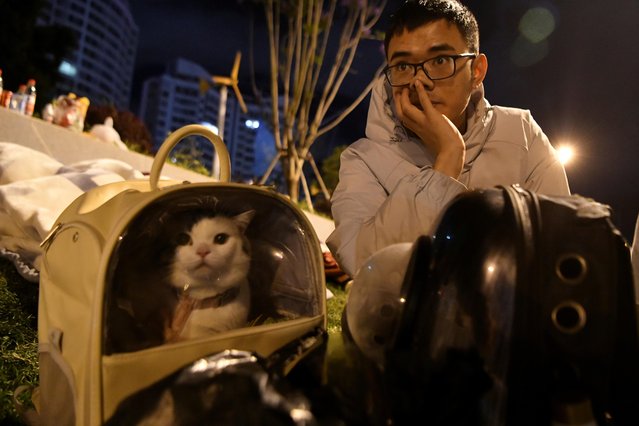
A man and his cat rest in the street after an earthquake on May 22, 2021 in Dali, Yunnan Province of China. According to the China Earthquake Networks Center, a 5.6-magnitude earthquake jolted Yangbi Yi autonomous county in Dali Bai autonomous prefecture, Southwest China's Yunnan province on Friday evening. (Photo by Liu Ranyang/China News Service via Getty Images)

A man and his cat rest in the street after an earthquake on May 22, 2021 in Dali, Yunnan Province of China. According to the China Earthquake Networks Center, a 5.6-magnitude earthquake jolted Yangbi Yi autonomous county in Dali Bai autonomous prefecture, Southwest China's Yunnan province on Friday evening. (Photo by Liu Ranyang/China News Service via Getty Images)
Details
01 Jun 2021 09:48:00


The original costumes for Star Wars character Darth Vader stand on display at “Star Wars: The Exhibition” at County hall on May 04, 2007 in London, England. (Photo by MJ Kim/Getty Images)
Details
14 Sep 2011 01:37:00
Lamas dance

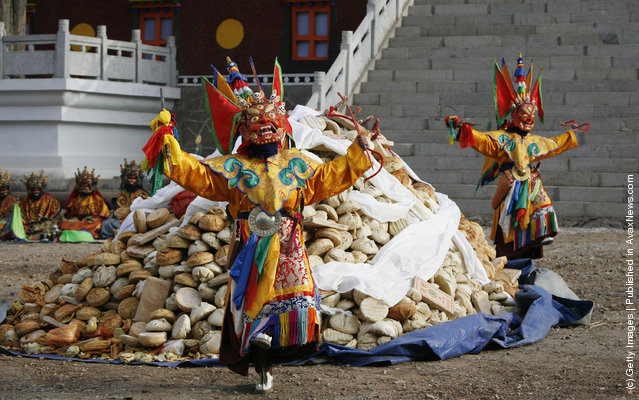
Lamas dance during the “Tiaoqian” praying ceremony at the Youning Temple on February 8, 2009 in Huzhu County of Qinghai Province, China. (Photo by China Photos/Getty Images)
Details
24 Oct 2011 15:11:00
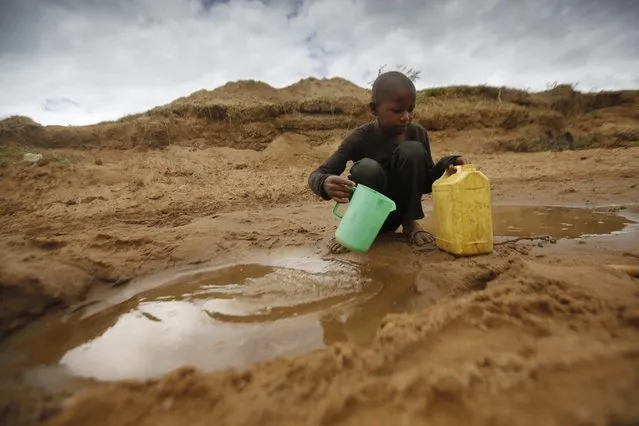
A young boy scoops water from a hand-dug well in the dry riverbed near Matinyani, in the semi-arid Kitui County in southeastern Kenya, 22 March 2015, the World Water Day. Residents of Kitui County and other arid and semi-arid areas of the country have been hard-hit by extremely poor rainfall this year while the government said in previous month that some 1.6 million people countrywide are facing acute starvation due to the drought and will need relief food over the next six months. (Photo by Dai Kurokawa/EPA)

A young boy scoops water from a hand-dug well in the dry riverbed near Matinyani, in the semi-arid Kitui County in southeastern Kenya, 22 March 2015, the World Water Day. Residents of Kitui County and other arid and semi-arid areas of the country have been hard-hit by extremely poor rainfall this year while the government said in previous month that some 1.6 million people countrywide are facing acute starvation due to the drought and will need relief food over the next six months. Residents of Matinyani say they haven't seen a drop of rain in nearly four months. Thousands of Kenyans in rural areas walk tens of kilometers just to fetch water to drink and to be used in their homes. According to an estimate by UNESCO (United Nations Educational, Scientific and Cultural Organization), 17 million people lack access to safe water in Kenya, where the drought is a perennial problem. (Photo by Dai Kurokawa/EPA)
Details
23 Mar 2015 11:01:00
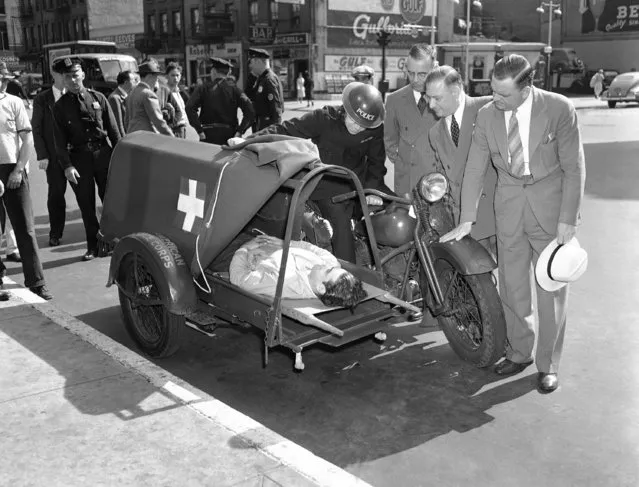
Developed for the British American Ambulance Corps, this new motorcycle ambulance is capable of speeding wounded soldiers 90 miles an hour from the front lines to field hospitals. Its springs are synchronized with the patient?s heartbeat to avoid increasing fever when traveling over various Terrain. Viewing it in New York  August 27, 1941, are left to right: constable Herbert Scott of England, driver; William E. Detlor, whose firm developed the vehicle; M. W. Stand, inspector-general of Civilian Defense, and Maj. Edward Riekert, also. (Photo by AP Photo)

Developed for the British American Ambulance Corps, this new motorcycle ambulance is capable of speeding wounded soldiers 90 miles an hour from the front lines to field hospitals. Its springs are synchronized with the patient's heartbeat to avoid increasing fever when traveling over various Terrain. Viewing it in New York August 27, 1941, are left to right: constable Herbert Scott of England, driver; William E. Detlor, whose firm developed the vehicle; M. W. Stand, inspector-general of Civilian Defense, and Maj. Edward Riekert, also. (Photo by AP Photo)
Details
28 Aug 2015 11:51:00