Loading...
Done
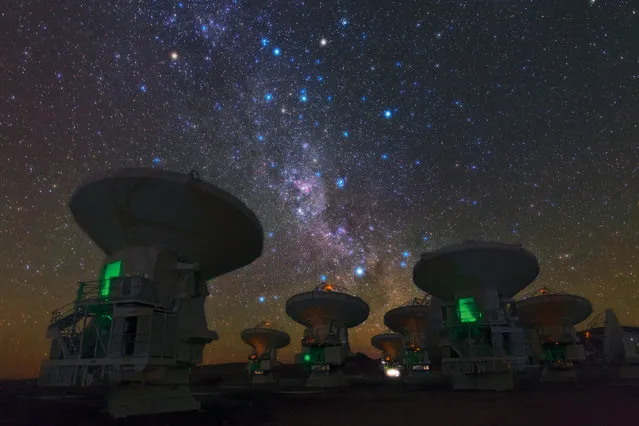
The antennas of the European Southern Observatory's Atacama Large Millimeter/Submillimeter Array, also known as ALMA, are set against the splendor of the Milky Way in this picture by Babak Tafreshi

The antennas of the European Southern Observatory's Atacama Large Millimeter/Submillimeter Array, also known as ALMA, are set against the splendor of the Milky Way in this picture by Babak Tafreshi. Construction of the full ALMA array is due to be completed in Chile's Atacama Desert in 2013, but the facility is already making scientific observations with a partial array of antennas. (Photo by ESO/B. Tafreshi/TWAN)
Details
03 Jun 2012 11:57:00
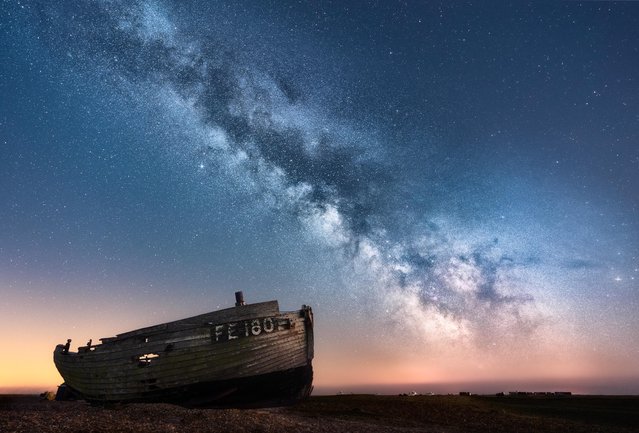
Paul Dixon is an engineer by day and an astrophotographer by night. He shot this broken boat on Dungeness beach, Kent in the last decade of August 2024, 17 times, stacking the images upon each other before combining them with a similar composite of the Milky Way. (Photo by Paul Dixon/Media Drum Images)

Paul Dixon is an engineer by day and an astrophotographer by night. He shot this broken boat on Dungeness beach, Kent in the last decade of August 2024, 17 times, stacking the images upon each other before combining them with a similar composite of the Milky Way. (Photo by Paul Dixon/Media Drum Images)
Details
10 Jul 2025 04:02:00
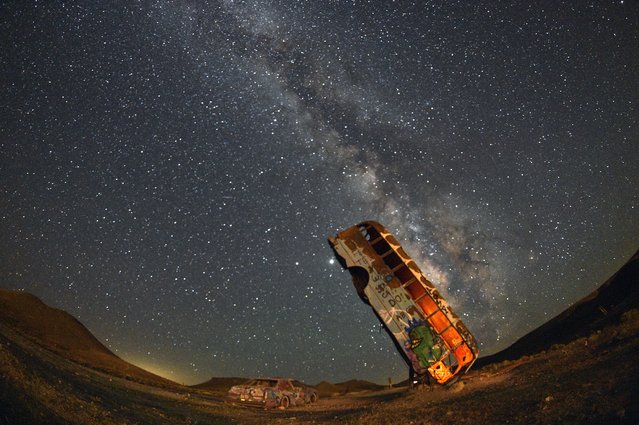
The Milky Way galaxy is seen in the sky above the International Car Forest of the Last Church in Goldfield, Nevada on July 18, 2020. The roadside attraction, created in 2002 by Mark Rippie, has over 36 automobiles including cars, trucks, vans and buses that have been balanced on their ends or stacked on top one of another. (Photo by David Becker/AFP Photo)

The Milky Way galaxy is seen in the sky above the International Car Forest of the Last Church in Goldfield, Nevada on July 18, 2020. The roadside attraction, created in 2002 by Mark Rippie, has over 36 automobiles including cars, trucks, vans and buses that have been balanced on their ends or stacked on top one of another. (Photo by David Becker/AFP Photo)
Details
20 Aug 2020 00:03:00
Merit: A Night at Deadvlei. The night before returning to Windhoek, we spent several hours at Deadveli. The moon was bright enough to illuminate the sand dunes in the distance, but the skies were still dark enough to clearly see the milky way and magellanic clouds. Deadveli means “dead marsh. (Photo and caption by Beth McCarley/National Geographic Traveler Photo Contest)

Merit: A Night at Deadvlei. The night before returning to Windhoek, we spent several hours at Deadveli. The moon was bright enough to illuminate the sand dunes in the distance, but the skies were still dark enough to clearly see the milky way and magellanic clouds. Deadveli means “dead marsh. The camelthorn trees are believed to be about 900 years old, but have not decomposed because the environment is so dry. (Photo and caption by Beth McCarley/National Geographic Traveler Photo Contest)
Details
04 Aug 2015 11:50:00
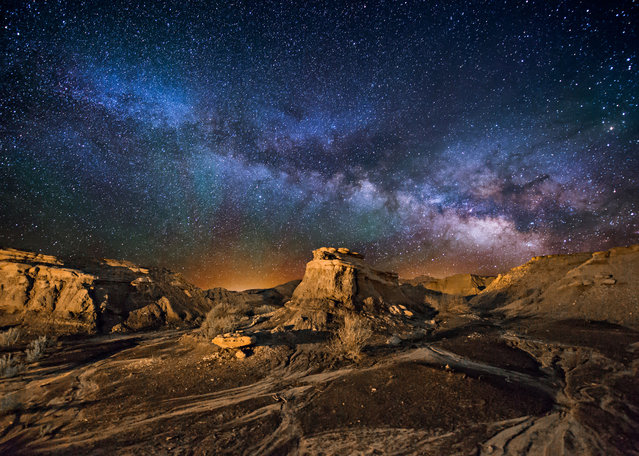
Bisit Badlands, New Mexico. (Photo by Wayne Pinkston/Caters News)

These are the stunning pictures of the night sky brilliantly capturing the lights and colors of the Milky Way glistening over desert landscapes. Taken in various locations across Australia and the United States from the Grand Canyon to the Coral Sea, the pictures perfectly show the bright lights of the starry skies. Here: Bisit Badlands, New Mexico. (Photo by Wayne Pinkston/Caters News)
Details
26 Sep 2015 08:05:00
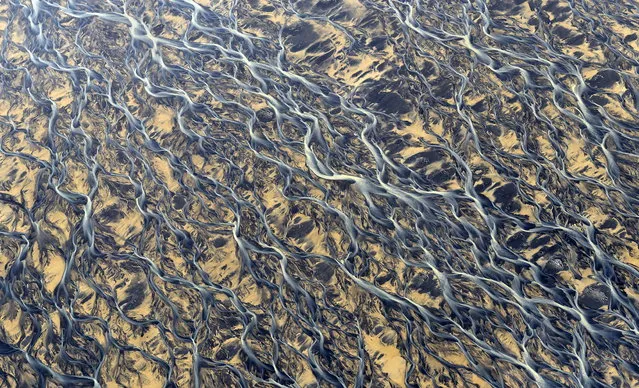
These pictures look like an artist has painted abstract patterns on canvas – but in fact they are natural rivers captured on camera. The spectacular rivers in Iceland's central highlands and southern parts originate from glaciers, which is why the water is a milky colour. (Photo by Andrey Ermolaev/Solent News)

These picture look like an artist has painted abstract patterns on canvas – but in fact they are natural rivers captured on camera. The spectacular rivers in Iceland's central highlands and southern parts originate from glaciers, which is why the water is a milky colour. They are shallow rivers and the water spreads quickly over a flat and sandy surface, creating random and beautiful patterns. Photographer Andrey Ermolaev from Moscow, Russia, flew 500ft above the unique sight in a small plane. (Photo by Andrey Ermolaev/Solent News)
Details
05 May 2014 10:57:00


An image produced by the Hubble telescope of the perfectly “edge-on” galaxy, or NGC 4013, March 1, 2001. This new Hubble picture reveals, with great detail, huge clouds of dust and gas extending along, as well as far above, the galaxy's main disk. NGC 4013 is a spiral galaxy, similar to the Milky Way, lying some 55 million light-years from Earth in the direction of the constellation Ursa Major. Viewed face-on, it would look like a nearly circular pinwheel, but NGC 4013 happens to be seen edge-on from our vantage point. Even at 55 million light-years, the galaxy is larger than Hubble's field of view, and the image shows only a little more than half of the object, albeit with unprecedented detail. (Photo Courtesy of NASA/Newsmakers)
Details
28 Feb 2015 22:33:00
“Shanghai Tian Wai №26, 2014”. This series was an attempt to document an ever-changing city and the things it loses, as working-class neighbourhoods give way to ever-more modern urban development. (Photo by Liu Tao/The Guardian)

This 2014 series Shanghai Tian Wa saw Chinese photographer Liu Tao train his lens on two distinct districts in Shanghai. Here: “Shanghai Tian Wai №26, 2014”. (Photo by Liu Tao/The Guardian)
Details
25 May 2018 00:01:00