Loading...
Done
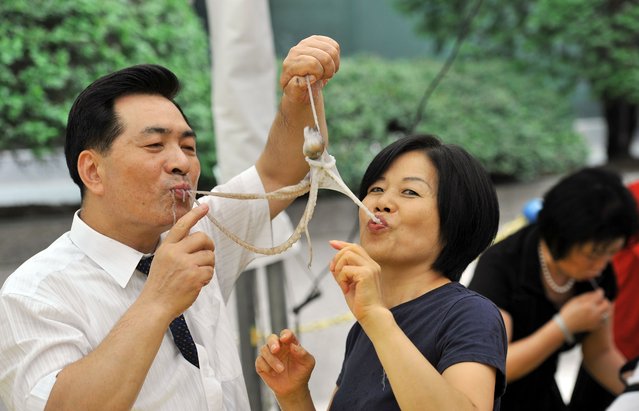
A South Korean man and a woman eat a live octopus during an event to promote a local food festival in Seoul on September 12, 2013. (Photo by Jung Yeon-Je/AFP Photo)

Live octopus is a delicacy in South Korea but is a known choking hazard, since the still-moving suction cups can cause tentacle pieces to stick in a person's throat. A baby octopus is often consumed whole, while larger varieties are cut up and the still-wriggling tentacles eaten with a splash of sesame oil. Photo: A South Korean man and a woman eat a live octopus during an event to promote a local food festival in Seoul on September 12, 2013. (Photo by Jung Yeon-Je/AFP Photo)
Details
13 Sep 2013 09:40:00
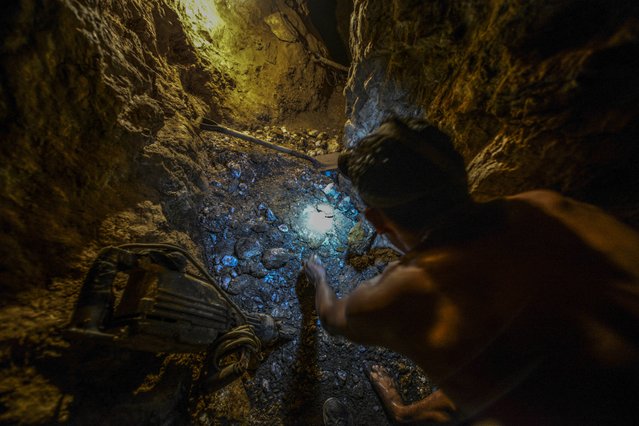
Ender Moreno looks for gold at La Culebra gold mine in El Callao, Bolivar state, southeastern Venezuela on March 1, 2017. (Photo by Juan Barreto/AFP Photo)

Ender Moreno looks for gold at La Culebra gold mine in El Callao, Bolivar state, southeastern Venezuela on March 1, 2017. Although life in the mines of eastern Venezuela is hard and dangerous, tens of thousands from all over the country head for the mines daily in overcrowded trucks, pushed by the rise in gold prices and by the severe economic crisis affecting the country, aggravated recently by the drop in oil prices. (Photo by Juan Barreto/AFP Photo)
Details
28 Mar 2017 09:15:00
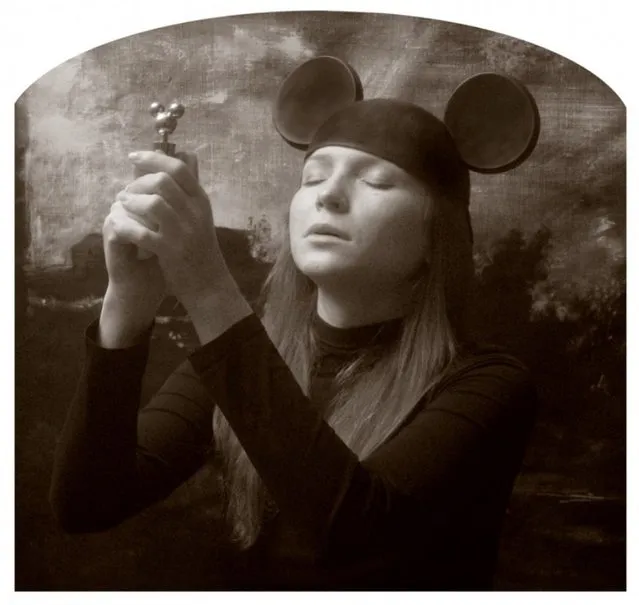
barbarian-art

To produce the images that convey his fatalistic and ironic approach to life, tinged with hope, he needed the environment and knowledge of Mother Russia, oiled with a bit of bribery to certain circus trainers. Enter the Great Russian Bear, the personification of Russia for the last several centuries, onto center stage and into his studio. The bear is recognized as both brutish and cute – Misha was the mascot for the 1980 Olympic Games – and has remained a symbol of Russia since Tsarist times. In 2009 it is the symbol of the United Russia Party.
Details
13 Apr 2015 09:10:00
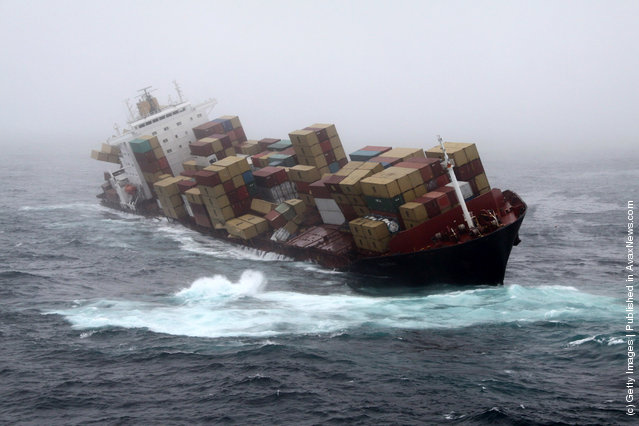
Authorities Fear MV Rena May Break-Up In Rough Seas

In this handout provided by Maritime New Zealand, MV Rena is battered by strong seas as it is stuck on Astrolabe Reef, on November 2, 2011 in Tauranga, New Zealand. The stricken vessel encountered a three metre swell, which led authorities to fear it may finally break up. Rena struck the reef on October 5, and has spilled 350 tonnes of oil, and almost 100 shipping containers. (Photo by Graeme Brown/Maritime New Zealand via Getty Images)
Details
02 Nov 2011 10:50:00
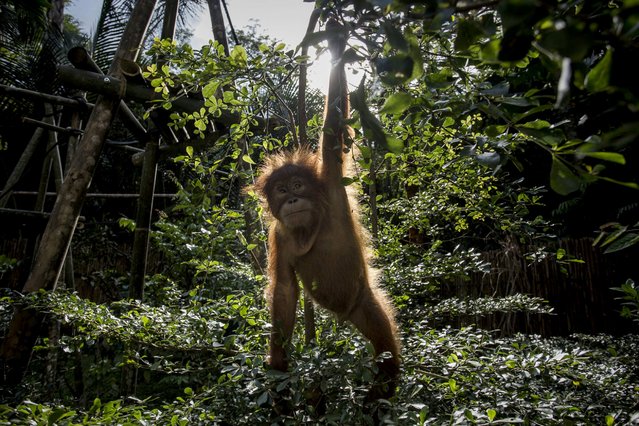
A Baby sumatran orangutan (Pongo abelii) plays around in a tree as they train at Sumatran Orangutan Conservation Programme's rehabilitation center on November 12, 2016 in Kuta Mbelin, North Sumatra, Indonesia. The Orangutans in Indonesia have been known to be on the verge of extinction as a result of deforestation and poaching. Found mostly in South-East Asia, where they live on the islands of Sumatra and Borneo, the endangered species continue to lose their habitat as a result of corporate expansion in a developing economy. Indonesia approved palm oil concessions on nearly 15 million acres of peatlands over the past years and thousands of square miles have been cleared for plantations, including the lowland areas that are the prime habitat for orangutans. (Photo by Ulet Ifansasti/Getty Images)

A Baby sumatran orangutan (Pongo abelii) plays around in a tree as they train at Sumatran Orangutan Conservation Programme's rehabilitation center on November 12, 2016 in Kuta Mbelin, North Sumatra, Indonesia. The Orangutans in Indonesia have been known to be on the verge of extinction as a result of deforestation and poaching. Found mostly in South-East Asia, where they live on the islands of Sumatra and Borneo, the endangered species continue to lose their habitat as a result of corporate expansion in a developing economy. Indonesia approved palm oil concessions on nearly 15 million acres of peatlands over the past years and thousands of square miles have been cleared for plantations, including the lowland areas that are the prime habitat for orangutans. (Photo by Ulet Ifansasti/Getty Images)
Details
16 Nov 2016 11:14:00
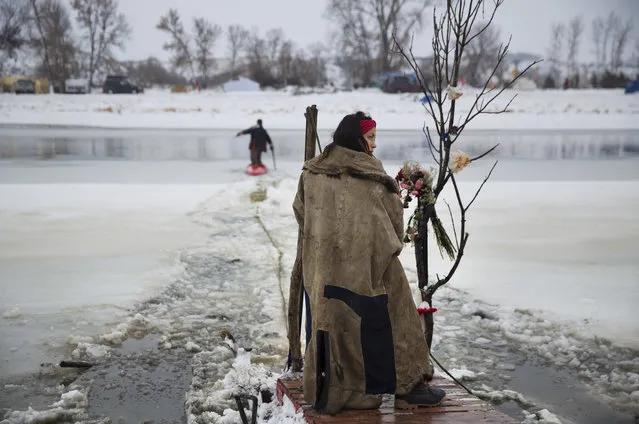
In this Thursday, December 1, 2016 photo, Cat Bigney, part of the Oglala Native American tribe, waits on the shore of the Cannonball river for travelers to arrive by canoe at the Oceti Sakowin camp where people have gathered to protest the Dakota Access oil pipeline in Cannon Ball, N.D. So far, those at the camp have shrugged off the heavy snow, icy winds and frigid temperatures. But if they defy next week's government deadline to abandon the camp, demonstrators know the real deep freeze lies ahead. Life-threatening wind chills and towering snow drifts could mean the greatest challenge is simple survival. (Photo by David Goldman/AP Photo)

In this Thursday, December 1, 2016 photo, Cat Bigney, part of the Oglala Native American tribe, waits on the shore of the Cannonball river for travelers to arrive by canoe at the Oceti Sakowin camp where people have gathered to protest the Dakota Access oil pipeline in Cannon Ball, N.D. So far, those at the camp have shrugged off the heavy snow, icy winds and frigid temperatures. But if they defy next week's government deadline to abandon the camp, demonstrators know the real deep freeze lies ahead. Life-threatening wind chills and towering snow drifts could mean the greatest challenge is simple survival. (Photo by David Goldman/AP Photo)
Details
06 Dec 2016 10:22:00
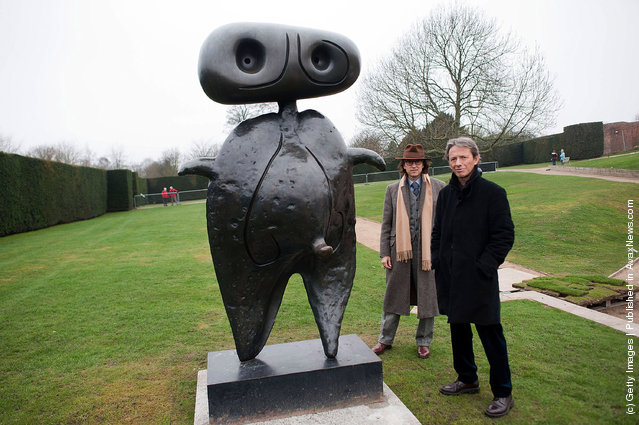
Joan Miro's, grandsons, Emilio Fernandez Miro and Joan Punyet Miro pose beside Personnage (1970) in the Yorkshire Sculpture park

“Joan Miro i Ferra (April 20, 1893 – December 25, 1983) was a Spanish Catalan painter, sculptor, and ceramicist born in Barcelona. Earning international acclaim, his work has been interpreted as Surrealism, a sandbox for the subconscious mind, a re-creation of the childlike, and a manifestation of Catalan pride. In numerous interviews dating from the 1930s onwards, Miro expressed contempt for conventional painting methods as a way of supporting bourgeois society, and famously declared an “assassination of painting” in favour of upsetting the visual elements of established painting”. – Wikipedia

Photo: Joan Miro's, grandsons, Emilio Fernandez Miro and Joan Punyet Miro pose beside Personnage (1970) in the Yorkshire Sculpture park on March 14, 2012 in Wakefield, England. Yorkshire Sculpture Park stages the first major UK survey of sculpture by Spanish artist Joan Miro. (Photo by Bethany Clarke/Getty Images)
Details
15 Mar 2012 13:47:00
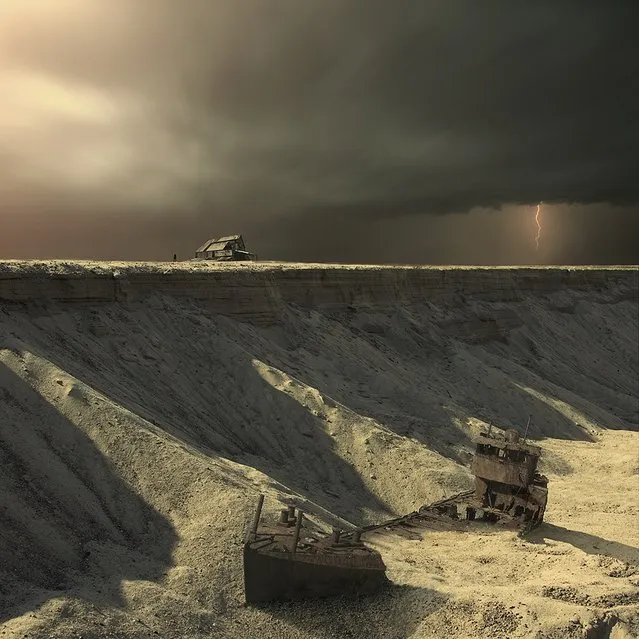
“Last Outpost”. (Photo by Michal Karcz)

“I was born in 1977 in Warsaw, Poland. I had graduated from the High School of Art in Warsaw. My journey into the world of photography began in the early 90's, but at that time my biggest passion was painting. Painting helped me develop vision that was hard to create. Unfortunately I had to leave the paintbrush and canvas. A few years ago, I opened “the door” to my own world with help of a different key”... – Michal Karcz. Photo: “Last Outpost”. (Photo by Michal Karcz)
Details
07 Aug 2013 14:15:00