Loading...
Done
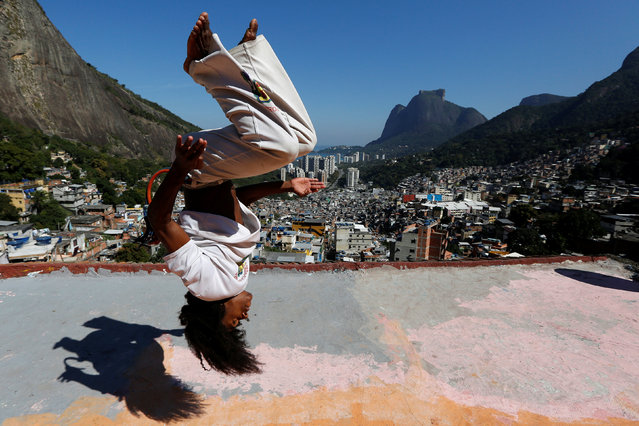
A member of the Acorda Capoeira (Awaken Capoeira) group performs on a rooftop in the Rocinha favela in Rio de Janeiro, Brazil, July 24, 2016. (Photo by Bruno Kelly/Reuters)

A member of the Acorda Capoeira (Awaken Capoeira) group performs on a rooftop in the Rocinha favela in Rio de Janeiro, Brazil, July 24, 2016. In a favela with a history of violence between police and drug gangs, or armed battles between traffickers themselves, capoeira is an outlet that gives kids a sense of community – its practice a collective exercise blending characteristics of drum circles, sparring and tag-team gymnastics. (Photo by Bruno Kelly/Reuters)
Details
30 Jul 2016 11:11:00
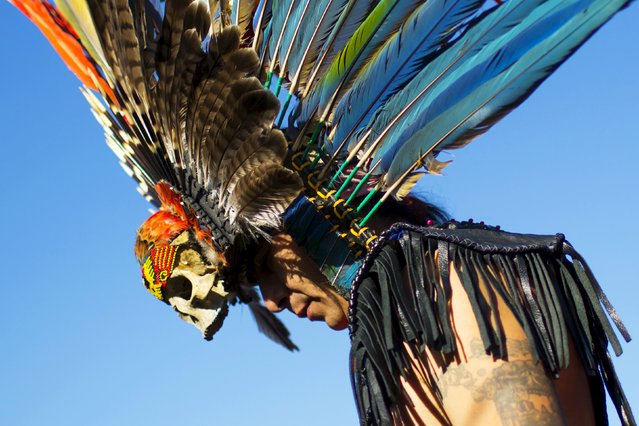
A reveller gets ready to dance during a "pow-wow" celebrating the Indigenous Peoples Day Festival in Randalls Island, New York, October 11, 2015. (Photo by Eduardo Munoz/Reuters)

A reveller gets ready to dance during a "pow-wow" celebrating the Indigenous Peoples Day Festival in Randalls Island, New York, October 11, 2015. The festival is held as a counter-celebration to Columbus Day and is to promote Native American culture and history. (Photo by Eduardo Munoz/Reuters)
Details
15 Oct 2015 08:03:00
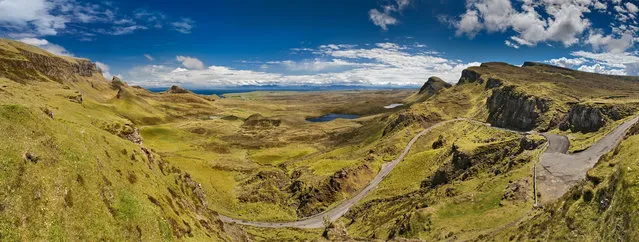
Island Of Skye, Scotland

A set of pictures taken by Kellie Netherwood on the northern-most island located in the Inner Hebrides of Scotland perfectly captures the spirit of the Scots: wild, free, and majestic. It is no wonder that Scottish people fought tooth and nail to gain their independence all throughout their history. The green fields, rocky hills, and the beautiful waterfalls all sing to the spirits of the Scots, instilling pride into everyone who considers this place to be their motherland. However, no matter what your origin may be, you cannot help being fascinated by the beauty of these landscapes, drawn to them as if by a powerful force. (Photo by Kellie Netherwood)
Details
17 Oct 2014 13:28:00
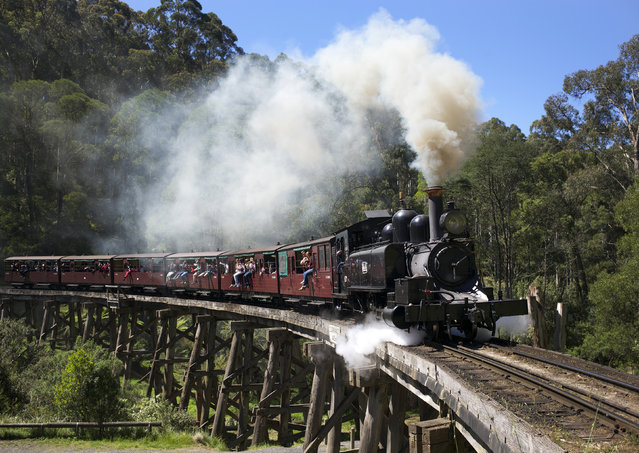
A Puffing Billy steam train hauled by locomotive 14A crosses the Monbulk Creek trestle after leaving Belgrave station near Melbourne, October 20, 2014. (Photo by Jason Reed/Reuters)

A Puffing Billy steam train hauled by locomotive 14A crosses the Monbulk Creek trestle after leaving Belgrave station near Melbourne, October 20, 2014. While the discovery of steam power 200 years ago powered the Industrial Revolution, the world long ago shunted most steam trains onto the sidings of history. (Photo by Jason Reed/Reuters)
Details
04 Nov 2014 12:21:00
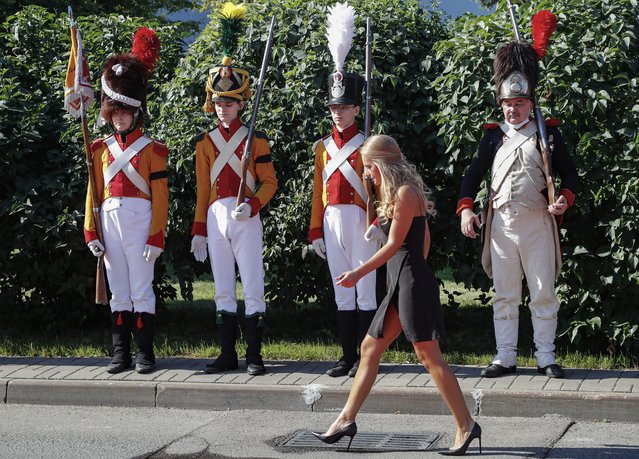
A woman passes Members of historical clubs dressed in the uniform of French soldiers during ceremony of repatriation of the remains of French General Charles-Etienne Gudin de la Sablonniere, participant in the French Revolutionary wars and Napoleonic wars, to France in Moscow airport Vnukovo-3, Russia, 13 July 2021. One of Napoleon Bonaparte's favourite military commanders died in the Battle of Smolensk during the Russian campaign of 1812. The search for his remains was one of the main goals of the joint archaeological expedition, which the historians of the two countries, led by Pierre Malinowski, President of the Foundation for the Development of Russian- French Historical Initiatives, began in the summer of 2019. A significant find was made during excavations at the Royal Bastion in the Lopatinsky Garden of Smolensk. (Photo by Sergei Ilnitsky/EPA/EFE)

A woman passes Members of historical clubs dressed in the uniform of French soldiers during ceremony of repatriation of the remains of French General Charles-Etienne Gudin de la Sablonniere, participant in the French Revolutionary wars and Napoleonic wars, to France in Moscow airport Vnukovo-3, Russia, 13 July 2021. (Photo by Sergei Ilnitsky/EPA/EFE)
Details
23 Jul 2021 09:07:00
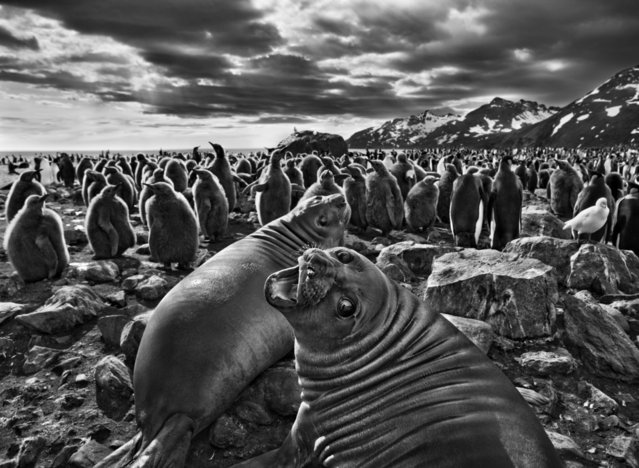
On South Georgia, a barren island in the far South Atlantic, a pair of southern elephant seal calves beckon before a colony of king penguins. “The male seals can grow to almost five tons,” says Salgado, “but these are just babies. This one looked at me with beautiful eyes”. (Photo by Sebastião Salgado/Amazonas/Contact Press Images)

Sebastião Salgado is a Brazilian documentary photographer living in Paris. He has produced several books, and his work has been exhibited extensively around the world. His latest work, «Genesis», premieres at The Natural History Museum in London on April 11, on view through September 8, 2013. Photo: On South Georgia, a barren island in the far South Atlantic, a pair of southern elephant seal calves beckon before a colony of king penguins. “The male seals can grow to almost five tons,” says Salgado, “but these are just babies. This one looked at me with beautiful eyes”. (Photo by Sebastião Salgado/Amazonas/Contact Press Images)
Details
30 Apr 2013 12:17:00
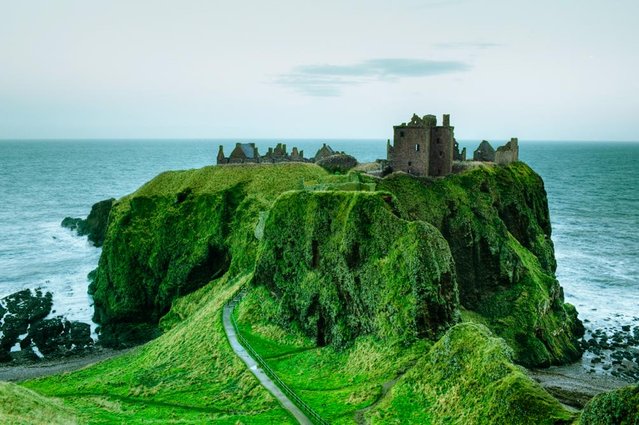
Dunnottar Castle In Scottish

Dunnottar Castleis a ruined medieval fortress located upon a rocky headland on the north-east coast of Scotland, about 3 kilometres (1.9 mi) south of Stonehaven. The surviving buildings are largely of the 15th and 16th centuries, but the site is believed to have been fortified in the Early Middle Ages. Dunnottar has played a prominent role in the history of Scotland through to the 18th-century Jacobite risings because of its strategic location and the strength of its situation. Dunnottar is best known as the place where the Honours of Scotland, the Scottish crown jewels, were hidden from Oliver Cromwell's invading army in the 17th century. The property of the Keiths from the 14th century, and the seat of the Earl Marischal, Dunnottar declined after the last Earl forfeited his titles by taking part in the Jacobite rebellion of 1715. The castle was restored in the 20th century and is now open to the public.
Details
13 Jan 2014 11:31:00


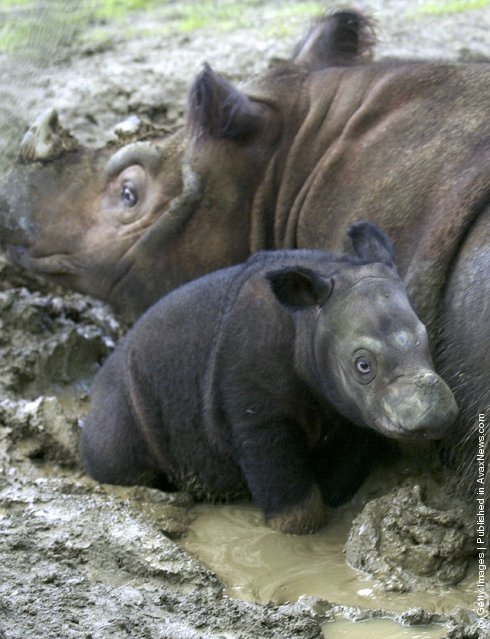
“The Sumatran Rhinoceros (Dicerorhinus sumatrensis) is a member of the family Rhinocerotidae and one of five extant rhinoceroses. It is the only extant species of the genus Dicerorhinus. It is the smallest rhinoceros, standing about 120–145 centimetres (3.9–4.76 ft) high at the shoulder, with a body length of 250 centimetres (8.2 ft) and weight of 500–800 kilograms (1,100–1,800 lb). Like the African species, it has two horns; the larger is the nasal horn, typically 15–25 centimetres (5.9–9.8 in), while the other horn is typically a stub. A coat of reddish-brown hair covers most of the Sumatran Rhino's body”. – Wikipedia

Photo: Emi, a Sumatran rhinoceros lies in the mud with her three-week-old female calf at the Cincinnati Zoo and Botanical Garden August 19, 2004 in Cincinnati, Ohio. Emi made history by becoming the first Sumatran rhino to produce two calves in captivity. (Photo by Mike Simons/Getty Images)
Details
22 Jun 2011 12:37:00