Loading...
Done
Spectacular images offering insight into the lives of the Huaorani people in the Ecuadorian Amazon have been revealed showing how they use traditional methods to hunt monkeys for food. The stunning pictures were taken by conservation photographer Pete Oxford from Torquay, Devon in the Ecuadorian Amazon. “The Huaorani Indians are a forest people highly in tune with their environment. Many are now totally acculturated since the 1950s by missionaries”, said Pete. “Today they face radical change to their culture to the proximity of oil exploration within their territory and the Yasuni National Park and Biosphere Reserve, they are vastly changed. Some still live very traditionally and for this shoot, through my Huaorani friend, a direct relative of those photographed he wanted to depict them as close to their original culture as possible. They still largely hunt with blow pipes and spears eating a lot of monkeys and peccaries”. The Huaorani are also known as the Waorani, Waodani or the Waos and are native Amerindians. Their lands are located between the Curaray and Napo rivers and speak the Huaorani language. Pete says that during his visit he was welcomed into the group and hopes that ancient cultures can be saved. Here: The tribe were seen celebrating after a hunter returned to camp with a wild pig. (Photo by Pete Oxford/Mediadrumworld.com)

Spectacular images offering insight into the lives of the Huaorani people in the Ecuadorian Amazon have been revealed showing how they use traditional methods to hunt monkeys for food. The stunning pictures were taken by conservation photographer Pete Oxford from Torquay, Devon in the Ecuadorian Amazon. Here: The tribe were seen celebrating after a hunter returned to camp with a wild pig. (Photo by Pete Oxford/Mediadrumworld.com)
Details
20 Jan 2017 07:58:00
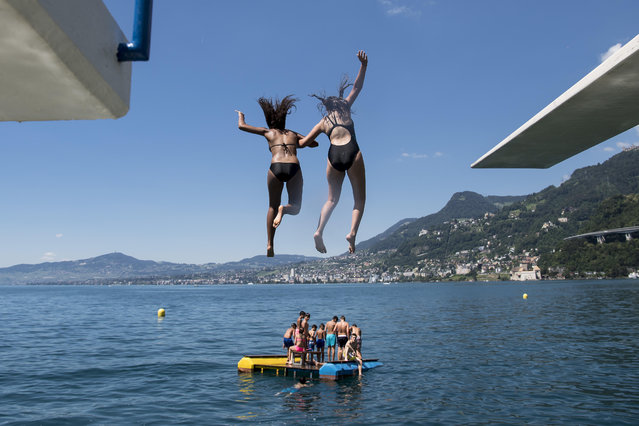
In this July 9, 2016 file photo, girls jump from a diving platform into the Geneva Lake and enjoy sunny and warm weather, in Villeneuve, Switzerland. After nearly 90 years, women can legally swim topless in Geneva’s lake and Rhone River without running the risk of a fine. Geneva’s regional council has voted to modify a 1929 ordinance that banned women from swimming topless in the city’s main natural waterways, though the change doesn’t apply to public swimming pools or swimming totally naked. Nicolas Bolle, an official with Geneva’s security department, on Thursday, April 6, 2017 confirmed the council’s action a day earlier. (Photo by Jean-Christophe Bott/Keystone via AP Photo)

In this July 9, 2016 file photo, girls jump from a diving platform into the Geneva Lake and enjoy sunny and warm weather, in Villeneuve, Switzerland. After nearly 90 years, women can legally swim topless in Geneva’s lake and Rhone River without running the risk of a fine. Geneva’s regional council has voted to modify a 1929 ordinance that banned women from swimming topless in the city’s main natural waterways, though the change doesn’t apply to public swimming pools or swimming totally naked. Nicolas Bolle, an official with Geneva’s security department, on Thursday, April 6, 2017 confirmed the council’s action a day earlier. (Photo by Jean-Christophe Bott/Keystone via AP Photo)
Details
08 Apr 2017 09:39:00
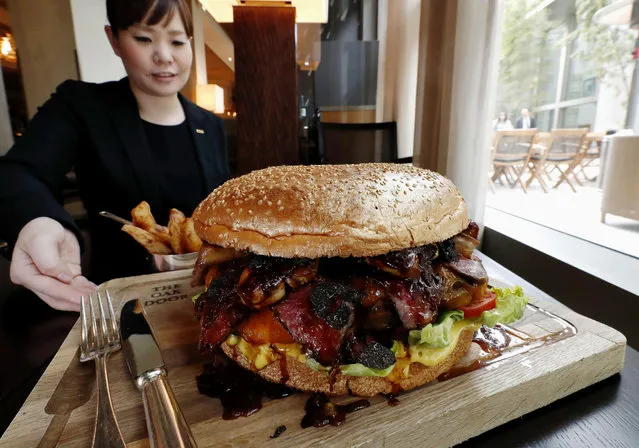
In this Thursday, March 28, 2019, photo, a “golden giant burger” is served at a restaurant of Hotel Grand Hyatt Tokyo in Tokyo. The $900 wagyu (Japanese-produced beef) burger was unveiled to commemorate the era change. What’s in a name? Quite a lot if you’re a Japanese citizen awaiting the official announcement Monday, April 1, 2019 of what the soon-to-be-installed new emperor’s next era will be called. It’s a proclamation that has happened only twice in nearly a century, and the new name will follow Emperor Naruhito, after his May 1 investiture, for the duration of his rule, attaching itself to much of what happens in Japan. (Photo by Kyodo News via AP Photo)

In this Thursday, March 28, 2019, photo, a “golden giant burger” is served at a restaurant of Hotel Grand Hyatt Tokyo in Tokyo. The $900 wagyu (Japanese-produced beef) burger was unveiled to commemorate the era change. What’s in a name? Quite a lot if you’re a Japanese citizen awaiting the official announcement Monday, April 1, 2019 of what the soon-to-be-installed new emperor’s next era will be called. It’s a proclamation that has happened only twice in nearly a century, and the new name will follow Emperor Naruhito, after his May 1 investiture, for the duration of his rule, attaching itself to much of what happens in Japan. (Photo by Kyodo News via AP Photo)
Details
02 Apr 2019 00:05:00
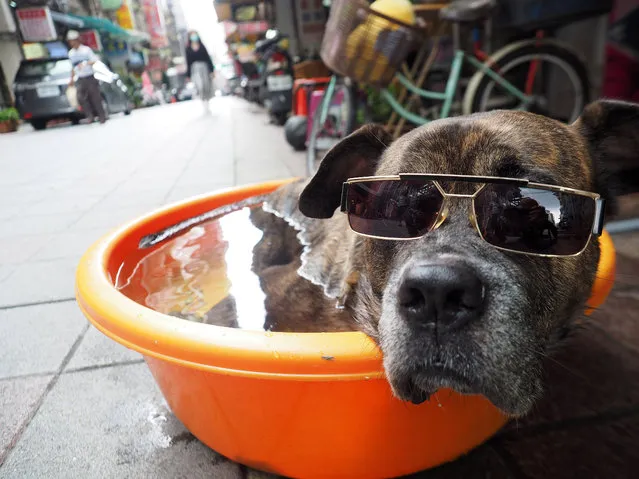
A dog sits in a plastic tub filled with water in Taipei, Taiwan, 28 July 2020. Betel nut seller Mr Luo, the dog's owner, said he puts his dog, a 12-year-old mixed breed called Ah Dai (Stupid), in a plastic tub filled with water whenever the weather gets hot. Ah Dai enjoys the bath and can sit in the basin for hours, according to Mr Luo. Luo has a dozen pairs of glasses for Ah Dai, so the dog wears different glasses every day and many tourists take photos of Ah Dai. (Photo by David Chang/EPA/EFE)

A dog sits in a plastic tub filled with water in Taipei, Taiwan, 28 July 2020. Betel nut seller Mr Luo, the dog's owner, said he puts his dog, a 12-year-old mixed breed called Ah Dai (Stupid), in a plastic tub filled with water whenever the weather gets hot. Ah Dai enjoys the bath and can sit in the basin for hours, according to Mr Luo. Luo has a dozen pairs of glasses for Ah Dai, so the dog wears different glasses every day and many tourists take photos of Ah Dai. (Photo by David Chang/EPA/EFE)
Details
15 Aug 2020 00:05:00
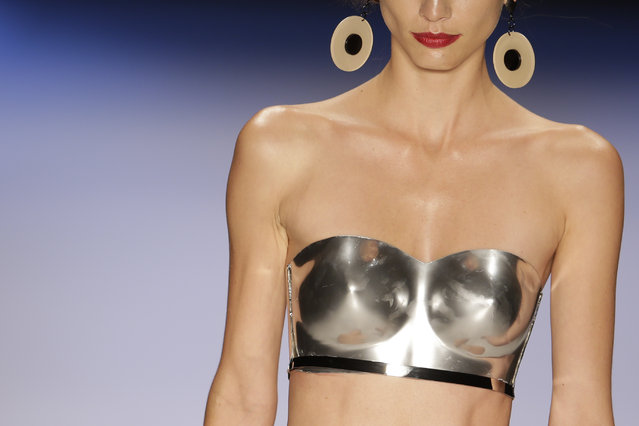
A model wears a creation from the Triya summer collection during Fashion Rio in Rio de Janeiro, Brazil, Friday, April 19, 2013. (Photo by Felipe Dana/AP Photo)

Felipe Dana discovered photography at age 15 when he started working as an assistant for event and commercial photographers. At the close of 2009, he decided to focus his career solely on photojournalism. Dana has focused his work on documenting the consequences of social changes in slums due to upcoming major sports events scheduled for 2014 and 2016 in Rio de Janeiro, where he currently lives and works as a staff photographer for The Associated Press. Photo: A model wears a creation from the Triya summer collection during Fashion Rio in Rio de Janeiro, Brazil, Friday, April 19, 2013. (Photo by Felipe Dana/AP Photo)
Details
15 May 2014 07:29:00
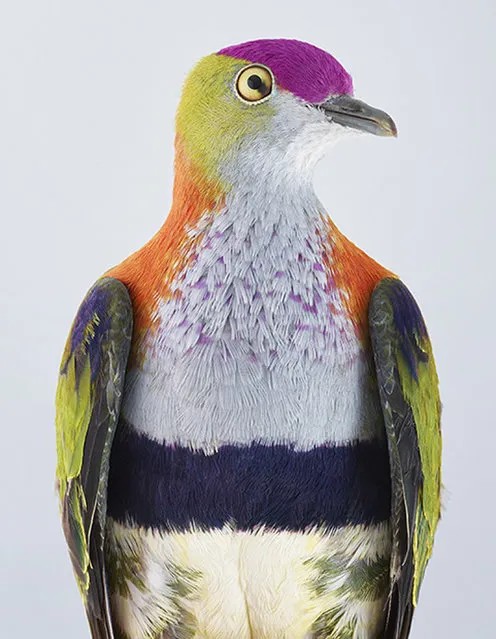
The series, which was photographed between 2015 and 2017, is currently on display at the Purdy Hicks Gallery in London, running through August 24, 2018. (Photo by Leila Jefferies/Caters News Agency)

This photographer has made it her mission to change people’s perception of pigeons – focusing on some of the most beautiful of the more than 300 species found globally. Rather than focus on the gray, nondescript birds people usually associate with the term “pigeon”, Leila Jeffreys has instead decided to snap the more vibrant varieties. Whether it be the wompoo pigeon, with its deep purple breast and green wings, or the rose-crowned fruit dove, with its pink head, Jeffreys, 46, gives the birds the same attention she would give a human model. (Photo by Leila Jefferies/Caters News Agency)
Details
14 Aug 2018 00:01:00
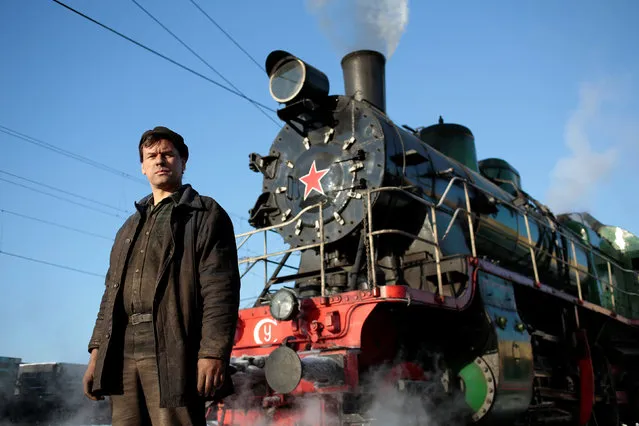
Alexei Gruk, 45, mechanic and supporter of presidential candidate Pavel Grudinin, poses for a picture in St. Petersburg, Russia, January 31, 2018. “The most important thing for me is that our foreign policy stays the same”, said Gruk. “To hell with the sanctions… So what if they don’t bring foreign stuff here anymore? As if that means we have to give up. I don't care”. (Photo by Anton Vaganov/Reuters)

Most Russians intending to vote for Vladimir Putin in Sunday's election say stability is at the root of their faith in their candidate – though many young voters believe it's time for a change of leader. Putin, 65, is expected to win a fourth term in office with 69 percent of the vote, according to the latest survey by a state-run pollster. Reuters correspondents and photographers who travelled around the country talking to voters ahead of the March 18 election found nothing to contradict expectation of an emphatic Putin victory. (Photo by Anton Vaganov/Reuters)
Details
15 Mar 2018 00:01:00
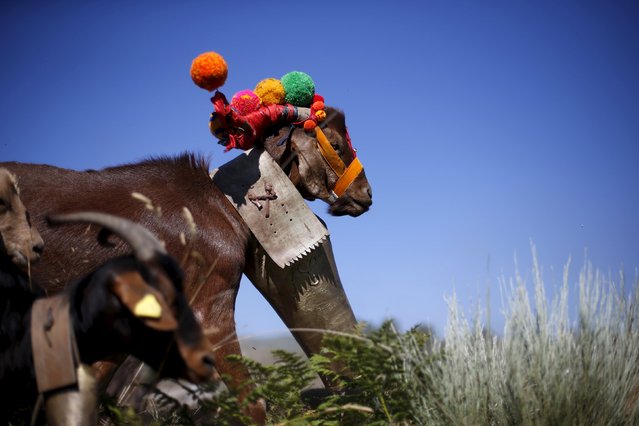
Sheep walk as they are herded to summer pastures in Serra da Estrela, near Seia, Portugal June 27, 2015. (Photo by Rafael Marchante/Reuters)

Sheep walk as they are herded to summer pastures in Serra da Estrela, near Seia, Portugal June 27, 2015. In late June, shepherds young and old in the Seia region of central Portugal start guiding sheep, goats and cattle to the Serra da Estrela, the country’s highest mountains, in search of better pastures. There they stay until the end of September. Modern-day shepherds may have mobile phones to keep in touch with family and friends, but their lifestyle has changed little for centuries. The sound of cowbells and the bark of longhaired mastiffs starts early in the morning as the animals – often decorated with traditional woollen balls on their horns – are herded up steep, narrow paths. (Photo by Rafael Marchante/Reuters)
Details
14 Jul 2015 13:48:00