Loading...
Done
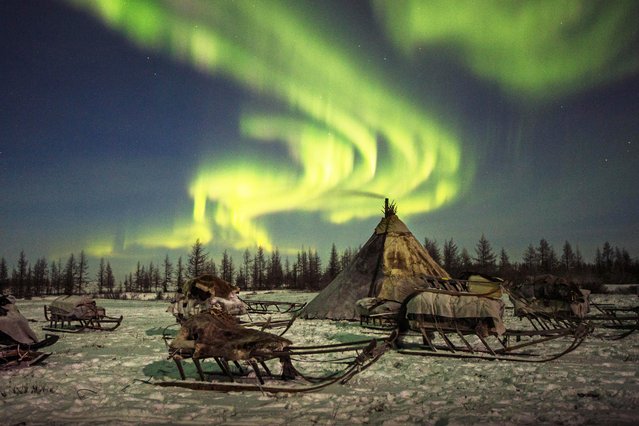
An empty camp is shown beneath a colourful sky in Siberia, December 2016. (Photo by Timothy Allen/Barcroft Productions)

A British photographer has captured life at the “edge of the world”. Timothy Allen, best known for his work on BBC's Human Planet, trekked through the freezing Siberian wilderness for 16 days as he joined part of an 800km migration of reindeer in the Yamal-Nenets region – a name that roughly translates to “edge of the world”. The stunning pictures feature the nomadic Nenets tribe, who drink blood to survive in -45°C temperatures. Timothy's epic journey, which will be revealed in an eight-minute documentary on Animal Planet USA, saw him travel across the bleak terrain of the frozen Ob River with the Nenets people in December last year. Here: An empty camp is shown beneath a colourful sky in Siberia, December 2016. (Photo by Timothy Allen/Barcroft Productions)
Details
19 Sep 2017 07:48:00


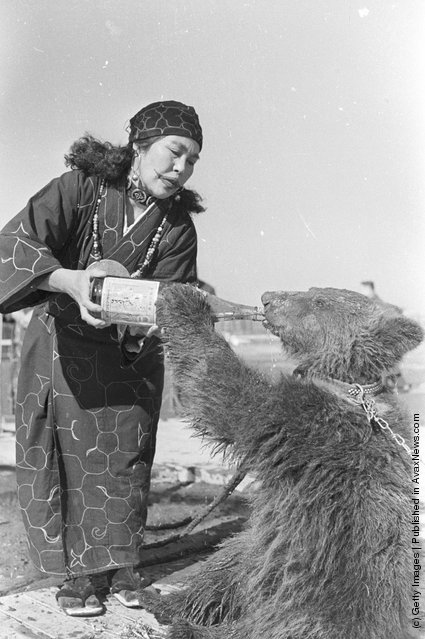
“The Ainu (アイヌ?), also called Aynu, Aino (アイノ), and in historical texts Ezo (蝦夷), are indigenous people or groups in Japan and Russia. Historically they spoke the Ainu language and related varieties and lived in Hokkaidō, the Kuril Islands, and much of Sakhalin. Most of those who identify themselves as Ainu still live in this same region, though the exact number of living Ainu is unknown. This is due to ethnic issues in Japan resulting in those with Ainu backgrounds hiding their identities and confusion over mixed heritages. In Japan, because of intermarriage over many years with Japanese, the concept of a 'pure Ainu' ethnic group is no longer feasible. Official estimates of the population are of around 25,000, while the unofficial number is upwards of 200,000 people”. – Wkipedia

Photo: A captive bear drinking from a large bottle held by an Ainu tribeswoman. (Photo by Evans/Three Lions/Getty Images). Circa 1955
Details
24 Mar 2011 14:01:00
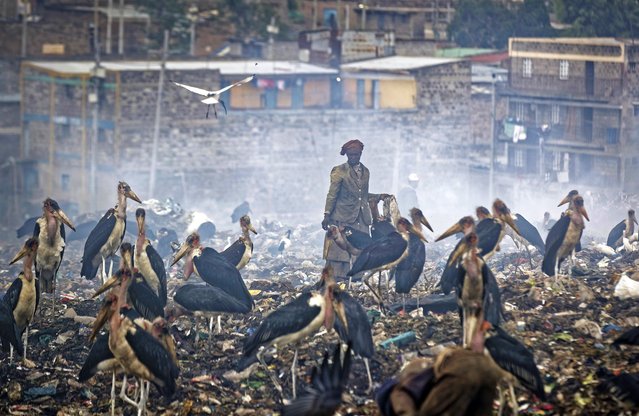
In this photo taken Wednesday, December 5, 2018, a woman who scavenges recyclable materials from garbage for a living is seen through a cloud of smoke from burning trash, surrounded by Marabou storks who feed on the garbage, at the dump in the Dandora slum of Nairobi, Kenya. As the world meets again to tackle the growing threat of climate change, how the continent tackles the growing solid waste produced by its more than 1.2 billion residents, many of them eager consumers in growing economies, is a major question in the fight against climate change. (Photo by Ben Curtis/AP Photo)

In this photo taken Wednesday, December 5, 2018, a woman who scavenges recyclable materials from garbage for a living is seen through a cloud of smoke from burning trash, surrounded by Marabou storks who feed on the garbage, at the dump in the Dandora slum of Nairobi, Kenya. As the world meets again to tackle the growing threat of climate change, how the continent tackles the growing solid waste produced by its more than 1.2 billion residents, many of them eager consumers in growing economies, is a major question in the fight against climate change. (Photo by Ben Curtis/AP Photo)
Details
14 Jan 2019 00:01:00
Azalea, whose Korean name is “Dalle”, a 19-year-old female chimpanzee, lights a cigarette at the Central Zoo in Pyongyang, North Korea on Wednesday, October 19, 2016. (Photo by Wong Maye-E/AP Photo)

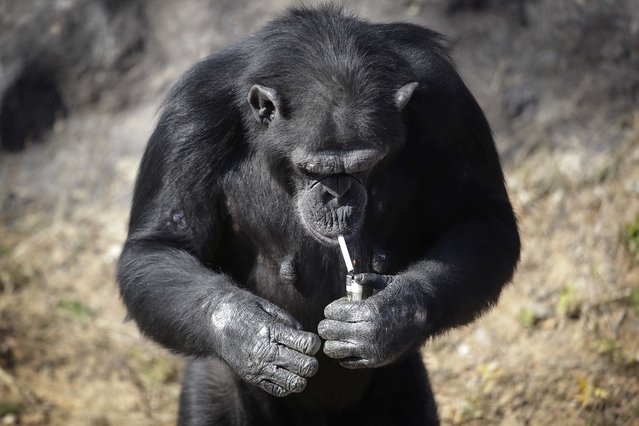
Azalea, whose Korean name is “Dalle”, a 19-year-old female chimpanzee, lights a cigarette at the Central Zoo in Pyongyang, North Korea on Wednesday, October 19, 2016. According to officials at the newly renovated zoo, which has become a favorite leisure spot in the North Korean capital since it was re-opened in July, the chimpanzee smokes about a pack a day. They insist, however, that she doesn’t inhale. (Photo by Wong Maye-E/AP Photo)
Details
20 Oct 2016 11:14:00
A photo made avialable on 05 August 2015 shows an Indian woman collecting drinking water from a water pump in the submerged village of Sreerampur, some 150 kilometers north of Calcutta, India, on 04 August 2015. At least 215 people have died in floods and a landslide following monsoon rains in India over the past week, 83 deaths were reported from the western state of Gujarat and 69 from eastern West Bengal. The worst-affected states were West Bengal, Gujarat and Rajasthan, the Home Ministry said. (Photo by Piyal Adhikary/EPA)

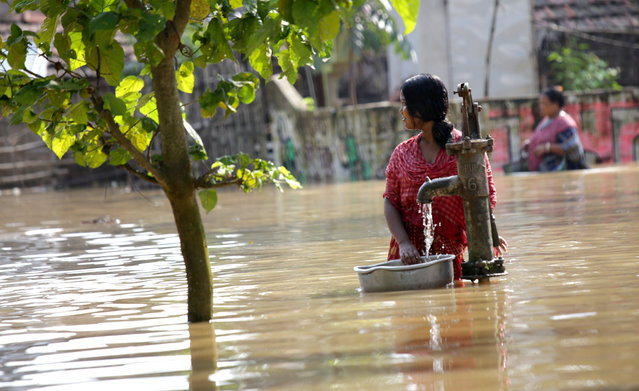
A photo made avialable on 05 August 2015 shows an Indian woman collecting drinking water from a water pump in the submerged village of Sreerampur, some 150 kilometers north of Calcutta, India, on 04 August 2015. At least 215 people have died in floods and a landslide following monsoon rains in India over the past week, 83 deaths were reported from the western state of Gujarat and 69 from eastern West Bengal. The worst-affected states were West Bengal, Gujarat and Rajasthan, the Home Ministry said. (Photo by Piyal Adhikary/EPA)
Details
08 Aug 2015 12:04:00
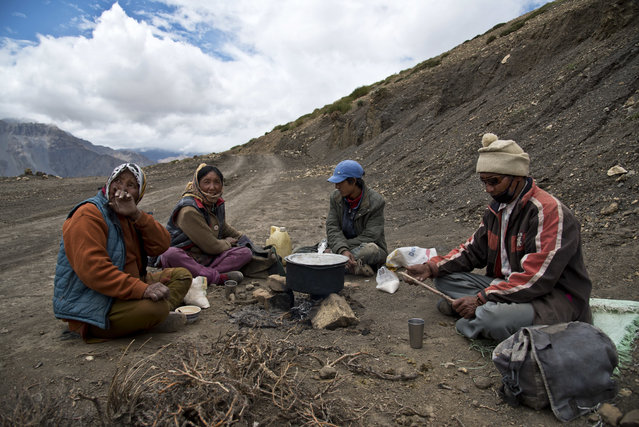
In this August 17, 2016, photo, from left to right, Chhering Chodom, 60, Tashi Yangzom, 50, Lobsang Chhering, 27, and Dorje Tandup, 58, drink milk tea on the side of the road. For centuries, the sleepy valley nestled in the Indian Himalayas remained a hidden Buddhist enclave forbidden to outsiders. Enduring the harsh year-round conditions of the high mountain desert, the people of Spiti Valley lived by a simple communal code – share the Earth's bounty, be hospitable to neighbors, and eschew greed and temptation at all turns. That's all starting to change, for better or worse. Since India began allowing its own citizens as well as outsiders to visit the valley in the early 1990s, tourism and trade have boomed. And the marks of modernization, such as solar panels, asphalt roads and concrete buildings, have begun to appear around some of the villages that dot the remote landscape at altitudes above 4,000 meters (13,000 feet). (Photo by Thomas Cytrynowicz/AP Photo)

In this August 17, 2016, photo, from left to right, Chhering Chodom, 60, Tashi Yangzom, 50, Lobsang Chhering, 27, and Dorje Tandup, 58, drink milk tea on the side of the road. For centuries, the sleepy valley nestled in the Indian Himalayas remained a hidden Buddhist enclave forbidden to outsiders. Enduring the harsh year-round conditions of the high mountain desert, the people of Spiti Valley lived by a simple communal code – share the Earth's bounty, be hospitable to neighbors, and eschew greed and temptation at all turns. That's all starting to change, for better or worse. (Photo by Thomas Cytrynowicz/AP Photo)
Details
15 Sep 2016 09:22:00
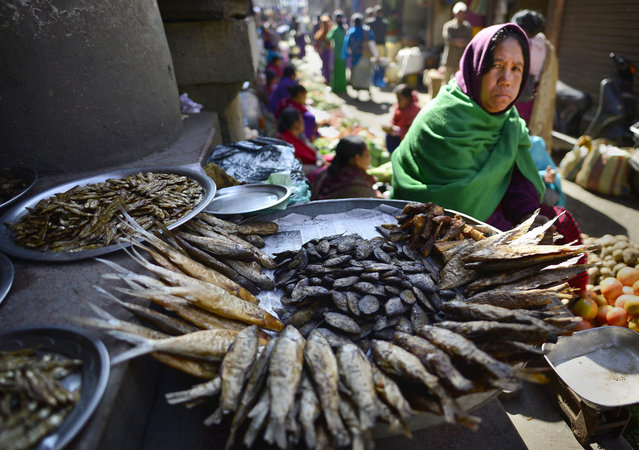
A Manipuri woman sells smoked and dry fish in Ima market - the world's largest all women market - in Imphal city, Manipur state, 06 January 2016. The 150-year-old Ima Keithel or 'Mothers's market' complex, which is run exclusively by women and was damaged in the 04 January 2016 earthquake, is returning back to normal. Nine deaths have been reported from in and around Imphal due to falling debris. (Photo by EPA/Stringer)

A Manipuri woman sells smoked and dry fish in Ima market - the world's largest all women market – in Imphal city, Manipur state, 06 January 2016. The 150-year-old Ima Keithel or “Mothers's market” complex, which is run exclusively by women and was damaged in the 04 January 2016 earthquake, is returning back to normal. Nine deaths have been reported from in and around Imphal due to falling debris. Imphal has a population of some 270,000 and people were jolted from their sleep and ran out of their homes in panic when the earth shook 04 January, reports say. (Photo by EPA/Stringer)
Details
08 Jan 2016 08:04:00
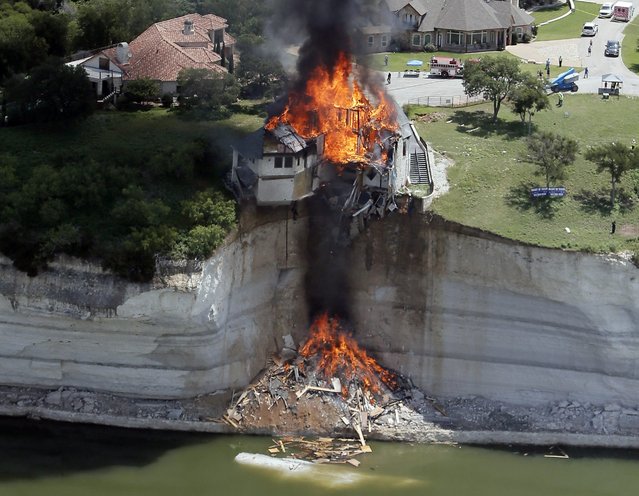
Smoke rises from a house days after part of the ground it was resting on collapsed into Lake Whitney, Texas in this June 13, 2014 file photo. I was covering the controlled burn of a house slowly falling into Lake Whitney due to the decaying cliff underneath.  Asked to take photos from an aerial perspective, an instructor and I took off from Grand Prairie Municipal Airport around 9am. (Photo and caption by Brandon Wade/Reuters)

Smoke rises from a house days after part of the ground it was resting on collapsed into Lake Whitney, Texas in this June 13, 2014 file photo. I was covering the controlled burn of a house slowly falling into Lake Whitney due to the decaying cliff underneath. Asked to take photos from an aerial perspective, an instructor and I took off from Grand Prairie Municipal Airport around 9am. The burn, scheduled to start an hour later, was delayed. I love flying, but patience proved challenging as circling for nearly three hours gets boring fast. Once the fire started we only had 15 minutes to take photos because the plane was booked at 1pm. The owners invested their retirement savings in the house and were even advised by geologists that the ground was stable. To watch your investment literally go up in flames must take its toll emotionally. The owners said they don't expect their insurance to cover the loss. (Photo and caption by Brandon Wade/Reuters)
Details
27 Nov 2014 15:01:00