Loading...
Done
A wild macaque monkey eats fruit dropped by pedestrians in a suburb of Kuala Lumpur, Malaysia, on June 11, 2013. (Photo by Mohd Rasfan/AFP Photo)

A wild macaque monkey eats fruit dropped by pedestrians in a suburb of Kuala Lumpur, Malaysia, on June 11, 2013. (Photo by Mohd Rasfan/AFP Photo)
Details
15 Jun 2013 11:38:00
Scantily clad spectators run alongside riders in the ascent of the Col du Tourmalet during the 6th stage of the 110th edition of the Tour de France cycling race, 145 km between Tarbes and Cauterets-Cambasque, in the Pyrenees mountains in southwestern France, on July 6, 2023. (Photo by Anne-Christine Poujoulat/AFP Photo)

Scantily clad spectators run alongside riders in the ascent of the Col du Tourmalet during the 6th stage of the 110th edition of the Tour de France cycling race, 145 km between Tarbes and Cauterets-Cambasque, in the Pyrenees mountains in southwestern France, on July 6, 2023. (Photo by Anne-Christine Poujoulat/AFP Photo)
Details
23 Oct 2024 02:53:00
This undated image provided by World View shows World View capsule and balloon spacecraft that will rise to 100,000 feet above Earth for passengers to see the curvature of the planet and the blackness of space. (Photo by World View via AP Photo)

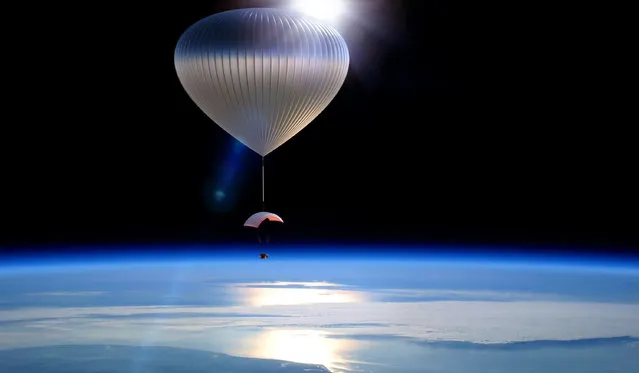
This undated image provided by World View shows World View capsule and balloon spacecraft that will rise to 100,000 feet above Earth for passengers to see the curvature of the planet and the blackness of space. Space tourism companies are employing designs including winged vehicles, vertical rockets with capsules and high-altitude balloons. While developers envision ultimately taking people to orbiting habitats, the moon or beyond, the immediate future involves short flights into or near the lowest reaches of space without going into orbit. (Photo by World View via AP Photo)
Details
15 Feb 2016 10:28:00
People walk near to a motorcycle ride called “Caravan of Terror”, in Caracas, Venezuela on October 29, 2022. (Photo by Leonardo Fernandez/Reuters)

People walk near to a motorcycle ride called “Caravan of Terror”, in Caracas, Venezuela on October 29, 2022. (Photo by Leonardo Fernandez/Reuters)

Details
26 Nov 2022 03:35:00
An Egyptian dancer performs the Tanoura outside a coffee shop at al-Muizz street in the old Islamic quarter of Cairo on August 29, 2024. (Photo by Khaled Desouki/AFP Photo)

An Egyptian dancer performs the Tanoura outside a coffee shop at al-Muizz street in the old Islamic quarter of Cairo on August 29, 2024. (Photo by Khaled Desouki/AFP Photo)
Details
14 Oct 2024 03:08:00
The double compound eyes of a male St. Mark's fly (Bibio marci), submitted by Dr. David Maitland from Feltwell, UK

The double compound eyes of a male St. Mark's fly (Bibio marci), submitted by Dr. David Maitland from Feltwell, UK. (Dr. David Maitland)
Details
07 Apr 2012 13:22:00
A small section of the expanding remains of the Veil Nebula, a massive star that exploded about 8,000 years ago. The entire nebula is 110 light-years across, covering six full moons on the sky as seen from Earth, and resides about 2,100 light-years away in the constellation Cygnus, the Swan. Image taken by NASA's Hubble Space Telescope. Released September 24, 2015. (Photo by Reuters/NASA/ESA/Hubble Heritage Team)


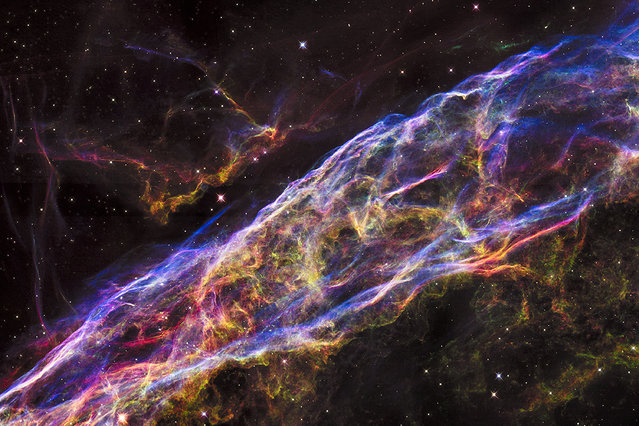
A small section of the expanding remains of the Veil Nebula, a massive star that exploded about 8,000 years ago. The entire nebula is 110 light-years across, covering six full moons on the sky as seen from Earth, and resides about 2,100 light-years away in the constellation Cygnus, the Swan. Image taken by NASA's Hubble Space Telescope. Released September 24, 2015. (Photo by Reuters/NASA/ESA/Hubble Heritage Team)

Details
10 Dec 2015 08:01:00
An infrared portrait from NASA's Spitzer Space Telescope which shows generations of stars is seen in this undated NASA handout image released February 14, 2013. In this wispy star-forming region, called W5, the oldest stars can be seen as blue dots in the centers of the two hollow cavities (other blue dots are background and foreground stars not associated with the region). Red shows heated dust that pervades the region's cavities, while green highlights dense clouds. (Photo by NASA/Reuters/JPL-Caltech/Harvard-Smithsonian/Handout)

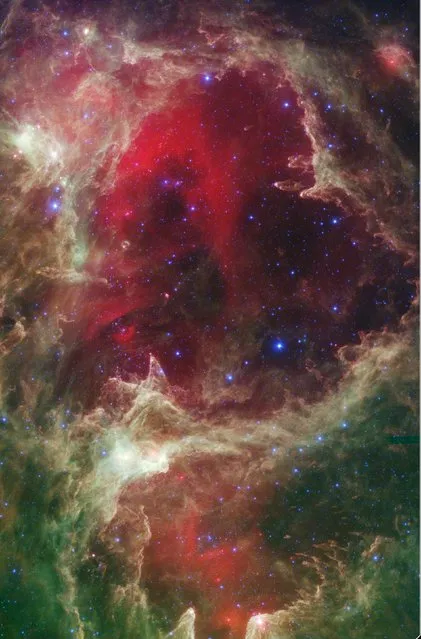
An infrared portrait from NASA's Spitzer Space Telescope which shows generations of stars is seen in this undated NASA handout image released February 14, 2013. In this wispy star-forming region, called W5, the oldest stars can be seen as blue dots in the centers of the two hollow cavities (other blue dots are background and foreground stars not associated with the region). Red shows heated dust that pervades the region's cavities, while green highlights dense clouds. (Photo by NASA/Reuters/JPL-Caltech/Harvard-Smithsonian/Handout)
Details
03 Mar 2013 08:44:00