Loading...
Done
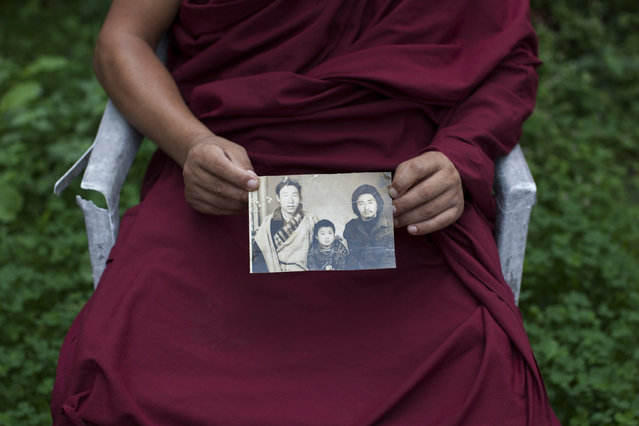
In this Saturday, September 27, 2014 photo, Tibetan monk Dorjee, 38, displays a photograph of his father, left, and himself, center, taken in Tibet, in Dharamsala, India. Dorjee said he held back his tears when he spoke with his parents on the phone after a separation period of 27 years. He exchanged a few words with his father but said his mother fainted on hearing his voice. (Photo by Tsering Topgyal/AP Photo)

“When I was 8 years old, my parents paid a smuggler to take me across the Himalayas, a weekslong walk over the mountains from Tibet to India. It was a trek that tens of thousands of other Tibetans have taken since the Dalai Lama fled a failed 1959 uprising against Chinese rule. My parents must have had their reasons to send me here; they must have had the best of intentions. But 18 years later, I still don't know why they did it. They are not political people. They are small farmers who raise barley and a few yak in a rural area not far from Lhasa, the Tibetan capital. I have not seen them since I left...”. – Tsering Topgyal via The Associated Press. (Photo by Tsering Topgyal/AP Photo)
Details
05 Nov 2014 12:27:00
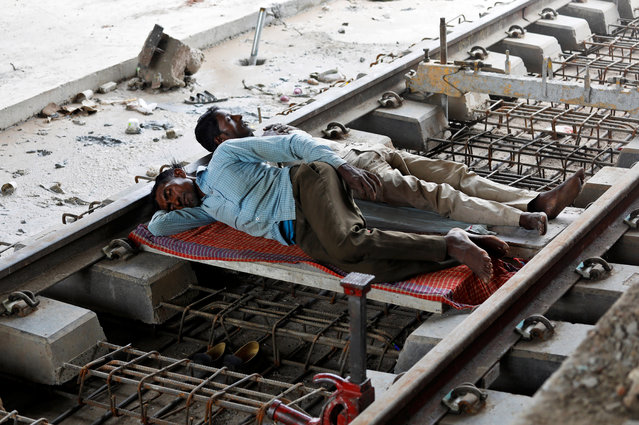
Workers sleep on a railway track under repair in New Delhi, India, June 15, 2018. (Photo by Saumya Khandelwal/Reuters)

Workers sleep on a railway track under repair in New Delhi, India, June 15, 2018. (Photo by Saumya Khandelwal/Reuters)
Details
22 Jun 2018 00:01:00
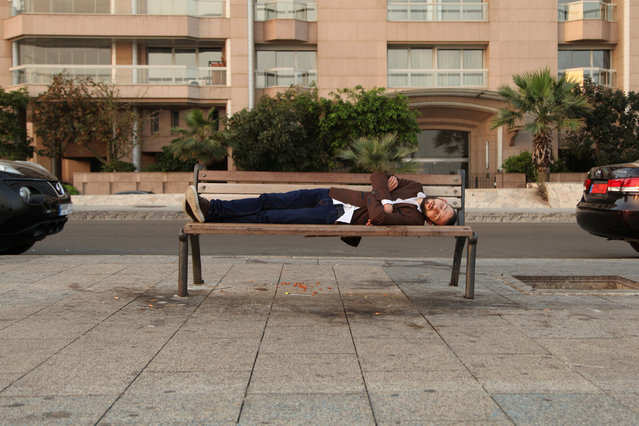
A man sleeps at Beirut's Corniche, a seaside promenade, in Lebanon May 2, 2016. (Photo by Alia Haju/Reuters)

A man sleeps at Beirut's Corniche, a seaside promenade, in Lebanon May 2, 2016. (Photo by Alia Haju/Reuters)
Details
12 Oct 2018 00:01:00
Sleeping Anthidium. Female Anthidium punctatum; Size: 7 mm. (John Hallmén)

Sleeping Anthidium. Female Anthidium punctatum; Size: 7 mm. (Photo by John Hallmén)
Details
30 Jun 2013 12:19:00
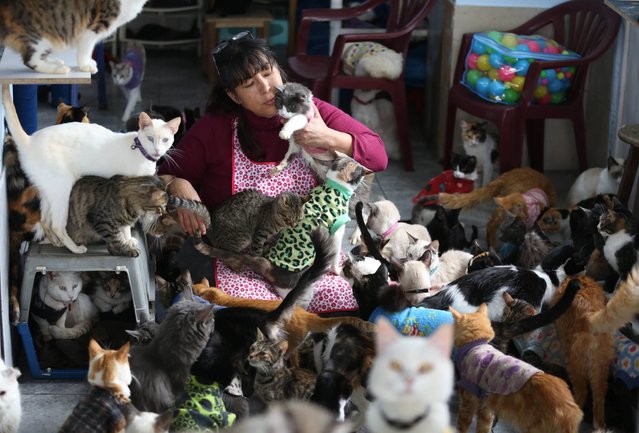
In this August 2, 2014 photo, Maria Torero, plays with a group of 175 cats with leukemia in her home in Lima, Peru. Torero says caring for cats with feline leukemia is her responsibility. Anybody else can care for healthy animals. (Photo by Martin Mejia/AP Photo)

“At her job, Maria Torero cares for sick human beings. At home, she lavishes love on slowly dying cats – 175 of them at last count. The 45-year-old nurse has turned her two-story, eight-room apartment into a hospice for cats with feline leukemia, scattering it with scores of feeding dishes and at least two dozen boxes litter boxes. Some have suggested she shelter healthy cats instead. “That's not my role”, she told The Associated Press. “I'm a nurse. My duty is to the cats that nobody cares about”. She said that “people don't adopt adult cats, especially if they are terminally ill”. – Franklin Briceno via Associated Press. (Photo by Martin Mejia/AP Photo)
Details
24 Aug 2014 09:28:00
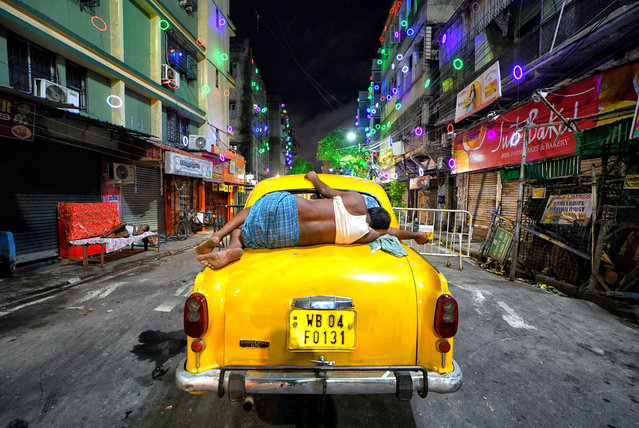
A taxi driver seen sleeping on his taxi in the middle of a decorated street during the Durga Puja Festival in Kolkata, India on October 22, 2020. (Photo by Avishek Das/SOPA Images/Rex Features/Shutterstock)

A taxi driver seen sleeping on his taxi in the middle of a decorated street during the Durga Puja Festival in Kolkata, India on October 22, 2020. (Photo by Avishek Das/SOPA Images/Rex Features/Shutterstock)
Details
28 Oct 2020 00:05:00
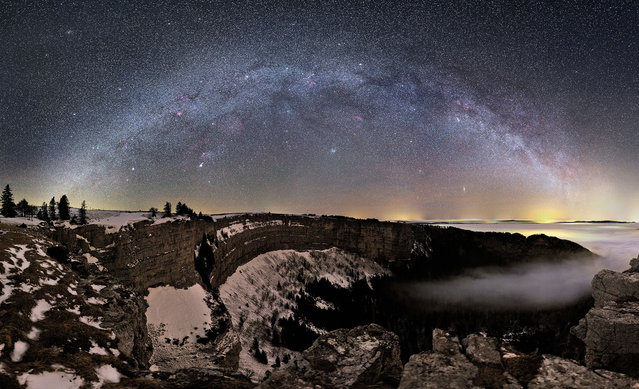
Milky Way over Switzerland

Milky Way over Switzerland

The Milky Way is the galaxy in which Earth is contained. This name derives from its appearance as a dim “milky” glowing band arching across the night sky, in which the naked eye cannot distinguish individual stars. The term “Milky Way” is a translation of the Classical Latin via lactea, from the Hellenistic Greek γαλαξίας κύκλος (pr. galaxías kýklos, “milky circle”). The Milky Way appears like a band because it is a disk-shaped structure being viewed from inside. The fact that this faint band of light is made up of stars was proven in 1610 when Galileo Galilei used his telescope to resolve it into individual stars. In the 1920s, observations by astronomer Edwin Hubble showed that the Milky Way is just one of many galaxies.


Details
20 Jun 2012 10:11:00
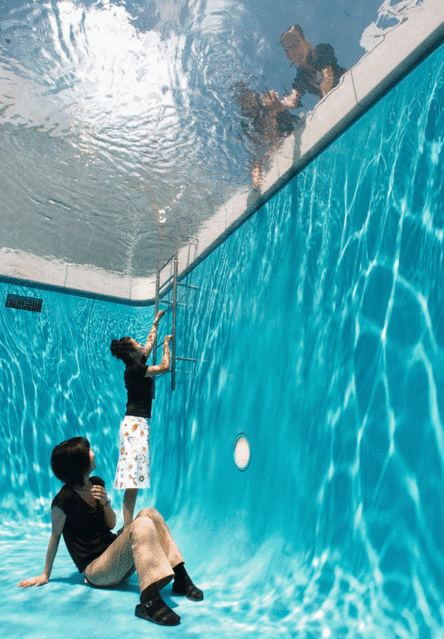
Swimming Pool Art Installation by Leandro Erlich

In one of the Museum’s courtyards is a swimming pool framed by a limestone deck. When seen from the deck, the pool appears to be filled with deep, shimmering water. In fact, however, a layer of water only some 10 centimeters deep is suspended over transparent glass. Below the glass is an empty space with aquamarine walls that viewers can enter. The work sets up an unfolding sequence of experiences—we view the pool through the glass wall enclosing the courtyard; from the deck, looking down into the pool; and from the interior of the pool, looking up. The Swimming Pool might hence be considered a place where, slowly, with time, different perspectives and perceptions of self and others all come to intersect.
Details
25 Aug 2012 07:31:00