Loading...
Done
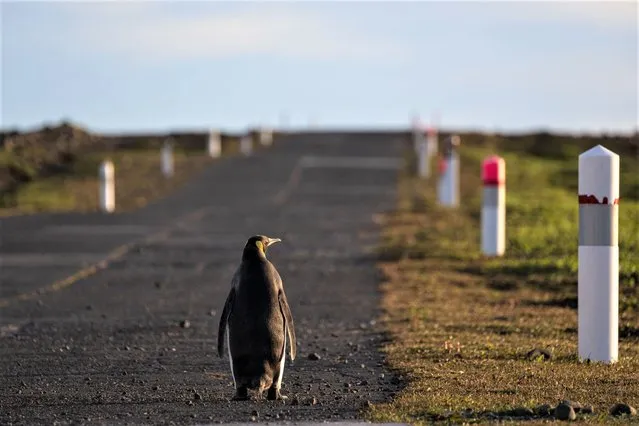
A penguin (Manchots Royaux) walks on the basement area, early morning on December 25, 2022, at the Kerguelen Islands, also known as the Desolation Islands, are a group of islands in the sub-Antarctic. (Photo by Patrick Hertzog/AFP Photo)

A penguin (Manchots Royaux) walks on the basement area, early morning on December 25, 2022, at the Kerguelen Islands, also known as the Desolation Islands, are a group of islands in the sub-Antarctic. (Photo by Patrick Hertzog/AFP Photo)
Details
22 Jan 2023 05:55:00
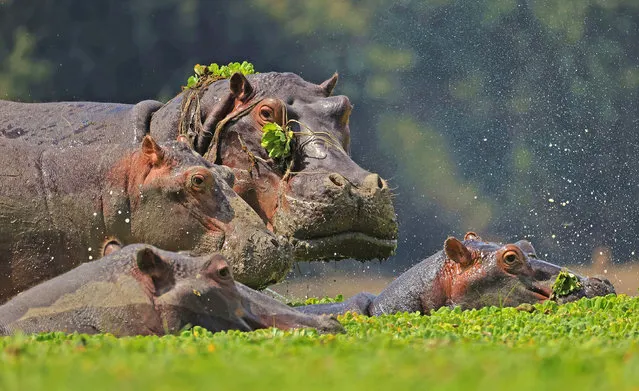
While many of us would pay good money for a spa mud bath, these fortunate hippos in South Luangwa National Park, Zambia, have nature to thank as they take a plunge in a lagoon in the second decade of February 2024. (Photo by Dimitar Nedelchev/Solent News)

While many of us would pay good money for a spa mud bath, these fortunate hippos in South Luangwa National Park, Zambia, have nature to thank as they take a plunge in a lagoon in the second decade of February 2024. (Photo by Dimitar Nedelchev/Solent News)
Details
10 Mar 2024 07:40:00
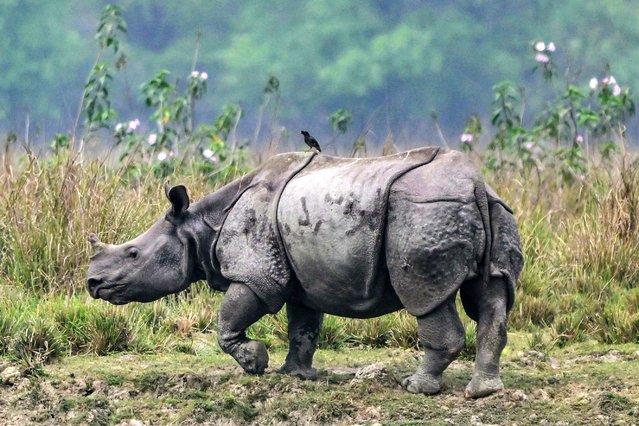
An Indian one-horned rhinoceros grazes on a dry wetland at the Pobitora Wildlife Sanctuary on the southern bank of the Brahmaputra River in Morigaon district of India's Assam state on April 4, 2025. (Photo by Biju Boro/AFP Photo)

An Indian one-horned rhinoceros grazes on a dry wetland at the Pobitora Wildlife Sanctuary on the southern bank of the Brahmaputra River in Morigaon district of India's Assam state on April 4, 2025. (Photo by Biju Boro/AFP Photo)
Details
20 Apr 2025 02:59:00
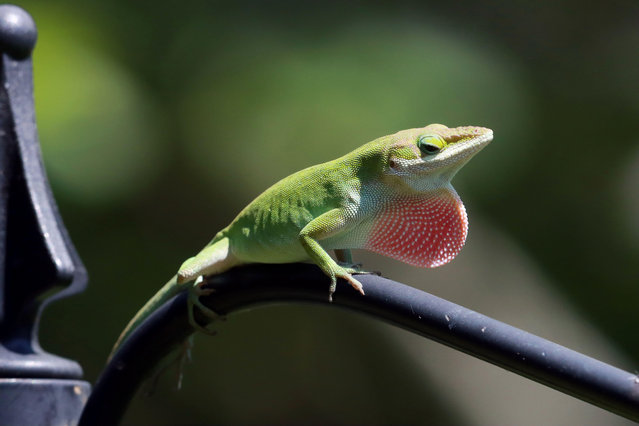
A male green anole lizard flares his throat fan in a backyard in Cary, North Carolina on April 27, 2021. This pink section is actually a thin flap of skin that hangs down below the green anole's throat. Anoles are renowned for their displays in which they do pushups, bob their heads up and down, and unfurl their colorful dewlaps. The male anole uses it for two primary purposes: to protect his territory and attract a mate. (Photo by Bob Karp/ZUMA Press Wire/Alamy Live News)

A male green anole lizard flares his throat fan in a backyard in Cary, North Carolina on April 27, 2021. This pink section is actually a thin flap of skin that hangs down below the green anole's throat. Anoles are renowned for their displays in which they do pushups, bob their heads up and down, and unfurl their colorful dewlaps. The male anole uses it for two primary purposes: to protect his territory and attract a mate. (Photo by Bob Karp/ZUMA Press Wire/Alamy Live News)
Details
15 May 2022 05:18:00
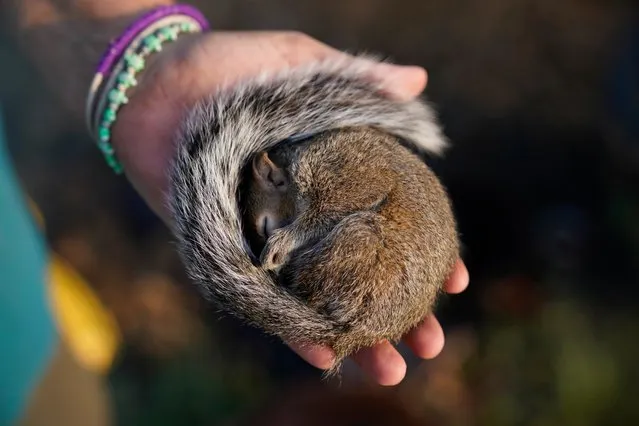
Penny Verdin displays a sleeping squirrel she helped rescue after it was injured during Hurricane Ida, Saturday, September 4, 2021, in Dulac, La. (Photo by John Locher/AP Photo)

Penny Verdin displays a sleeping squirrel she helped rescue after it was injured during Hurricane Ida, Saturday, September 4, 2021, in Dulac, La. (Photo by John Locher/AP Photo)
Details
19 Sep 2021 05:16:00
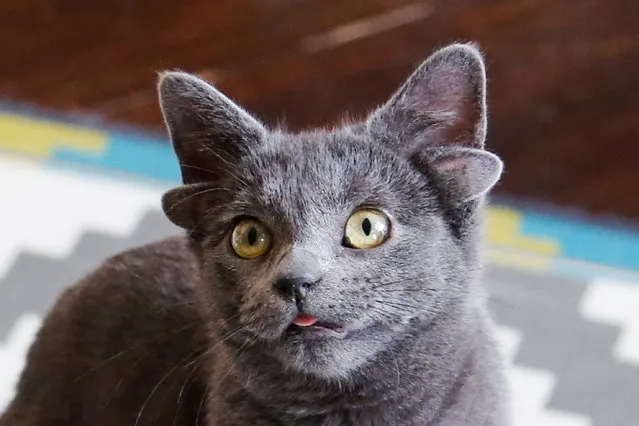
Midas, a four-month-old kitten born with four ears, is pictured at her home in Ankara, Turkey on November 19, 2021. (Photo by Cagla Gurdogan/Reuters)

Midas, a four-month-old kitten born with four ears, is pictured at her home in Ankara, Turkey on November 19, 2021. (Photo by Cagla Gurdogan/Reuters)
Details
12 Dec 2021 05:34:00
A schoolgirl collects rubbish from Karachi's Clifton beach early morning April 22, 2013, during a cleaning campaign as part of the commemoration of Earth Day. (Photo by Akhtar Soomro/Reuters)

A schoolgirl collects rubbish from Karachi's Clifton beach early morning April 22, 2013, during a cleaning campaign as part of the commemoration of Earth Day. (Photo by Akhtar Soomro/Reuters)
Details
23 Apr 2013 07:24:00
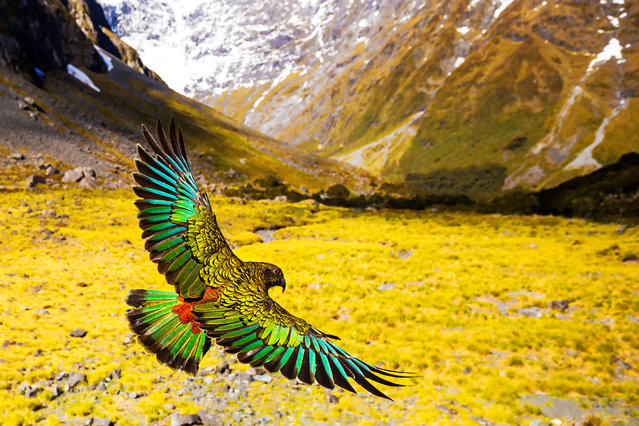
Kea are the only true alpine parrots in the world and thrive as cunning opportunists in the freezing conditions of the Southern Alps. Kea are thought to have developed their wide array of food-finding strategies during the last great ice age, where they learned to adapt using their unusual powers of curiosity. (Photo by Tom Walker/BBC Pictures/The Guardian)

Kea are the only true alpine parrots in the world and thrive as cunning opportunists in the freezing conditions of the Southern Alps. Kea are thought to have developed their wide array of food-finding strategies during the last great ice age, where they learned to adapt using their unusual powers of curiosity. (Photo by Tom Walker/BBC Pictures/The Guardian)
Details
19 Jul 2016 13:03:00