Loading...
Done
Ireland's Philip Mulpeter, left, is kicked by Brazilian Vitor Nobrega during their welterweight mixed martial arts bout of International Pro Combat at the Estoril Casino in Estoril, near Lisbon, Portugal, Monday, January 26, 2015. Nobrega defeated Mulpeter. (Photo by Francisco Seco/AP Photo)

Ireland's Philip Mulpeter, left, is kicked by Brazilian Vitor Nobrega during their welterweight mixed martial arts bout of International Pro Combat at the Estoril Casino in Estoril, near Lisbon, Portugal, Monday, January 26, 2015. Nobrega defeated Mulpeter. (Photo by Francisco Seco/AP Photo)
Details
31 Jan 2015 12:42:00
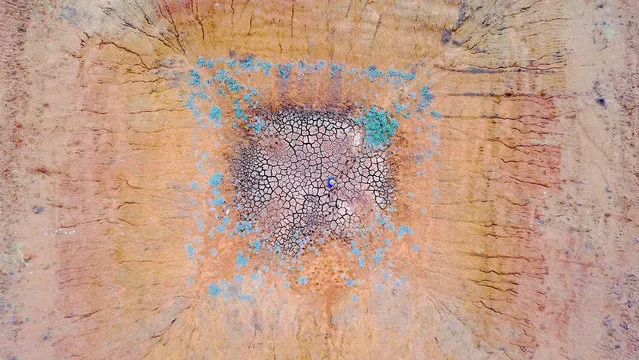
Farmer Ash Whitney stands in the middle of a dried-up dam in a drought-effected paddock on his property located west of the town of Gunnedah in New South Wales, Australia, June 3, 2018. “I have been here all my life, and this drought is feeling like it will be around a while”, said Whitney. (Photo by David Gray/Reuters)

Farmer Ash Whitney stands in the middle of a dried-up dam in a drought-effected paddock on his property located west of the town of Gunnedah in New South Wales, Australia, June 3, 2018. “I have been here all my life, and this drought is feeling like it will be around a while”, said Whitney. (Photo by David Gray/Reuters)
Details
07 Aug 2018 00:05:00
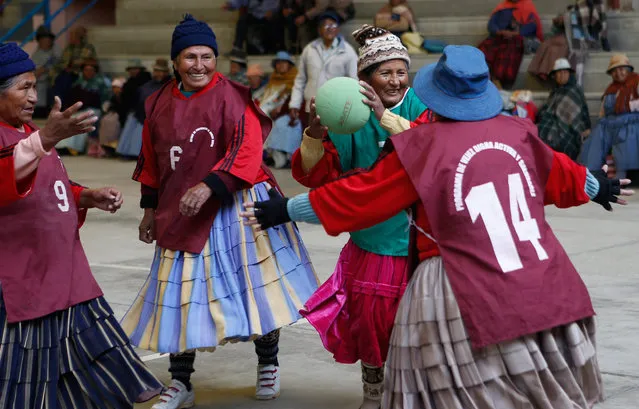
In this February 11, 2105 photo, 72-year-old Aurea Murillo prepares to make a pass during a handball match among elderly Aymara indigenous women in El Alto, Bolivia. Dozens of traditional Aymara grandmothers ease many of the aches and pains of aging by practicing a sport that is decidedly untraditional in Bolivia: team handball. (Photo by Juan Karita/AP Photo)

In this February 11, 2105 photo, 72-year-old Aurea Murillo prepares to make a pass during a handball match among elderly Aymara indigenous women in El Alto, Bolivia. Dozens of traditional Aymara grandmothers ease many of the aches and pains of aging by practicing a sport that is decidedly untraditional in Bolivia: team handball. (Photo by Juan Karita/AP Photo)
Details
27 Feb 2015 19:34:00
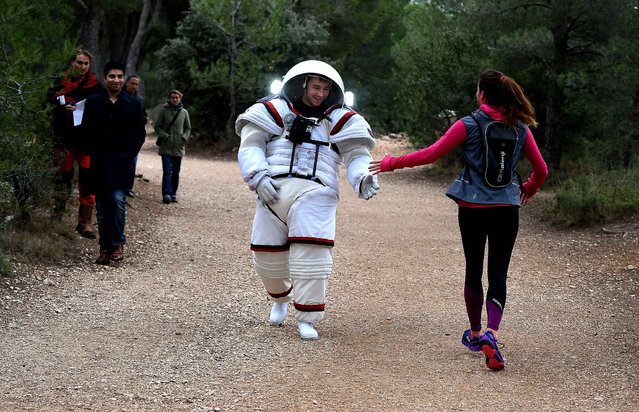
Aeronautics and Space engineer at France's Compagnie Maritime d'Expertises, or Comex, Arnaud Prost (C) meets with a jogger as he tests on the ground the “Gandolfi 2” underwater training suit for spacewalk, on January 20, 2016 in the calanques region (rocky inlets) of Marseille. The underwater training suit “Gandolfi 2”, developed with the European Space Agency (ESA), is designed for training astronauts underwater to simulate space gravity for the astronaut's extravehicular activities (EVAs). (Photo by Boris Horvat/AFP Photo)

Aeronautics and Space engineer at France's Compagnie Maritime d'Expertises, or Comex, Arnaud Prost (C) meets with a jogger as he tests on the ground the “Gandolfi 2” underwater training suit for spacewalk, on January 20, 2016 in the calanques region (rocky inlets) of Marseille. The underwater training suit “Gandolfi 2”, developed with the European Space Agency (ESA), is designed for training astronauts underwater to simulate space gravity for the astronaut's extravehicular activities (EVAs). (Photo by Boris Horvat/AFP Photo)
Details
23 Jan 2016 13:41:00
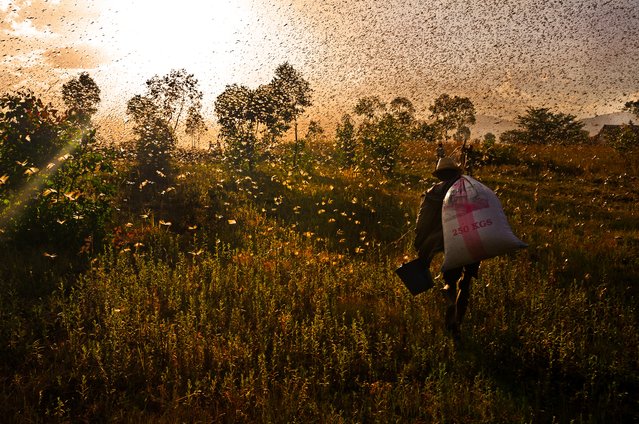
“Locusts & Men”. Oppression, interaction, collaboration. In the life cycle of nature nothing is lost, but the coexistence of different species is sometimes difficult. In Madagascar periodically returns the archaic antagonism between man and the migratory locust, in a circle of life where the two species are looking for space and food for their survival. Photo location: Madagascar, 2013. (Photo and caption by Michele Martinelli/National Geographic Photo Contest)

“Locusts & Men”. Oppression, interaction, collaboration. In the life cycle of nature nothing is lost, but the coexistence of different species is sometimes difficult. In Madagascar periodically returns the archaic antagonism between man and the migratory locust, in a circle of life where the two species are looking for space and food for their survival. At the end of the day a man walks home carrying on his shoulders the heavy bag which contains the locusts captured during the day. The insects provide nutritious meals for the man and his family. Photo location: Madagascar, 2013. (Photo and caption by Michele Martinelli/National Geographic Photo Contest)

ATTENTION! All pictures are presented in high resolution. To see Hi-Res images – just TWICE click on any picture. In other words, click small picture – opens the BIG picture. Click BIG picture – opens VERY BIG picture.
Details
03 Dec 2013 10:59:00
“Cub”. In the colony of penguins in South Georgia. (Photo and caption by Ondrej Zaruba/National Geographic Traveler Photo Contest)

“Cub”. In the colony of penguins in South Georgia. (Photo and caption by Ondrej Zaruba/National Geographic Traveler Photo Contest)

ATTENTION! All pictures are presented in high resolution. To see Hi-Res images – just TWICE click on any picture. In other words, click small picture – opens the BIG picture. Click BIG picture – opens VERY BIG picture.
Details
28 Jun 2013 12:32:00
“Red Land: Sunset Cloud Village is one of the most picturesque places in Red Land, China. As its name indicates, it's best to see before sunset. The reddish brown soil turns redder after rainfall and after farmers plow the land”. (Photo and comment by Peng Jiang/National Geographic Photo Contest via The Atlantic)

“Red Land: Sunset Cloud Village is one of the most picturesque places in Red Land, China. As its name indicates, it's best to see before sunset. The reddish brown soil turns redder after rainfall and after farmers plow the land”. (Photo and comment by Peng Jiang/National Geographic Photo Contest via The Atlantic)


Details
05 Dec 2012 11:07:00
“So you're on a boat in Bahamas and then this pig swims by begging for food”. (Photo and caption by Lisa Larsen/Public Domain)

The Bahamas, the Commonwealth nation of hundreds of islands roughly the size of Connecticut and with population of just a bit over Anaheim, is known for its crystal waters and pristine beaches. This is possibly one of the world’s most beautiful havens of nature, yet people are coming here to see pigs. It is unclear when the pigs first appeared on Exuma Island or where they come from. There’s talk about a daring escape from a shipwreck, or sailors releasing the swine on purpose. In all probability, there were no pigs on this tropical paradise before European settlers came, so their mere presence is the work of human. The intriguing feat of nature, however, is that this population of pigs developed a fine aptitude for swimming. Here: “So you're on a boat in Bahamas and then this pig swims by begging for food”. (Photo and caption by Lisa Larsen/Public Domain)
Details
03 Sep 2015 11:53:00