Loading...
Done
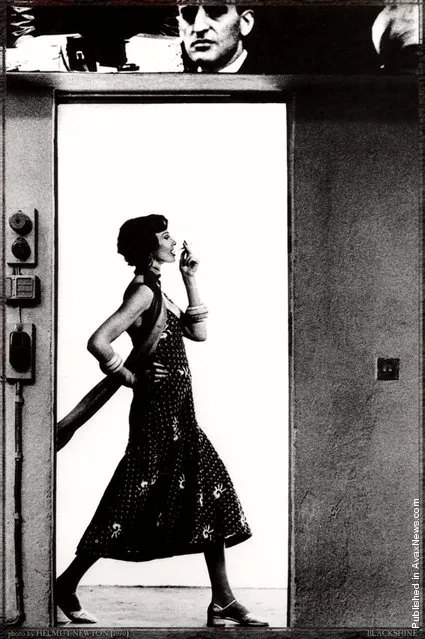
Photographers: Helmut Newton

“Newton was born in Berlin, the son of Klara “Claire” (Marquis) and Max Neustädter, a button factory owner. His family was Jewish. Newton attended the Heinrich-von-Treitschke-Realgymnasium and the American School in Berlin. Interested in photography from the age of 12 when he purchased his first camera, he worked for the German photographer Yva (Elsie Neulander Simon) from 1936. The increasingly oppressive restrictions placed on Jews by the Nuremberg laws meant that his father lost control of the factory in which he manufactured buttons and buckles; he was briefly interned in a concentration camp on “Kristallnacht”, November 9, 1938, which finally compelled the family to leave Germany. Newton's parents fled to South America. He was issued with a passport just after turning 18, and left Germany on December 5, 1938. At Trieste he boarded the “Conte Rosso” (along with about 200 others escaping the Nazis) intending to journey to China. After arriving in Singapore he found he was able to remain there, first and briefly as a photographer for the Straits Times and then as a portrait photographer”. – Wikipedia

Photo: Sigourney Weaver by Helmut Newton, 1995.
Details
08 Apr 2012 13:49:00
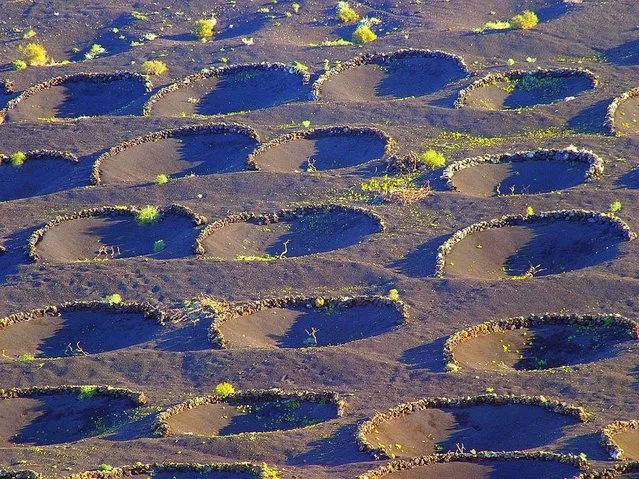
Grapes Born of Volcano In Lanzarote, Spanish

The valley of La Geria, which has been declared a 'Protected Area', is Lanzarote’s main wine-growing region, occupying about 20 square miles (52 square kilometres) and stretching on both sides of the road from Masdache to Uga and right up to the volcanic slopes. This area produces most of Lanzarote’s excellent wines, of which 75 per cent are made from the Malvasía grape, one of the oldest known grape varieties. Best known as a honey-coloured, very sweet wine with a rich flavour, already praised by Shakespeare hundreds of years ago, today the Malvasía grape produces a wide variety of quality white, red or rosé wines, from very sweet to very dry.
Details
31 Oct 2013 09:10:00
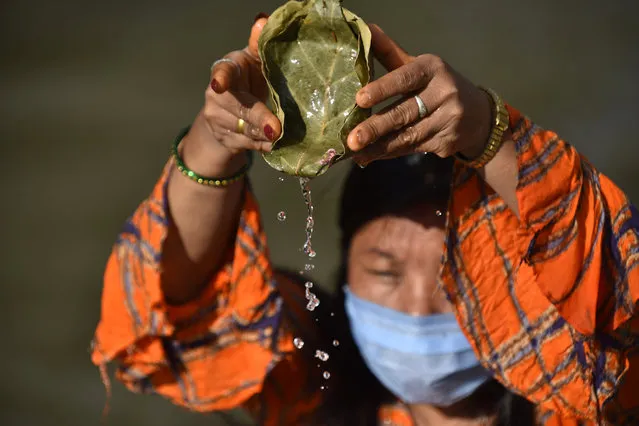
A Nepalese devotee offers ritual prayer at the Bank of Bagmati River of Pashupatinath Temple during Rishi Panchami Festival celebrations at Kathmandu, Nepal on Sunday, August 23, 2020. Rishi Panchami festival is  celebrated as the last day of three-day long Teej Festival. The Teej festival is celebrated by Hindu women in Nepal as well as in some parts of India. During the three-day long festival, women observe a day-long fast and pray for the long life of their husbands as well as for a happy family. Those who are unmarried pray for a good husband and a long life. Due to prohibitory order lockdown in Kathmandu valley for a week-long, as rapid increase in the number of COVID-19 cases. (Photo by Narayan Maharjan/NurPhoto via Getty Images)

A Nepalese devotee offers ritual prayer at the Bank of Bagmati River of Pashupatinath Temple during Rishi Panchami Festival celebrations at Kathmandu, Nepal on Sunday, August 23, 2020. Rishi Panchami festival is celebrated as the last day of three-day long Teej Festival. The Teej festival is celebrated by Hindu women in Nepal as well as in some parts of India. (Photo by Narayan Maharjan/NurPhoto via Getty Images)
Details
20 Sep 2020 00:01:00
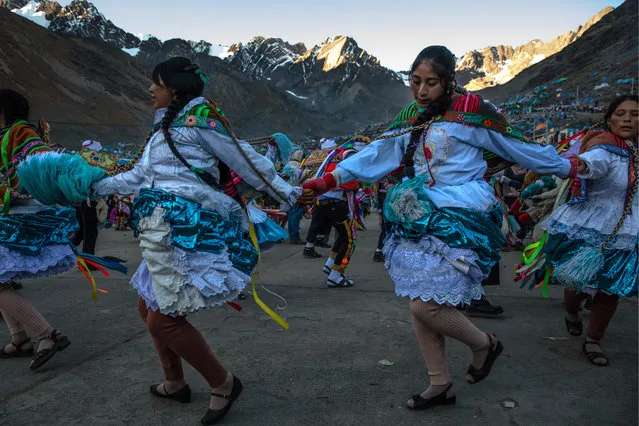
Costumed dancers parade on the first day of the annual Qoyllur Rit'i festival on May 27, 2018 in Ocongate, Peru. (Photo by Dan Kitwood/Getty Images)

Costumed dancers parade on the first day of the annual Qoyllur Rit'i festival on May 27, 2018 in Ocongate, Peru. Every year, since 1783 in the Sinakara Valley at the foot of Mt Ausagante, the Qoyllur Rit'i, or “Snow and Star” festival draws tens of thousands of pilgrims from across the Peruvian Andes and beyond to what is the biggest religious gathering of its kind. Since 1780 the event merged into a mosaic of indigenous, pagan and Catholic worship when an image of Jesus appeared on a boulder after the death of a young shepherd. (Photo by Dan Kitwood/Getty Images)
Details
05 Jun 2018 00:01:00
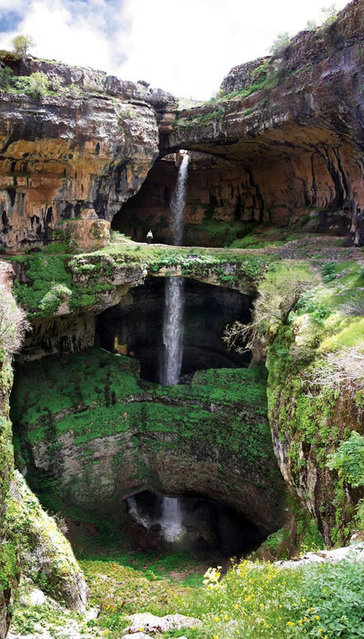
Baatara Gorge Waterfall

Discovered in 1952 by French bio-speleologist Henri Coiffait, the waterfall and accompanying sinkhole were fully mapped in the 1980s by the Spéléo club du Liban. The cave is also known as the "Cave of the Three Bridges." Traveling from Laklouk to Tannourine one passes the village of Balaa, and the "Three Bridges Chasm" (in French "Gouffre des Trois Ponts") is a five-minute journey into the valley below where one sees three natural bridges, rising one above the other and overhanging a chasm descending into Mount Lebanon. During the spring melt, a 90–100-metre (300–330 ft) cascade falls behind the three bridges and then down into the 250-metre (820 ft) chasm. A 1988 fluorescent dye test demonstrated that the water emerged at the spring of Dalleh in Mgharet al-Ghaouaghir.
Details
31 Aug 2013 11:27:00
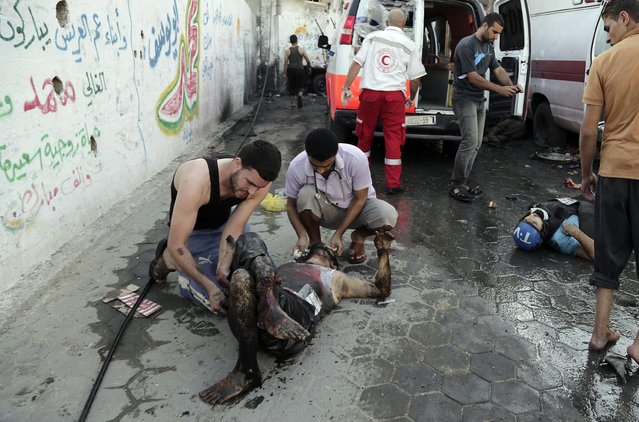
In this July 30, 2014 photo, neighbors help gravely injured Mohammed al-Selek, 39, wounded by an Israeli mortar strike as he lays next to the body of Palestinian journalist Rami Reyan who was killed, in the Shijaiyah neighborhood of the northern Gaza Strip. Al-Selek's life changed forever last July 30, when the shells slammed into his home killing all his three children, his father and six other relatives. (Photo by Adel Hana/AP Photo)

In this July 30, 2014 photo, neighbors help gravely injured Mohammed al-Selek, 39, wounded by an Israeli mortar strike as he lays next to the body of Palestinian journalist Rami Reyan who was killed, in the Shijaiyah neighborhood of the northern Gaza Strip. Al-Selek's life changed forever last July 30, when the shells slammed into his home killing all his three children, his father and six other relatives. A year later, al-Selek, who lost his leg during the airstrike, still struggles to recover and come to terms with his family's loss in the 50-day Israel-Hamas war. (Photo by Adel Hana/AP Photo)
Details
07 Jul 2015 11:28:00


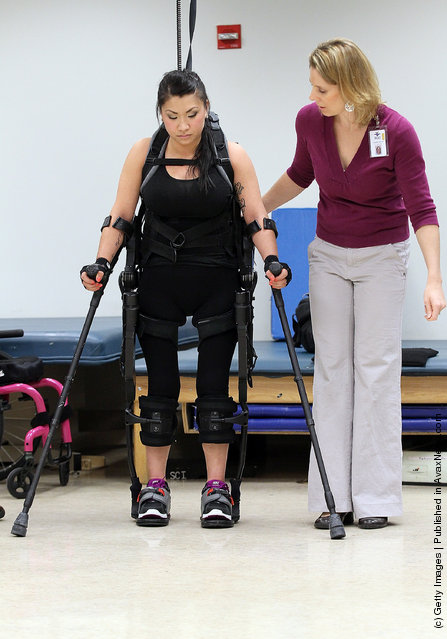
“eLEGS is a wearable, artificially intelligent, bionic device that enables people with paralysis to stand up and walk again. The exoskeleton is battery-powered and rechargeable, fitting comfortably and securely over clothing. Initially, eLEGS will be used under medical supervision for rehabilitation and training”. – BerkeleyBionics.com

Photo: Paralysis victim Stephanie Sablan (L) is helped by physical therapist Shonna Moran as she walks using eLEGS robotic legs at Santa Clara Valley Medical Center on May 25, 2011 in San Jose, California. Sablan, 24, was paralyzed from the waist down earlier this year when she was in a car accident and has begun using the newly developed eLEGS made by Berkeley Bionics. The robot-like battery powered eLEGS fit over clothing and enables people with paralysis to stand up and walk again. (Photo by Justin Sullivan/Getty Images)
Details
26 May 2011 09:56:00
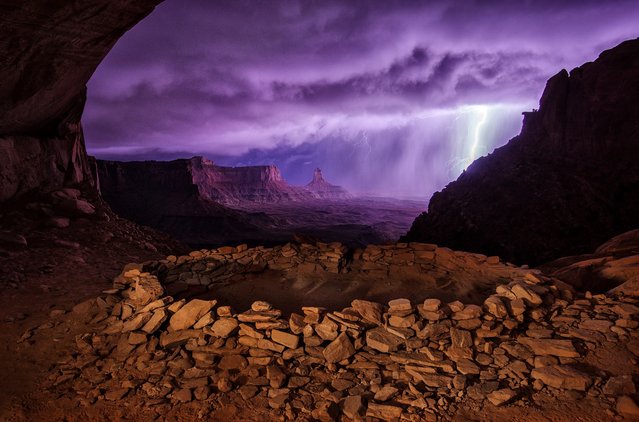
Second Place Winner: “Thunderstorm at False Kiva”. I hiked out to these ruins at night hoping to photograph them with the Milky Way, but instead a thunderstorm rolled through, creating this dramatic image. – Max Seigal. (Photo and caption by Max Seigal/National Geographic Traveler Photo Contest)

Second Place Winner: “Thunderstorm at False Kiva”. I hiked out to these ruins at night hoping to photograph them with the Milky Way, but instead a thunderstorm rolled through, creating this dramatic image. – Max Seigal. National Geographic Traveler Director of Photography Dan Westergren, one of this year's judges, shares his thoughts on the second place winner: “This photo combines two different scenes into one: the small kiva in a cliff dwelling and the grand vista of Canyonlands National Park across the valley. I really like the two different color palettes – warm inside and purple outside. This two-for-one scene was caused by the lightning storm outside the dwelling, which lit up the landscape like it was a huge electronic flash. Looking at this picture I can imagine what a wonderful sight it must have been for the ancient people who lived here. It doesn't seem too amazing now in our modern world, but might have been mind-blowing for the prehistoric residents”. Location: Utah. (Photo and caption by Max Seigal/National Geographic Traveler Photo Contest)
Details
02 Aug 2013 06:16:00