Loading...
Done
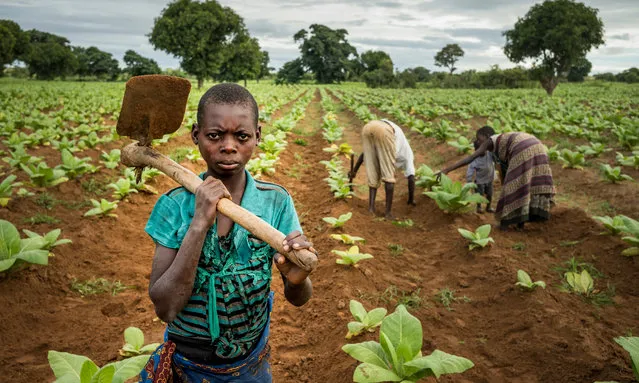
Tiyamike Phiri hopes to become a nurse because she wants to travel the country and help others. (Photo by David Levene/The Guardian)

Life as tenant farmers in Kasungu, northern Malawi, can be a struggle for families trapped in poverty, who feel forced to rely on their children’s help, impacting schooling. Here: A tobacco field at a farm in Kasungu region, Malawi. Tobacco is the country’s most important export crop, with tobacco leaf from Malawi filling cigarettes found all over the world. Here: Tiyamike Phiri hopes to become a nurse because she wants to travel the country and help others. (Photo by David Levene/The Guardian)
Details
27 Jun 2018 00:05:00
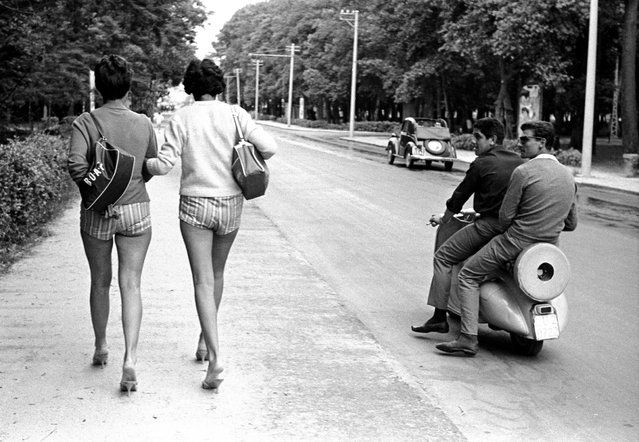
Viareggio in 1959. (Photo by Paolo Di Paolo/National Museum of 21st Century Arts)

The “Paolo Di Paolo: Lost World” exhibition presents more than 250 largely unseen images from the photographer’s archive. Di Paolo chronicled life in his country as an economic boom followed the destruction of the second world war. Although those were the years of la dolce vita he was an anti-paparazzo – he shunned the salacious and respected his subjects. The exhibition is at MAXXI, the National Museum of 21st Century Arts in Rome until 30 June. Here: Viareggio in 1959. (Photo by Paolo Di Paolo/National Museum of 21st Century Arts)
Details
01 May 2019 00:03:00
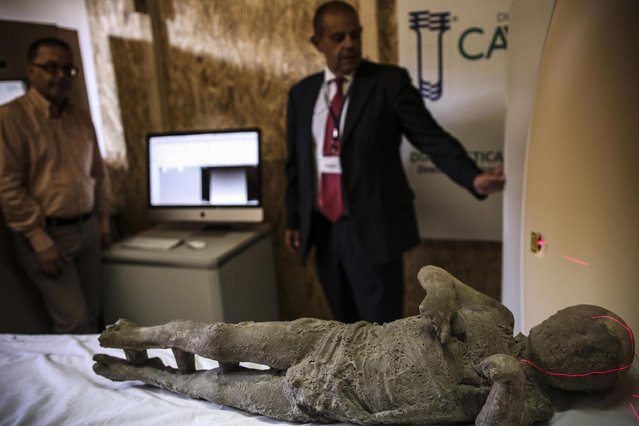
A working team appointed by the Archaeological Superintendence of Pompeii performs a Cat scan (Computerized axial tomography) one out of thirty casts of victims of the eruption of Vesuvius in 79 AD in Pompeii, in Napoli, Italy, 29 September 2015. (Photo by Cesare Abbate/EPA)

A working team appointed by the Archaeological Superintendence of Pompeii performs a Cat scan (Computerized axial tomography) one out of thirty casts of victims of the eruption of Vesuvius in 79 AD in Pompeii, in Napoli, Italy, 29 September 2015. The project which aims to trace the habits of life, employment and social class of the victims, involves a working team of archeologists, anthropologists, radiologists, dentists and engineers to obtain results from the scan. (Photo by Cesare Abbate/EPA)
Details
02 Oct 2015 08:04:00
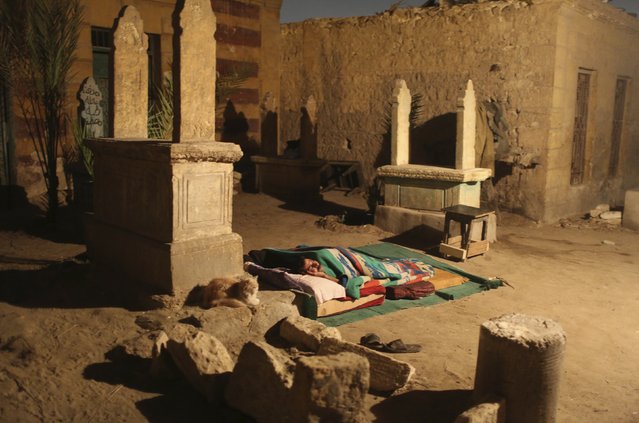
A man sleeps between tombstones in front of his single-room home on a hot night in the Cairo Necropolis, Egypt, October 13, 2015. (Photo by Asmaa Waguih/Reuters)

A man sleeps between tombstones in front of his single-room home on a hot night in the Cairo Necropolis, Egypt, October 13, 2015. In the sprawling Cairo Necropolis, known as the City of the Dead, life and death are side by side. Amid a housing crisis in Egypt, and with the population of greater Cairo estimated at about 20 million, people count themselves lucky to have a place to call home in the graveyards that date back hundreds of years. (Photo by Asmaa Waguih/Reuters)
Details
01 Jan 2016 08:04:00
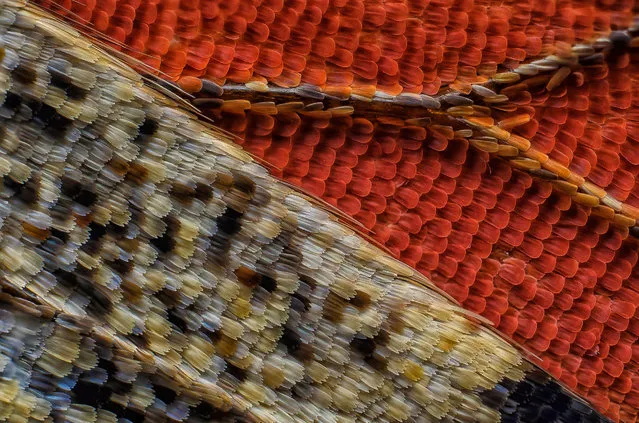
11th Place: Scales of a butterfly wing underside (Vanessa atalanta). (Photo by Francis Sneyers/Nikon's Small World 2016)

Each year Nikon Small World recognizes the excellence of photography taken under the microscope. The contest showcases the beauty and complexity of life. Anyone interested in microscopy and photography can enter the contest and in its 42nd year, Nikon Small World received 2,000 entries from 70 countries. Here: 11th Place; Scales of a butterfly wing underside (Vanessa atalanta). (Photo by Francis Sneyers/Nikon's Small World 2016)
Details
20 Oct 2016 11:19:00
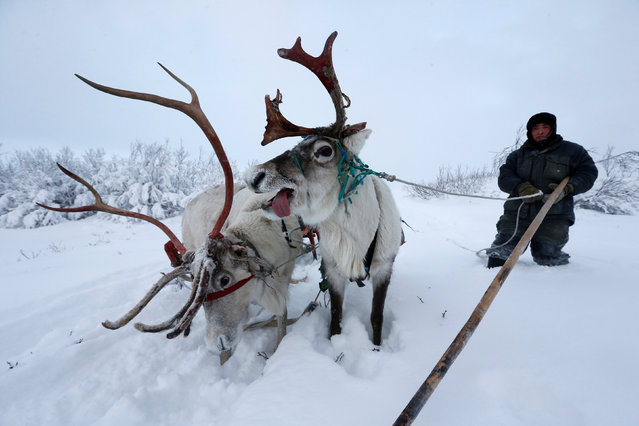
A herder stops for reindeers to have a rest while riding along the tundra area in Nenets Autonomous District, Russia, November 27, 2016. (Photo by Sergei Karpukhin/Reuters)

A herder stops for reindeers to have a rest while riding along the tundra area in Nenets Autonomous District, Russia, November 27, 2016. In Russia's remote Arctic regions reindeer herding has been a way of life for centuries. Each winter herders in Russia's sparsely populated Nenets Autonomous District corral their reindeers into open-air pens before selecting weak animals to be culled... (Photo by Sergei Karpukhin/Reuters)
Details
16 Dec 2016 10:41:00
Galapagos – Rocking the Cradle: Four major ocean currents converge along the Galapagos archipelago, creating the conditions for an extraordinary diversity of animal life, April 25, 2016. The islands are home to at least 7,000 flora and fauna species, of which 97 percent of the reptiles, 80 percent of the land birds, 50 percent of the insects and 30 percent of the plants are endemic. The local ecosystem is highly sensitive to the changes in temperature, rainfall and ocean currents that characterize the climatic events known as El Niño and La Niña. These changes cause marked fluctuations in weather and food availability. Many scientists expect the frequency of El Niño and La Niña to increase as a result of climate change, making the Galapagos a possible early-warning location for its effects. (Photo by Thomas P. Peschak for National Geographic/World Press Photo)

Galapagos – Rocking the Cradle: Four major ocean currents converge along the Galapagos archipelago, creating the conditions for an extraordinary diversity of animal life, April 25, 2016. The islands are home to at least 7,000 flora and fauna species, of which 97 percent of the reptiles, 80 percent of the land birds, 50 percent of the insects and 30 percent of the plants are endemic. (Photo by Thomas P. Peschak for National Geographic/World Press Photo)
Details
16 Apr 2018 00:01:00
A handout photo made available by the NASA shows the United Launch Alliance Delta IV Heavy rocket launches NASA's Parker Solar Probe to touch the Sun, from Launch Complex 37 at Cape Canaveral Air Force Station, Florida, USA, 12 August 2018. Parker Solar Probe is humanity’s first-ever mission into a part of the Sun’s atmosphere called the corona. Here it will directly explore solar processes that are key to understanding and forecasting space weather events that can impact life on Earth. (Photo by Bill Ingalls/EPA-EFE/NASA)

A handout photo made available by the NASA shows the United Launch Alliance Delta IV Heavy rocket launches NASA's Parker Solar Probe to touch the Sun, from Launch Complex 37 at Cape Canaveral Air Force Station, Florida, USA, 12 August 2018. Parker Solar Probe is humanity’s first-ever mission into a part of the Sun’s atmosphere called the corona. Here it will directly explore solar processes that are key to understanding and forecasting space weather events that can impact life on Earth. (Photo by Bill Ingalls/EPA-EFE/NASA)
Details
13 Aug 2018 07:26:00