Loading...
Done
The Lun-class Ekranoplane was used by the Soviet Navy starting in 1987, and wasn't retired until the late 1990s, after the Soviet Union's fall. (Igor113)

“The Lun-class ekranoplan (NATO reporting name Duck) was a ground effect vehicle (GEV) designed by Rostislav Evgenievich Alexeev and used by the Soviet and Russian navies from 1987 until sometime in the late 1990s. It “flew” using the lift generated by the ground effect of its large wings when close to the surface of the water – about four metres or less. Although they might look similar and/or have related technical characteristics, ekranoplans like the Lun are not aircraft, seaplanes, hovercraft, or hydrofoils – ground effect is a separate technology altogether. The International Maritime Organization classifies these vehicles as maritime ships. The name Lun comes from the Russian for harrier”. – Wikipedia (Photo by Igor113)
Details
08 Aug 2014 10:51:00
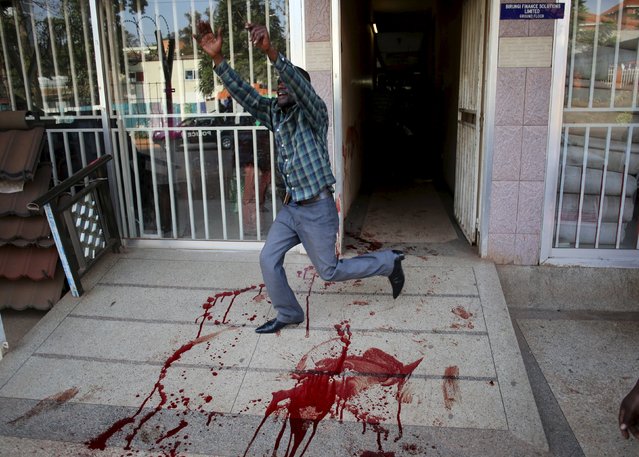
A protester gestures after he saw a dead protester in Kampala, Uganda February 15, 2016. (Photo by Goran Tomasevic/Reuters)

A protester gestures after he saw a dead protester in Kampala, Uganda February 15, 2016. At least one person has been killed in Uganda's capital Kampala as police clashed with opposition supporters after briefly detaining a top presidential candidate twice as he tried to hold campaign rallies days before a general election. Several people were wounded in the clashes as police fired bullets and tear gas while opposition supporters hurled rocks and erected street barricades in the capital's Wandegeya suburb, witnesses said according to a Reuters news agency report. (Photo by Goran Tomasevic/Reuters)
Details
16 Feb 2016 13:17:00
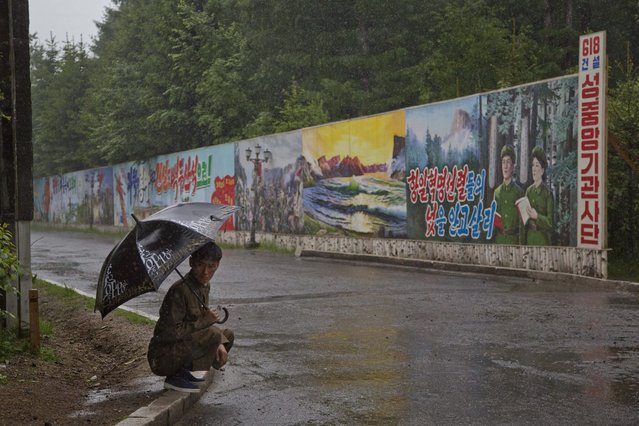
In this June 17, 2014 photo, a North Korean man takes shelter in the rain next to long propaganda billboards in the town of Samjiyon in North Korea's Ryanggang province. (Photo by David Guttenfelder/AP Photo)

In this June 17, 2014 photo, a North Korean man takes shelter in the rain next to long propaganda billboards in the town of Samjiyon in North Korea's Ryanggang province. The Associated Press was granted to embark on a weeklong road trip across North Korea to the country’s spiritual summit Mount Paektu. The trip was on North Korea's terms. An AP reporter and photographer couldn't interview ordinary people or wander off course, and government “minders” accompanied them the entire way. (Photo by David Guttenfelder/AP Photo)
Details
23 Oct 2014 11:51:00
Bride Fan Huixiang (front R), a 25-year-old cancer patient, receives flowers from nurses on her bed before her wedding ceremony at a hospital in Zhengzhou, Henan province November 17, 2014. Fan was diagnosed with late stage adenocarcinoma, a type of cancerous tumor, at her thoracic vertebra this June. (Photo by Reuters/China Daily)

Bride Fan Huixiang (front R), a 25-year-old cancer patient, receives flowers from nurses on her bed before her wedding ceremony at a hospital in Zhengzhou, Henan province November 17, 2014. Fan was diagnosed with late stage adenocarcinoma, a type of cancerous tumor, at her thoracic vertebra this June. She and her 24-year-old husband Yu Haining held their wedding ceremony at the hospital on Monday after five years of relationship, local media reported. (Photo by Reuters/China Daily)
Details
19 Nov 2014 14:15:00
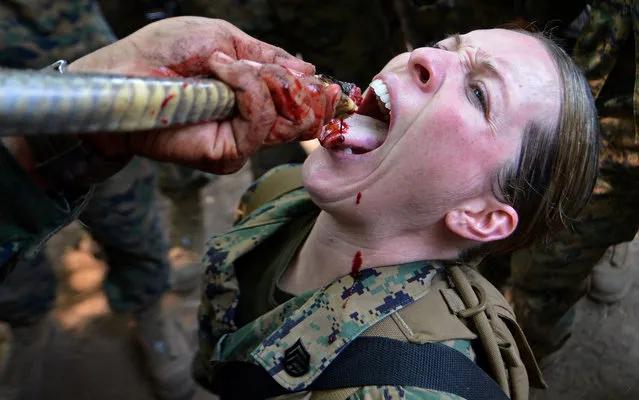
In a military base in the Thai province of Chon Buri February 20 U.S. Marines Navy with Thailand began their studies in jungle survival. The event is held in joint military exercises “Cobra Gold 2013”. During a jungle survival program February 20, 2013 taught by Royal Thai Special Forces in Sannapit, Thailand, U.S. Marines learned to catch cobras and drink their fresh blood, not to mention eat forest insects and pull the heads off of chicken. The training was part of Operation Cobra Gold 13, the 32nd edition of international military exercises hosted by the Thai. According to a U.S. Marines press release, Cobra Gold is the largest exercise of its kind in Asia and incorporates troops from five other nations in addition to the U.S. and Thailand. The Daily Mail reports that the Marines were invited to experience the local custom of drinking cobra blood after being taught to catch and kill cobras in the wild. As CNN notes, Cobra blood is believed to be a panacea and aphrodiasic in parts of Southeast Asia. In Jakarta, vendors can earn over $100 a night selling shots of cobra blood mixed with liquor. (Photo by Pornchai Kittiwongsakul/AFP Photo)

During a jungle survival program February 20, 2013 taught by Royal Thai Special Forces in Sannapit, Thailand, U.S. Marines learned to catch cobras and drink their fresh blood, not to mention eat forest insects and pull the heads off of chicken. The training was part of Operation Cobra Gold 13, the 32nd edition of international military exercises hosted by the Thai. According to a U.S. Marines press release, Cobra Gold is the largest exercise of its kind in Asia and incorporates troops from five other nations in addition to the U.S. and Thailand. The Daily Mail reports that the Marines were invited to experience the local custom of drinking cobra blood after being taught to catch and kill cobras in the wild. As CNN notes, Cobra blood is believed to be a panacea and aphrodiasic in parts of Southeast Asia. In Jakarta, vendors can earn over $100 a night selling shots of cobra blood mixed with liquor. (Photo by Pornchai Kittiwongsakul/AFP Photo)
Details
23 Feb 2013 11:52:00
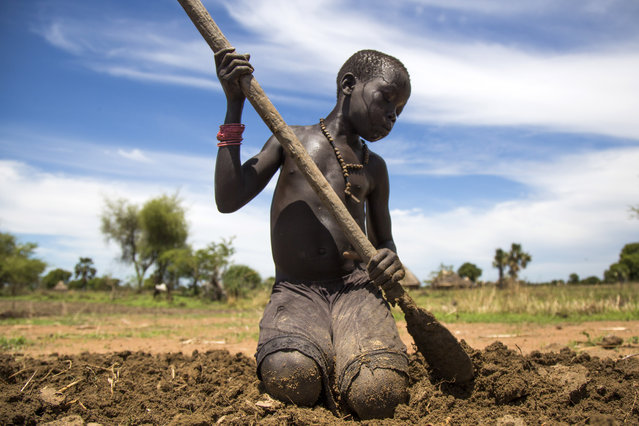
Nyibol Lual, 13 years old, helps her family to prepare the land for cultivation on May 31, 2017, in Panthau, Northern Bahr al Ghazal, South Sudan. The family has a small land where they cultivate sorghum. An estimated 63 per cent of the population in Northern Bahr al Ghazal is experiencing severe food insecurity, according to the latest Integrated Food Security Phase Classification (IPC) report. The situation is particularly bad in Aweil West and Aweil South counties, where the exhaustion of household food stocks and growing dependence on financially inaccessible markets have left the population facing Emergency levels of food insecurity. (Photo by Albert Gonzalez Farran/AFP Photo)

Nyibol Lual, 13 years old, helps her family to prepare the land for cultivation on May 31, 2017, in Panthau, Northern Bahr al Ghazal, South Sudan. The family has a small land where they cultivate sorghum. An estimated 63 per cent of the population in Northern Bahr al Ghazal is experiencing severe food insecurity, according to the latest Integrated Food Security Phase Classification (IPC) report. The situation is particularly bad in Aweil West and Aweil South counties, where the exhaustion of household food stocks and growing dependence on financially inaccessible markets have left the population facing Emergency levels of food insecurity. (Photo by Albert Gonzalez Farran/AFP Photo)
Details
01 Jun 2017 10:10:00
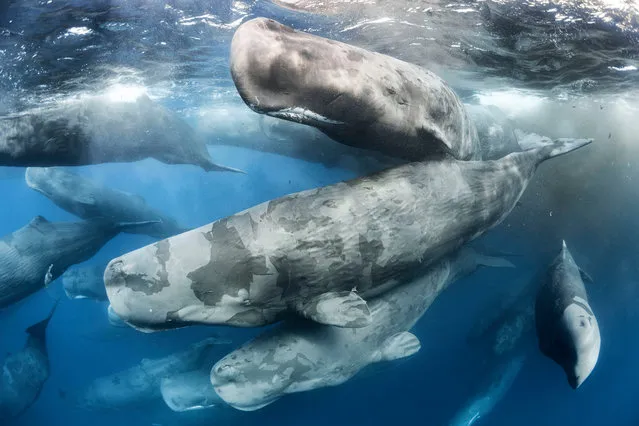
Behaviour: Mammals category. Giant Gathering by Tony Wu, USA. Dozens of sperm whales mingled noisily off Sri Lanka’s northeast coast, stacked as far down as Tony could see. This was a congregation of dozens of social units, like a gathering of the clans. Aggregations like this could be a critical part of the whales’ rich social lives but are rarely reported. Some two thirds of the population was wiped out before commercial whaling was banned in 1986. This kind of major gathering could be “a sign that populations are recovering”, says Tony. (Photo by Tony Wu/Wildlife Photographer of the Year 2017)

Behaviour: Mammals category. Giant Gathering by Tony Wu, USA. Dozens of sperm whales mingled noisily off Sri Lanka’s northeast coast, stacked as far down as Tony could see. This was a congregation of dozens of social units, like a gathering of the clans. Aggregations like this could be a critical part of the whales’ rich social lives but are rarely reported. Some two thirds of the population was wiped out before commercial whaling was banned in 1986. This kind of major gathering could be “a sign that populations are recovering”, says Tony. (Photo by Tony Wu/Wildlife Photographer of the Year 2017)
Details
19 Oct 2017 09:38:00
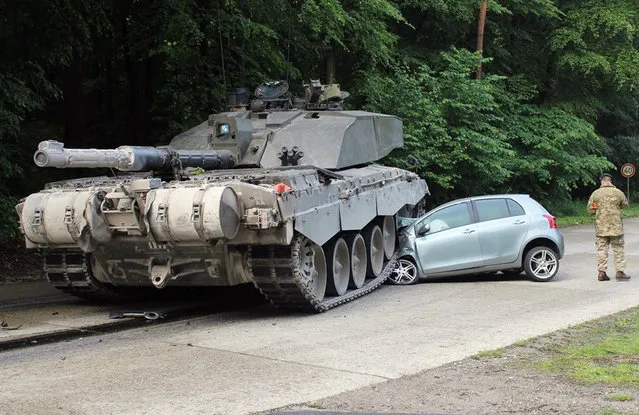
A handout photo provided by the Police department in Lippe on 01 June 2015 of a British “Challenger 2” tank after it rolled over a car's front in Lippe, Germany, 01 June 2015. Police reported that a 18-year old female driving beginner from Detmold apparently overlooked a convoy of tanks when she turned left onto the Panzeringstrasse (lit. Tank Ring Road). The driver of the convoy'e leading tank, a 24-year old British national, was not able to stop his vehicle fast enough, hit the car and overran the vehicle's front. The young female car driver remained unhurt. The exclusive damage to the car was estimated at about 12,000 euro. (Photo by EPA/Polizei Lippe)

A handout photo provided by the Police department in Lippe on 01 June 2015 of a British “Challenger 2” tank after it rolled over a car's front in Lippe, Germany, 01 June 2015. Police reported that a 18-year old female driving beginner from Detmold apparently overlooked a convoy of tanks when she turned left onto the Panzeringstrasse (lit. Tank Ring Road). (Photo by EPA/Polizei Lippe)
Details
06 Mar 2020 00:03:00