Loading...
Done
Wizard of Oz Eyes

One side is the scene when they come out of the forest to see the Emerald City. There's the field of poppies, , the yellow brick road, a rainbow and Glinda in her bubble floating above it. On the other eye is the wicked witches castle with her flying over it.
Details
16 Jul 2012 02:35:00
Sequence Photography

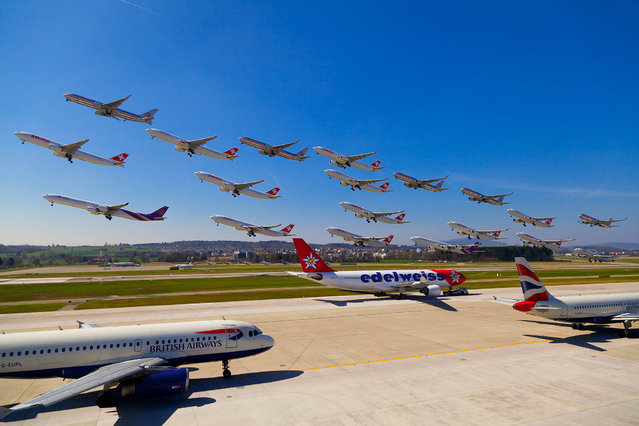
Sequence photography is a technique of shooting a series of images in where the subject is captured in successive motion. This technique conveys motion in a static image, and comes in great use for sport based photography. A merged photo sequence can radically show a different perspective much more than what can be captured in a single image, you get to experience the entire process of the action taken by the athlete.
Details
14 Jul 2012 04:44:00
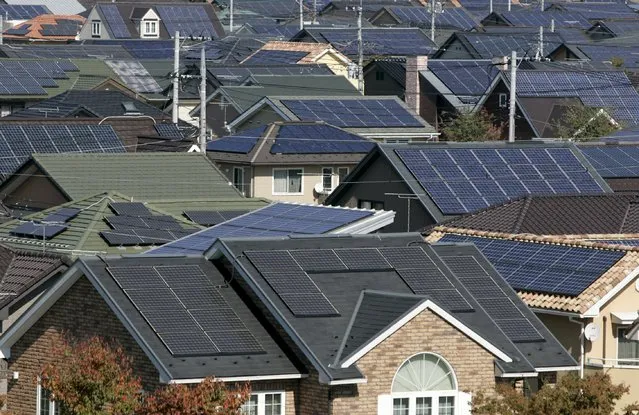
Rooftops of solar powered houses are pictured in Ota, 80 km northwest of Tokyo in this October 28, 2008 file photo. One by one, Japan is turning off the lights at the giant oil-fired power plants that propelled it to the ranks of the world's top industrialised nations. With nuclear power in the doldrums after the Fukushima disaster, it's solar energy that is becoming the alternative. (Photo by Yuriko Nakao/Reuters)

Rooftops of solar powered houses are pictured in Ota, 80 km northwest of Tokyo in this October 28, 2008 file photo. One by one, Japan is turning off the lights at the giant oil-fired power plants that propelled it to the ranks of the world's top industrialised nations. With nuclear power in the doldrums after the Fukushima disaster, it's solar energy that is becoming the alternative. Solar power is set to become profitable in Japan as early as this quarter, according to the Japan Renewable Energy Foundation (JREF), freeing it from the need for government subsidies and making it the last of the G7 economies where the technology has become economically viable. (Photo by Yuriko Nakao/Reuters)
Details
24 Nov 2015 08:04:00
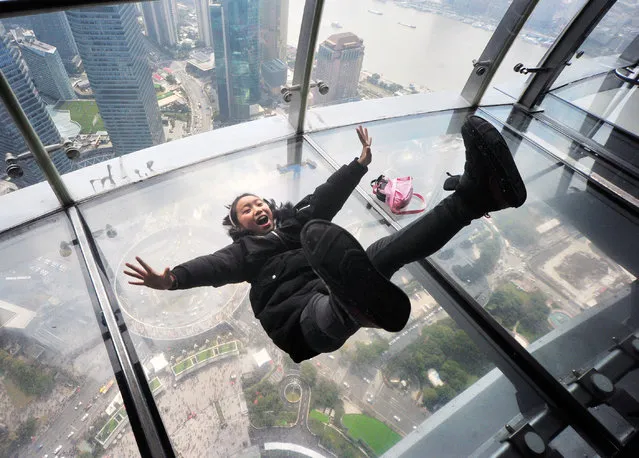
A young girl plays on the glass bottom platform of the Oriental Pear TV Tower as she travels with her family on the second day of the Chinese Lunar New Year holiday, also known as Spring Festival, in Shanghai, China on February 18, 2018. Some 287 million tourists travelled in China during the first four days of the week-long Chinese Lunar New Year holiday, up 11.1 percent from the same period last year, new data showed Sunday (18 February 2018). Tourism revenue rose 11.6 percent to 352.7 billion yuan (55.61 billion U.S. dollars) in the four days, the China National Tourism Administration (CNTA) said. On Sunday alone, some 73 million tourist trips were made across the country, up 15.3 percent, while tourism revenue rose 16.6 percent to 94.4 billion yuan. (Photo by Imaginechina/Rex Features/Shutterstock)

A young girl plays on the glass bottom platform of the Oriental Pear TV Tower as she travels with her family on the second day of the Chinese Lunar New Year holiday, also known as Spring Festival, in Shanghai, China on February 18, 2018. Some 287 million tourists travelled in China during the first four days of the week-long Chinese Lunar New Year holiday, up 11.1 percent from the same period last year, new data showed Sunday. (Photo by Imaginechina/Rex Features/Shutterstock)
Details
21 Feb 2018 00:03:00
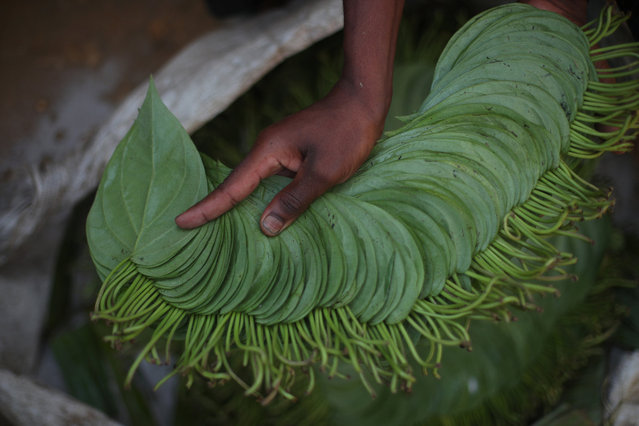
Faruk, 17, a Rohingya refugee trader holds betel leaves which are on sale at a stall in Palong Khali refugee camp near Cox's Bazar, Bangladesh, November 3, 2017. He left his village in Myanmar when the military opened fire towards the Rohingya. “I buy this betel leaf from Palong Khali market, in one bundle there are 160 pieces, I buy it for 80 taka and I sell it for 100 taka. Bangladeshi's and I sell for the same rate in the camp. Outside in the local market it is 80 taka per bundle. My problem is that I don't have money so I can't buy anything to eat, I can't buy fish to eat”, he said. (Photo by Hannah McKay/Reuters)


Faruk, 17, a Rohingya refugee trader holds betel leaves which are on sale at a stall in Palong Khali refugee camp near Cox's Bazar, Bangladesh, November 3, 2017. He left his village in Myanmar when the military opened fire towards the Rohingya. “I buy this betel leaf from Palong Khali market, in one bundle there are 160 pieces, I buy it for 80 taka and I sell it for 100 taka (1 Bangladeshi Taka = 0.012 US Dollar). Bangladeshi's and I sell for the same rate in the camp. Outside in the local market it is 80 taka per bundle. My problem is that I don't have money so I can't buy anything to eat, I can't buy fish to eat”, he said. (Photo by Hannah McKay/Reuters)
Details
27 Nov 2017 08:54:00
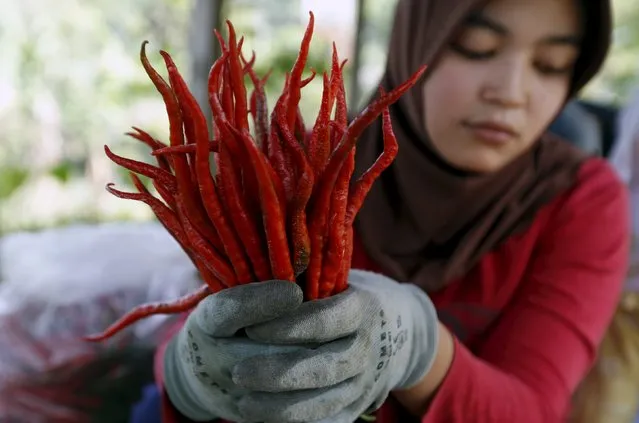
A worker holds harvested chillies at a chilli plantation in Pasir Datar Indah village near Sukabumi, Indonesia's West Java province, August 6, 2015. (Photo by Reuters/Beawiharta)

A worker holds harvested chillies at a chilli plantation in Pasir Datar Indah village near Sukabumi, Indonesia's West Java province, August 6, 2015. (Photo by Reuters/Beawiharta)
Details
20 Aug 2015 13:03:00
People carry drinks at 80s Bar in Damascus, Syria, March 11, 2016. (Photo by Omar Sanadiki/Reuters)

People carry drinks at 80s Bar in Damascus, Syria, March 11, 2016. In Damascus's Old City, just a mile from the battered frontline between government and rebel-held territory, young Syrians smoke, drink beer or soft drinks, and talk about anything but the war. The revival of activity in this once-vibrant quarter is part of efforts to project an air of normality in the Syrian capital, even as the five-year-old war that has killed more than 250,000 people and created 5 million refugees continues to rage nearby. (Photo by Omar Sanadiki/Reuters)
Details
28 Apr 2016 12:07:00
Britain's Most Cosmetically Enhanced Family

Chantal Marshall, mum of Britain's most cosmetically enhanced family, pushes 14-year-old daughter Britney Marshall to have boob job. But perhaps that is no surprise as Britney is the youngest daughter in Britain's most cosmetically enhanced family. (Photo by Barcroft Media)
Details
09 Jul 2012 10:59:00