Loading...
Done
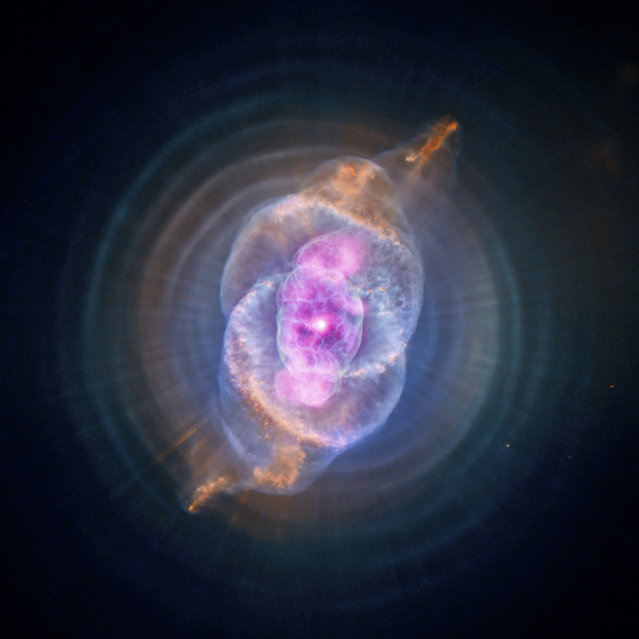
This image is NGC 6543 known as the Cat's Eye Nebula as it appears to the Chandra X-Ray Observatory and Hubble Telescope. A planetary nebula is a phase of stellar evolution that the sun should experience several billion years from now, when it expands to become a red giant and then sheds most of its outer layers, leaving behind a hot core that contracts to form a dense white dwarf star. This image was released October 10, 2012. (Photo by J. Kastner/NASA/CXC/RIT)

This image is NGC 6543 known as the Cat's Eye Nebula as it appears to the Chandra X-Ray Observatory and Hubble Telescope. A planetary nebula is a phase of stellar evolution that the sun should experience several billion years from now, when it expands to become a red giant and then sheds most of its outer layers, leaving behind a hot core that contracts to form a dense white dwarf star. This image was released October 10, 2012. (Photo by J. Kastner/NASA/CXC/RIT)
Details
15 Apr 2013 10:09:00
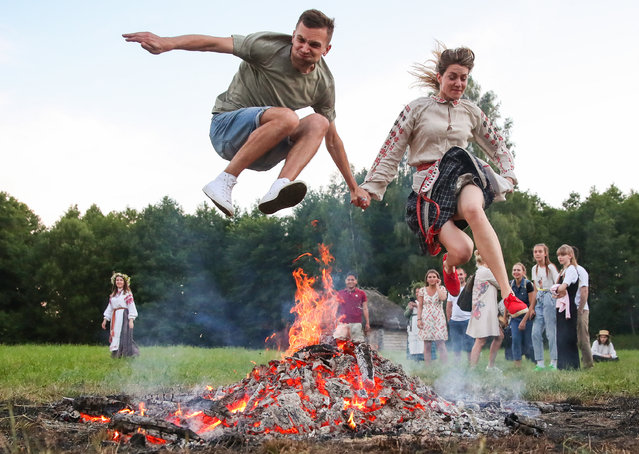
A man and a woman jump over a bonfire during Ivan Kupala Day celebrations held by the Belarusian State Museum of Folk Architecture and Rural Lifestyle in the village of Ozertso near Minsk, Belarus on July 4, 2020. Ivan Kupala Day, also known as Ivana-Kupala or Kupala Night, is a traditional pagan holiday celebrated in eastern Slavic cultures. Various rituals are traditionally performed on Kupala Night, including making flower wreaths, fortune-telling, jumping over bonfires, and burning a wheel-like effigy symbolizing the sun. (Photo by Natalia Fedosenko/TASS)

A man and a woman jump over a bonfire during Ivan Kupala Day celebrations held by the Belarusian State Museum of Folk Architecture and Rural Lifestyle in the village of Ozertso near Minsk, Belarus on July 4, 2020. Ivan Kupala Day, also known as Ivana-Kupala or Kupala Night, is a traditional pagan holiday celebrated in eastern Slavic cultures. Various rituals are traditionally performed on Kupala Night, including making flower wreaths, fortune-telling, jumping over bonfires, and burning a wheel-like effigy symbolizing the sun. (Photo by Natalia Fedosenko/TASS)
Details
23 Jan 2021 09:53:00
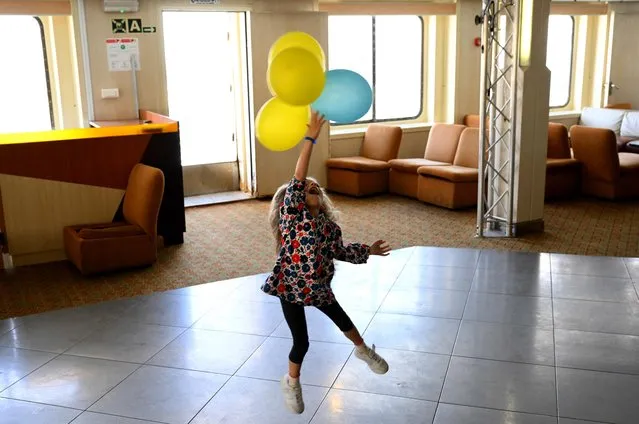
A Ukrainian girl plays with balloons with the colours of her country's flag aboard the Corsica Linea ferry “Mediterranee” in Marseille, southern France, on April 26, 2022. Anna and her children enjoy the sun on the deck of a ferry moored in Marseille: they are not vacationers but Ukrainian refugees who, on this boat, have finally found safety, “like in a village”, with 700 others compatriots. The “Mediterranean” usually serves Algeria, for the Corsica Linea. But it is now docked, at the Joliette ferry terminal in Marseille, with its unusual passengers. (Photo by Nicolas Tucat/AFP Photo)

A Ukrainian girl plays with balloons with the colours of her country's flag aboard the Corsica Linea ferry “Mediterranee” in Marseille, southern France, on April 26, 2022. Anna and her children enjoy the sun on the deck of a ferry moored in Marseille: they are not vacationers but Ukrainian refugees who, on this boat, have finally found safety, “like in a village”, with 700 others compatriots. The “Mediterranean” usually serves Algeria, for the Corsica Linea. But it is now docked, at the Joliette ferry terminal in Marseille, with its unusual passengers. (Photo by Nicolas Tucat/AFP Photo)
Details
28 Apr 2022 05:49:00
On August 31, 2012, a long filament of solar material that had been hovering in the sun's atmosphere, the corona, erupted out into space at 4:36 p.m. EDT. The coronal mass ejection, or CME, traveled at over 900 miles per second. The CME did not travel directly toward Earth, but did connect with Earth's magnetic environment, or magnetosphere, causing aurora to appear on the night of Monday, September 3. (Photo by NASA/GSFC/SDO)

On August 31, 2012, a long filament of solar material that had been hovering in the sun's atmosphere, the corona, erupted out into space at 4:36 p.m. EDT. The coronal mass ejection, or CME, traveled at over 900 miles per second. The CME did not travel directly toward Earth, but did connect with Earth's magnetic environment, or magnetosphere, causing aurora to appear on the night of Monday, September 3. (Photo by NASA/GSFC/SDO via The Atlantic)
Details
14 Sep 2012 09:01:00
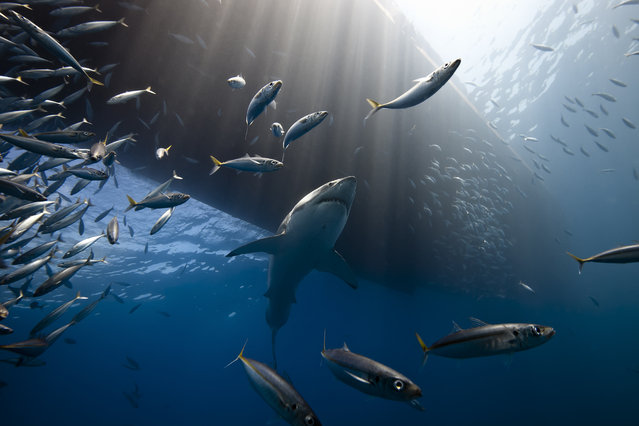
“Great White Shark of Guadalupe Island”. A great white shark very quiet under the boat and a lot of fish. The sun ray lighting the head of the shark. Location: Guadalupe Island, Mexico. (Photo and caption by Marc Henauer/National Geographic Traveler Photo Contest)

“Great White Shark of Guadalupe Island”. A great white shark very quiet under the boat and a lot of fish. The sun ray lighting the head of the shark. Location: Guadalupe Island, Mexico. (Photo and caption by Marc Henauer/National Geographic Traveler Photo Contest)

ATTENTION! All pictures are presented in high resolution. To see Hi-Res images – just TWICE click on any picture. In other words, click small picture – opens the BIG picture. Click BIG picture – opens VERY BIG picture.
Details
04 Jul 2013 09:49:00
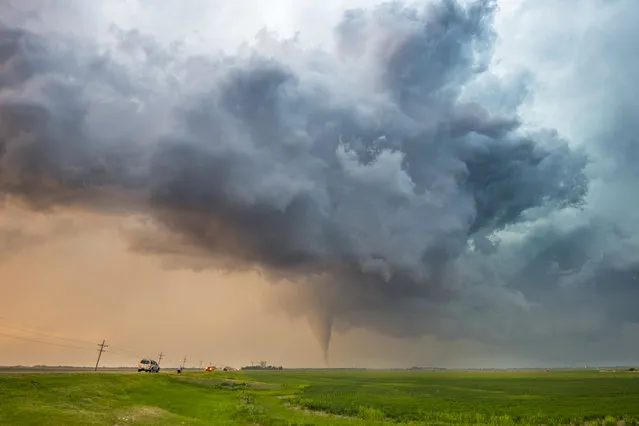
“The Sunsetter”. An EF-4 tornado rips through the open space of farmland near Rozel, Kansas. This tornado moves slowly but powerful towards the setting sun an gets its beautiful color right before sunset. Storm Chasers are spotting on the left side. Photo location: Rozel, Kansas. (Photo and caption by Dennis Oswald/National Geographic Photo Contest)

“The Sunsetter”. An EF-4 tornado rips through the open space of farmland near Rozel, Kansas. This tornado moves slowly but powerful towards the setting sun an gets its beautiful color right before sunset. Storm Chasers are spotting on the left side. Photo location: Rozel, Kansas. (Photo and caption by Dennis Oswald/National Geographic Photo Contest)

ATTENTION! All pictures are presented in high resolution. To see Hi-Res images – just TWICE click on any picture. In other words, click small picture – opens the BIG picture. Click BIG picture – opens VERY BIG picture.
Details
01 Dec 2013 11:03:00
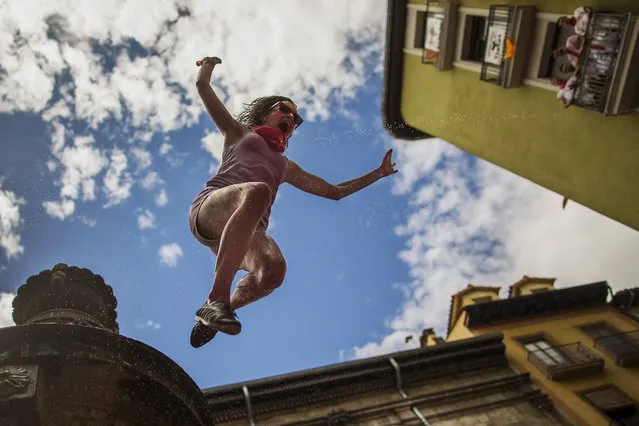
A reveler jumps from a fountain onto the crowd below, after the launch of the “Chupinazo” rocket, to celebrate the official opening of the 2014 San Fermin fiestas in Pamplona, Spain, Sunday, July 6, 2014. Revelers from around the world turned out here to kick off the festival with a messy party in the Pamplona town square, one day before the first of eight days of the running of the bulls glorified by Ernest Hemingway's 1926 novel “The Sun Also Rises”. (Photo by Andres Kudacki/AP Photo)

A reveler jumps from a fountain onto the crowd below, after the launch of the “Chupinazo” rocket, to celebrate the official opening of the 2014 San Fermin fiestas in Pamplona, Spain, Sunday, July 6, 2014. Revelers from around the world turned out here to kick off the festival with a messy party in the Pamplona town square, one day before the first of eight days of the running of the bulls glorified by Ernest Hemingway's 1926 novel “The Sun Also Rises”. (Photo by Andres Kudacki/AP Photo)
Details
09 Jul 2014 12:53:00
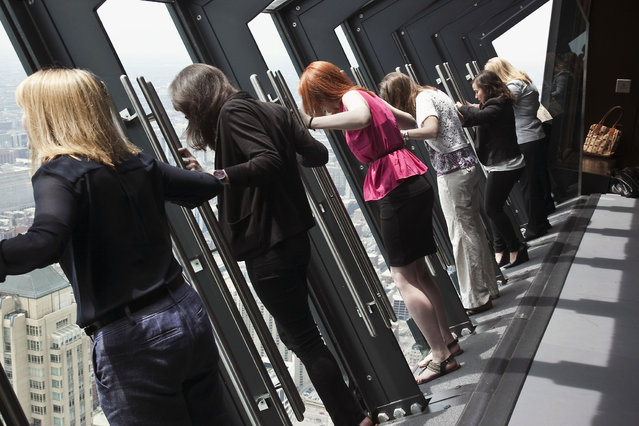
In this Thursday, May 8, 2014 photo, guests look down from the Tilt!, a new tourist attraction that provides guests a unique view of the downtown area from the 94th floor of the John Hancock Building, after it was unveiled in Chicago. People hold onto handrails as the glass and steel facade tilts forward 30 degrees. (Photo by Ashlee Rezin/AP Photo/Sun-Times Media)

In this Thursday, May 8, 2014 photo, guests look down from the Tilt!, a new tourist attraction that provides guests a unique view of the downtown area from the 94th floor of the John Hancock Building, after it was unveiled in Chicago. People hold onto handrails as the glass and steel facade tilts forward 30 degrees. (Photo by Ashlee Rezin/AP Photo/Sun-Times Media)
Details
10 May 2014 14:30:00