Loading...
Done
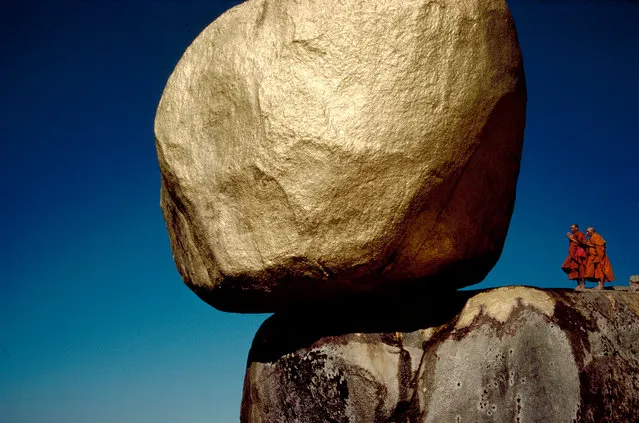
Kyaiktiyo, Burma, 1978. The Golden Rock at Shwe Pyi Daw (the Golden Country), the Buddhist holy place. Hiroji Kubota writes: “I was desperate to keep a distance from America for a while; luckily, I found Burma and its gentle and compassionate people. In the spring of 1978, on the top of the hill where I took this photo, I had two Leica bodies: the one with Tri-X and the other with Kodachrome 64. Soon after, I realised that the colour one looked very colourful and was more powerful. That was my decisive moment, to become a colour photographer”. (Photo by Hiroji Kubota/Magnum Photos)

Kyaiktiyo, Burma, 1978. The Golden Rock at Shwe Pyi Daw (the Golden Country), the Buddhist holy place. Hiroji Kubota writes: “I was desperate to keep a distance from America for a while; luckily, I found Burma and its gentle and compassionate people. In the spring of 1978, on the top of the hill where I took this photo, I had two Leica bodies: the one with Tri-X and the other with Kodachrome 64. Soon after, I realised that the colour one looked very colourful and was more powerful. That was my decisive moment, to become a colour photographer”. (Photo by Hiroji Kubota/Magnum Photos)
Details
10 Jun 2016 13:30:00
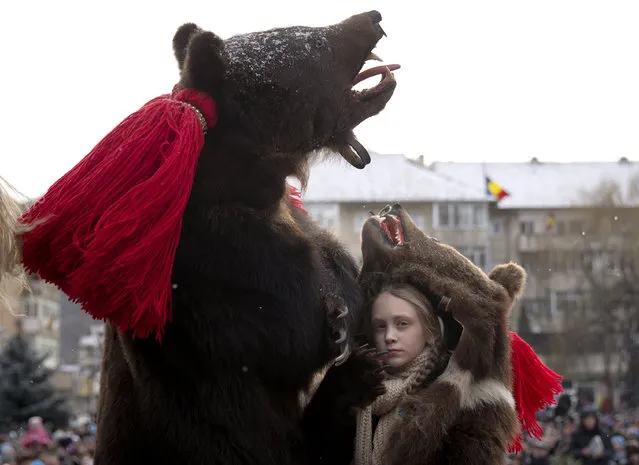
People wearing bear furs perform during a festival of New Year ritual dances attended by hundreds in Comanesti, northern Romania, Wednesday, December 30 2015. In pre-Christian rural traditions, dancers wearing colored costumes or animal furs, toured from house to house in villages singing and dancing to ward off evil, in the present the tradition has moved to Romania's cities too, where dancers travel to perform the ritual for money. (Photo by Vadim Ghirda/AP Photo)

People wearing bear furs perform during a festival of New Year ritual dances attended by hundreds in Comanesti, northern Romania, Wednesday, December 30 2015. In pre-Christian rural traditions, dancers wearing colored costumes or animal furs, toured from house to house in villages singing and dancing to ward off evil, in the present the tradition has moved to Romania's cities too, where dancers travel to perform the ritual for money. (Photo by Vadim Ghirda/AP Photo)
Details
31 Dec 2015 08:52:00
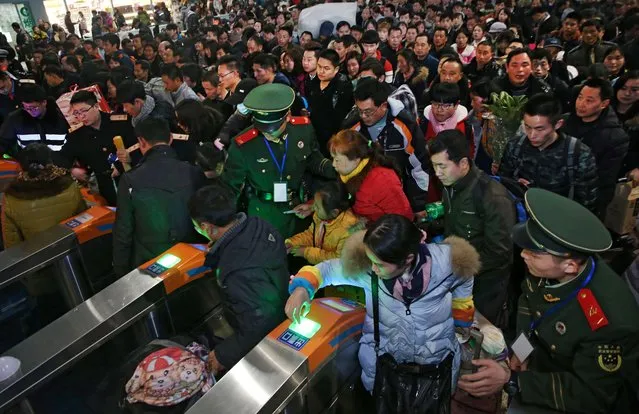
Chinese paramilitary guards monitoring passengers as they head to their train to travel to their hometowns for the “Spring Festival” or Lunar New Year at Nantong Railway Station in Jiangsu province, near Shanghai Travellers taking part in the world' s largest annual human migration must be home by January 27 to usher in the new year on January 28. (Photo by AFP Photo/Stringer)

Chinese paramilitary guards monitoring passengers as they head to their train to travel to their hometowns for the “Spring Festival” or Lunar New Year at Nantong Railway Station in Jiangsu province, near Shanghai Travellers taking part in the world' s largest annual human migration must be home by January 27 to usher in the new year on January 28. (Photo by AFP Photo/Stringer)
Details
27 Jan 2017 11:57:00
This picture taken on February 1, 2015 shows participants competing in a tofu (beancurd) wrestling competition in Fogang county, south China's Guangdong province. Participants, mostly women, fight it out in an inflatable pool which is filled with nearly two tons of fresh milk and tofu, in a promotion to attract tourists for the upcoming Chinese Lunar New Year holiday. (Photo by AFP Photo/Stringer)

This picture taken on February 1, 2015 shows participants competing in a tofu (beancurd) wrestling competition in Fogang county, south China's Guangdong province. Participants, mostly women, fight it out in an inflatable pool which is filled with nearly two tons of fresh milk and tofu, in a promotion to attract tourists for the upcoming Chinese Lunar New Year holiday. The upcoming Chinese lunar new year of the sheep, which will fall on February 19 this year, marks the biggest festival of the year in China as hundreds of millions of people journey across the country to celebrate the season with their families. (Photo by AFP Photo/Stringer)
Details
07 Feb 2015 14:44:00


“The Berlin Wall (German: Berliner Mauer) was a barrier constructed by the German Democratic Republic (GDR, East Germany) starting on 13 August 1961, that completely cut off West Berlin from surrounding East Germany and from East Berlin. The barrier included guard towers placed along large concrete walls, which circumscribed a wide area (later known as the “death strip”) that contained anti-vehicle trenches, “fakir beds” and other defenses. The Soviet-dominated Eastern Bloc officially claimed that the wall was erected to protect its population from fascist elements conspiring to prevent the “will of the people” in building a socialist state in East Germany. However, in practice, the Wall served to prevent the massive emigration and defection that marked Germany and the communist Eastern Bloc during the post-World War II period”. – Wikipedia

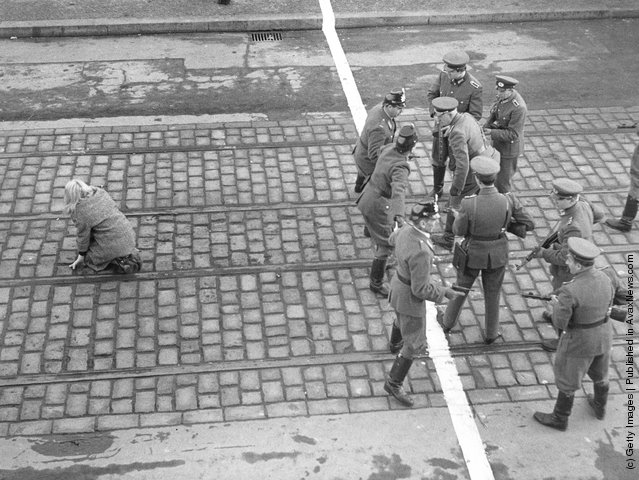
Photo: West Berlin policemen and East German Volkspolizei face each other across the border in Berlin, circa 1955. (Photo by Three Lions/Hulton Archive/Getty Images)
Details
22 May 2011 10:49:00
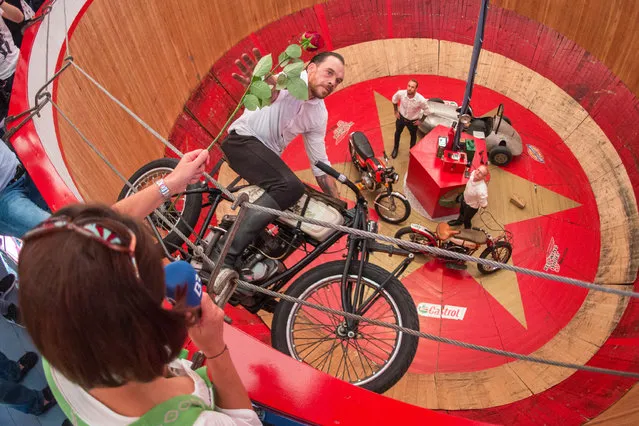
Donald Ganslmeier, operator of the Motodrom, rides a motorbike inside the Motodrom during a press tour at Theresienwiese on the premises of the 182nd annual Oktoberfest in Munich, Germany, September 17, 2015. (Photo by Matthias Balk/EPA)

Donald Ganslmeier, operator of the Motodrom, rides a motorbike inside the Motodrom during a press tour at Theresienwiese on the premises of the 182nd annual Oktoberfest in Munich, Germany, September 17, 2015. (Photo by Matthias Balk/EPA)
Details
18 Sep 2015 15:28:00
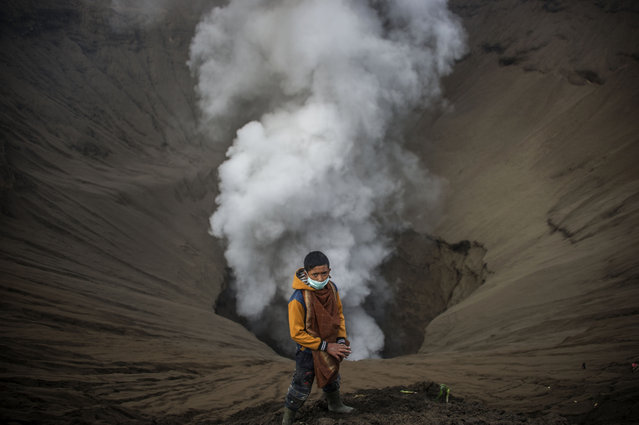
An Indonesian boy waits as he prepares to catch offerings released by Hindu devotees of the Tengger tribe during the Yadnya Kasada festival, on the crater of Mount Bromo in Probolinggo on July 21, 2016. During the annual Yadnya Kasada festival the Tenggerese climb Mount Bromo, an active volcano, and seek the blessing from the main deity Hyang Widi Wasa by presenting offerings of rice, fruit, livestock and other local produce. (Photo by Juni Kriswanto/AFP Photo)

An Indonesian boy waits as he prepares to catch offerings released by Hindu devotees of the Tengger tribe during the Yadnya Kasada festival, on the crater of Mount Bromo in Probolinggo on July 21, 2016. During the annual Yadnya Kasada festival the Tenggerese climb Mount Bromo, an active volcano, and seek the blessing from the main deity Hyang Widi Wasa by presenting offerings of rice, fruit, livestock and other local produce. (Photo by Juni Kriswanto/AFP Photo)
Details
22 Jul 2016 12:33:00
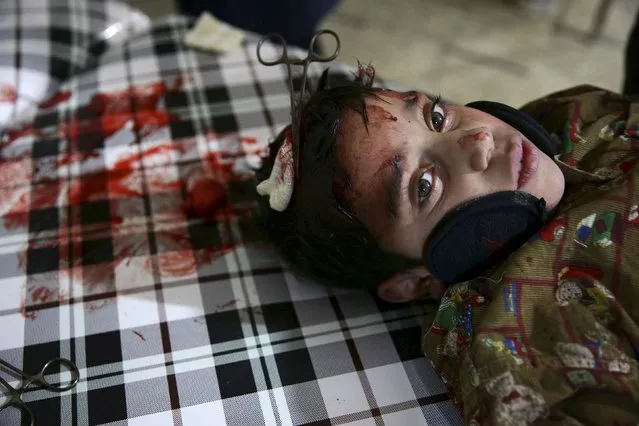
An injured boy who is undergoing surgery, after he was injured in what activists said was an airstrike by forces loyal to Syria's president Bashar al-Assad, rests inside a field hospital in the Douma neighborhood of Damascus, Syria December 5, 2015. (Photo by Bassam Khabieh/Reuters)

An injured boy who is undergoing surgery, after he was injured in what activists said was an airstrike by forces loyal to Syria's president Bashar al-Assad, rests inside a field hospital in the Douma neighborhood of Damascus, Syria December 5, 2015. Douma in Syria, an area controlled by rebels fighting to topple President Bashar al-Assad, has been shelled continuously for the past three years. The injured are taken to basements and shelters transformed into field hospitals run by medical staff who have stayed in the battered neighbourhood of Damascus. (Photo by Bassam Khabieh/Reuters)
Details
19 Dec 2015 08:06:00