Loading...
Done
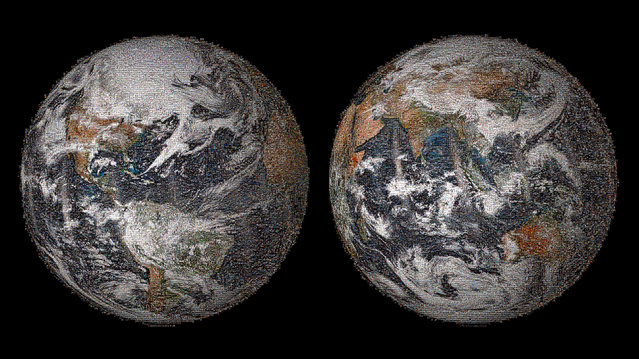
NASA’s “Global Selfie” Earth mosaic contains more than 36,000 individual photographs from the more than 50,000 images posted around the world. (Photo by NASA)

On Earth Day this year, NASA asked people all around the world a question: “Where are you on Earth Right Now?” To answer this question people were asked to post their selfie on social media. The goal was to use each picture as a pixel in the creation of a “Global Selfie” – a mosaic image that would look like Earth appeared from the space. The 3.2 gigapixel “Global Selfie”, was made the with 36,422 individual images.
Details
25 May 2014 08:37:00
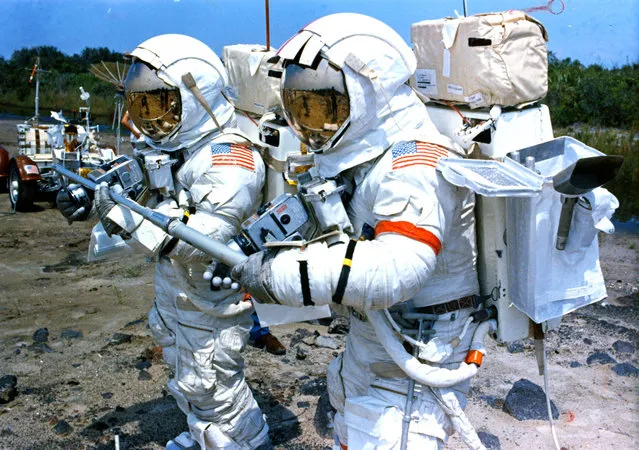
Astronauts Harrison Schmitt (left) and Eugene Andrew Cernan practice taking geological samples at the Kennedy Space Center in Florida, in preparation for NASA's scheduled Apollo 17 lunar landing mission, on August 28, 1972. Schmitt is the Lunar Module Pilot and Cernan is the mission's Commander. They are training for their period of EVA (extravehicular activity) on the Moon. (Photo by Space Frontiers/Getty Images)

Astronauts Harrison Schmitt (left) and Eugene Andrew Cernan practice taking geological samples at the Kennedy Space Center in Florida, in preparation for NASA's scheduled Apollo 17 lunar landing mission, on August 28, 1972. Schmitt is the Lunar Module Pilot and Cernan is the mission's Commander. They are training for their period of EVA (extravehicular activity) on the Moon. (Photo by Space Frontiers/Getty Images)
Details
24 Dec 2022 04:10:00
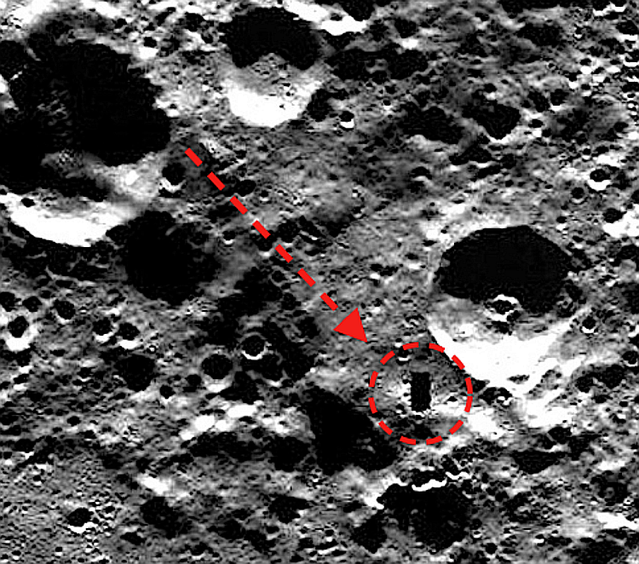
Victoria Rupes: Unnatural Anomaly Discovered On Mercury

On the Internet appeared the video, on which shows, according to the author of the video, as in the photos, which were taken by U.S. space probe MESSENGER (MErcury Surface, Space ENvironment, GEochemistry and Ranging), American automatic interplanetary station (AWS) for the study of Mercury, on the surface of Mercury has been found an unusual object... (Photo by NASA)
Details
31 Dec 2012 12:16:00


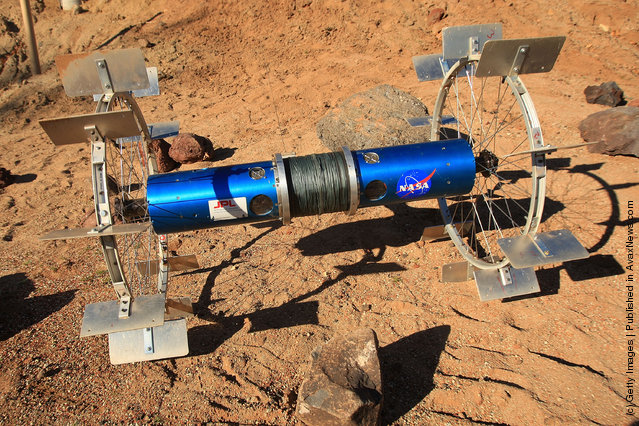
Axel, a research prototype rover for exploring the Moon, Mars and other planets, is remotely driven over rocks as engineers from Jet Propulsion (JPL) and grad students from Caltech (California Institute of Technology) demonstrate its mobile over the steep and rocky grounds of the JPL Mars Yard on January 14, 2009 in Pasadena, California. The rover is capable of descending cliffs or into craters and returning by a cable tethered to its starting point. Development of the Axel rover is a point effort funded by NASA Exploration Systems Mission Directorate (ESMD) and lead by Principal Investigator Issa Newnas and Co-Investigator and Caltech professor of mechanical engineering bio engineering Joel Burdick. (Photo by David McNew/Getty Images)
Details
05 Apr 2011 07:47:00
A woman photographs “Super Space Titan Kitty” by Colin Christian at the “Hello! Exploring the Supercute World of Hello Kitty” museum exhibit in honor of Hello Kitty's 40th anniversary, at the Japanese American National Museum in Los Angeles, California October 10, 2014. (Photo by Lucy Nicholson/Reuters)

A woman photographs “Super Space Titan Kitty” by Colin Christian at the “Hello! Exploring the Supercute World of Hello Kitty” museum exhibit in honor of Hello Kitty's 40th anniversary, at the Japanese American National Museum in Los Angeles, California October 10, 2014. (Photo by Lucy Nicholson/Reuters)
Details
11 Oct 2014 13:31:00
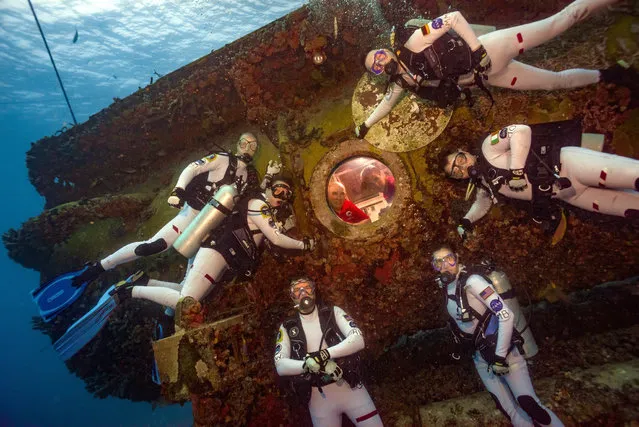
The NASA Extreme Environment Mission Operations (NEEMO) 21 mission began on July 21 as an international crew of aquanauts splashed down to the undersea Aquarius Reef Base, located 62 feet below the surface of the Atlantic Ocean in the Florida Keys National Marine Sanctuary. The NEEMO 21 crew will perform research both inside and outside the habitat during a 16-day simulated space mission. During simulated spacewalks carried out underwater, they will evaluate tools and mission operation techniques that could be used in future space missions, including journeys to Mars. (Photo by Karl Shreeves/NASA)

The NASA Extreme Environment Mission Operations (NEEMO) 21 mission began on July 21 as an international crew of aquanauts splashed down to the undersea Aquarius Reef Base, located 62 feet below the surface of the Atlantic Ocean in the Florida Keys National Marine Sanctuary. The NEEMO 21 crew will perform research both inside and outside the habitat during a 16-day simulated space mission. During simulated spacewalks carried out underwater, they will evaluate tools and mission operation techniques that could be used in future space missions, including journeys to Mars. (Photo by Karl Shreeves/NASA)
Details
31 Jul 2016 11:29:00
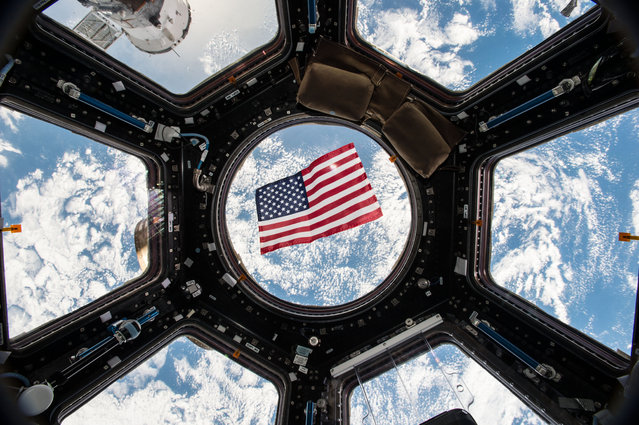
An American flag is visible in the windows of the cupola aboard the International Space Station. Thanks to a bill passed by Texas legislators in 1997 that put in place technical voting procedure for astronauts – nearly all of whom live in Texas – they have the ability to vote from space through specially designed absentee ballots. To preserve the integrity of the secret vote, the ballot is encrypted and only accessible by the astronaut and the county clerk responsible for casting the ballot. (Photo by NASA)

An American flag is visible in the windows of the cupola aboard the International Space Station. Thanks to a bill passed by Texas legislators in 1997 that put in place technical voting procedure for astronauts – nearly all of whom live in Texas – they have the ability to vote from space through specially designed absentee ballots. To preserve the integrity of the secret vote, the ballot is encrypted and only accessible by the astronaut and the county clerk responsible for casting the ballot. (Photo by NASA)
Details
10 Nov 2016 12:35:00
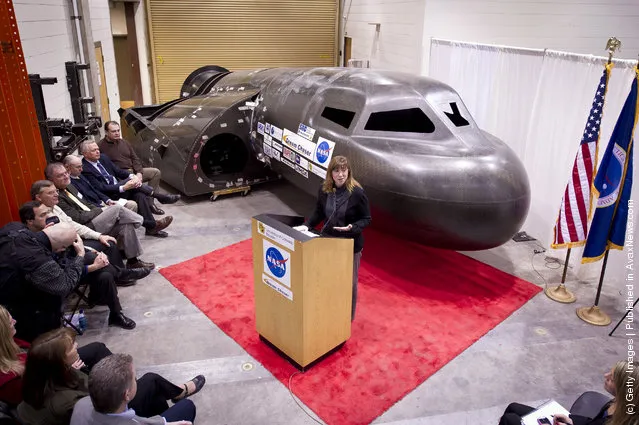
Dream Chaser

“The Dream Chaser is a planned crewed suborbital and orbital vertical-takeoff, horizontal-landing (VTHL) lifting-body spaceplane being developed by SpaceDev, a wholly owned subsidiary of Sierra Nevada Corporation (SNC). The Dream Chaser design is planned to carry seven people to and from low earth orbit. The vehicle would launch vertically on an Atlas V and land horizontally on conventional runways”. – Wikipedia

Photo: NASA Deputy Administrator Lori Garver talks during a press conference with Sierra Nevada's Dream Chaser spacecraft in the background at the University of Colorado at Boulder on February 5, 2011 in Boulder, Colorado. Sierra Nevada's Dream Chaser spacecraft is under development with support from NASA's Commercial Crew Development Program to provide crew transportation to and from low Earth orbit. NASA is helping private companies develop innovative technologies to ensure that the U.S. remains competitive in future space endeavors. (Photo by Bill Ingalls/NASA via Getty Images)
Details
12 Aug 2011 14:16:00