Loading...
Done
In this March 13, 2015 photo,  Yohan, 4, from left, Cristian, 7, and Angelo, 6, playfully toss coca leaves into the air, singing: “I have a lot of money, look at all the money I have”, in La Mar, province of Ayacucho, Peru. Hauling cocaine out of the remote valley is about the only way to earn decent cash in this region where a farmhand earns less than $10 a day. Beyond extinguishing young lives, the practice has packed Peru's highland prisons with cocaine backpackers while their bosses evade incarceration. (Photo by Rodrigo Abd/AP Photo)

In this March 13, 2015 photo, Yohan, 4, from left, Cristian, 7, and Angelo, 6, playfully toss coca leaves into the air, singing: “I have a lot of money, look at all the money I have”, in La Mar, province of Ayacucho, Peru. Hauling cocaine out of the remote valley is about the only way to earn decent cash in this region where a farmhand earns less than $10 a day. Beyond extinguishing young lives, the practice has packed Peru's highland prisons with cocaine backpackers while their bosses evade incarceration. (Photo by Rodrigo Abd/AP Photo)
Details
12 May 2015 12:40:00
A female hippopotamus named “Mali”, which means Jasmine, eats fruits arranged to look like a cake during her 50th birthday celebration at Dusit Zoo in Bangkok, Thailand September 23, 2016. (Photo by Chaiwat Subprasom/Reuters)

A female hippopotamus named “Mali”, which means Jasmine, eats fruits arranged to look like a cake during her 50th birthday celebration at Dusit Zoo in Bangkok, Thailand September 23, 2016. (Photo by Chaiwat Subprasom/Reuters)
Details
25 Sep 2016 07:06:00
Rahma, 19, pictured with her 10-year old brother Fahad on June 21, 2016 in Kano, Nigeria. A teenage girl born without limbs lives her life in a plastic bowl. Rahma Haruna is a bright, happy girl, despite suffering from a mystery condition that stopped her arms and legs developing properly – leaving her practically limbless and in constant pain. The 19-year- old, from Kano, Nigeria, was born a healthy baby but when she turned six months old her growth came to a sudden halt and she stopped hitting key development milestones. Rahma’s family do their best to provide her with a fulfilling life and transport her around the village in a plastic bowl. Rahma said: “They help me a lot. How do they? They give me anything I need”. Rahma died on 25 December 2016. (Photo by Sani Maikatanga/Barcroft Images)

Rahma, 19 (L), pictured with her 10-year old brother Fahad on June 21, 2016 in Kano, Nigeria. A teenage girl born without limbs lives her life in a plastic bowl. Rahma Haruna is a bright, happy girl, despite suffering from a mystery condition that stopped her arms and legs developing properly – leaving her practically limbless and in constant pain. The 19-year- old, from Kano, Nigeria, was born a healthy baby but when she turned six months old her growth came to a sudden halt and she stopped hitting key development milestones. Rahma’s family do their best to provide her with a fulfilling life and transport her around the village in a plastic bowl. Rahma said: “They help me a lot. How do they? They give me anything I need”. Rahma died on 25 December 2016. (Photo by Sani Maikatanga/Barcroft Images)
Details
30 Dec 2016 10:52:00
Heesco, Windsor. Born and raised in Mongolia and now living and working in Melbourne, Heesco is well known for his skill in rendering photo-realistic portraits. They speak to the viewer in a way that the subtext is enjoyable to decipher. Just what is the Blue Lady’s message? The sunglasses might mask the confronting gaze but her body language fills in the gaps. Heesco’s characters often wear traditional jewellery and clothing that remind us of his Mongolian cultural heritage. (Photo by Lou Chamberlin/The Guardian)

Heesco, Windsor. Born and raised in Mongolia and now living and working in Melbourne, Heesco is well known for his skill in rendering photo-realistic portraits. They speak to the viewer in a way that the subtext is enjoyable to decipher. Just what is the Blue Lady’s message? The sunglasses might mask the confronting gaze but her body language fills in the gaps. Heesco’s characters often wear traditional jewellery and clothing that remind us of his Mongolian cultural heritage. (Photo by Lou Chamberlin/The Guardian)
Details
26 Dec 2017 08:28:00
A boy runs with a burning barrel soaked in tar at the annual Ottery St Mary tar barrel festival on November 5, 2015 in Ottery St. Mary, England. The tradition, which is over 400 years old, sees competitors (who must have been born in the town to take part) running with burning barrels on their backs through the village, until the heat becomes too unbearable or the barrel breaks down, starting with junior barrels carried by children and continuing all evening with ever larger and larger barrels. (Photo by Matt Cardy/Getty Images)

A boy runs with a burning barrel soaked in tar at the annual Ottery St Mary tar barrel festival on November 5, 2015 in Ottery St. Mary, England. The tradition, which is over 400 years old, sees competitors (who must have been born in the town to take part) running with burning barrels on their backs through the village, until the heat becomes too unbearable or the barrel breaks down, starting with junior barrels carried by children and continuing all evening with ever larger and larger barrels. The event, which has been threatened with closure on previous years due to increasing public liability insurance costs, raises thousands of pounds for charity and attracts spectators from around the world. (Photo by Matt Cardy/Getty Images)
Details
07 Nov 2015 08:07:00
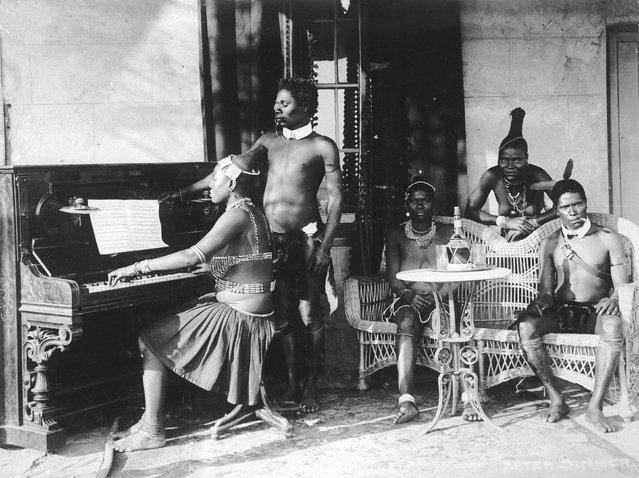
circa 1925:  A Zulu woman playing the piano while a group of others sit and listen.  (Photo by General Photographic Agency/Getty Images)

“The Zulu are the largest South African ethnic group, with an estimated 10–11 million people living mainly in the province of KwaZulu-Natal. Small numbers also live in Zimbabwe, Zambia, and Mozambique. Their language, Zulu, is a Bantu language; more specifically, part of the Nguni subgroup. The Zulu Kingdom played a major role in South African history during the 19th and 20th centuries. Under apartheid, Zulu people were classed as third-class citizens and suffered from state-sanctioned discrimination. They remain today the most numerous ethnic group in South Africa, and now have equal rights along with all other citizens”. – Wikipedia.

Photo: A Zulu woman playing the piano while a group of others sit and listen (to put it briefly, Englishmen scoff over Zulu). South Africa, circa 1925. (Photo by General Photographic Agency)

Details
03 Feb 2014 09:40:00
In this March 17, 2015 photo, Ashaninka Indian men, identified by locals as illegal loggers, tie tree trunks together to move them along the Putaya River near the hamlet of Saweto, Peru. Illegal logging persists unabated in this remote Amazon community where four indigenous leaders who resisted it were slain in September. The Putaya River is the waterway that transports felled trees, cut both legally and illegally, to the city of Pucallpa. (Photo by Martin Mejia/AP Photo)

In this March 17, 2015 photo, Ashaninka Indian men, identified by locals as illegal loggers, tie tree trunks together to move them along the Putaya River near the hamlet of Saweto, Peru. Illegal logging persists unabated in this remote Amazon community where four indigenous leaders who resisted it were slain in September. The Putaya River is the waterway that transports felled trees, cut both legally and illegally, to the city of Pucallpa. (Photo by Martin Mejia/AP Photo)
Details
27 Mar 2015 12:40:00
View of an American marine as he lies in a foxhole and whistles at a husky, one of the scouting dogs used during the landing on Guam, August 1944. (Photo by W. Eugene Smith/Time & Life Pictures/Getty Images)

View of an American marine as he lies in a foxhole and whistles at a husky, one of the scouting dogs used during the landing on Guam, August 1944. (Photo by W. Eugene Smith/Time & Life Pictures/Getty Images)
Details
25 Feb 2017 00:04:00