Loading...
Done
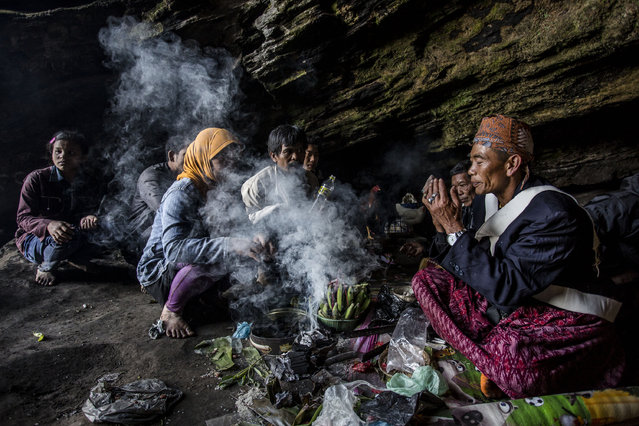
A Tenggerese shaman praying for worshippers at Widodaren cave during the Tenggerese Hindu Yadnya Kasada festival on July 31, 2015 in Probolinggo, East Java, Indonesia. The festival is the main festival of the Tenggerese people and lasts about a month. On the fourteenth day, the Tenggerese make the journey to Mount Bromo to make offerings of rice, fruits, vegetables, flowers and livestock to the mountain gods by throwing them into the volcano's caldera. (Photo by Ulet Ifansasti/Getty Images)

A Tenggerese shaman praying for worshippers at Widodaren cave during the Tenggerese Hindu Yadnya Kasada festival on July 31, 2015 in Probolinggo, East Java, Indonesia. The festival is the main festival of the Tenggerese people and lasts about a month. On the fourteenth day, the Tenggerese make the journey to Mount Bromo to make offerings of rice, fruits, vegetables, flowers and livestock to the mountain gods by throwing them into the volcano's caldera. The origin of the festival lies in the 15th century when a princess named Roro Anteng started the principality of Tengger with her husband Joko Seger, and the childless couple asked the mountain Gods for help in bearing children. The legend says the Gods granted them 24 children but on the provision that the 25th must be tossed into the volcano in sacrifice. The 25th child, Kesuma, was finally sacrificed in this way after initial refusal, and the tradition of throwing sacrifices into the caldera to appease the mountain Gods continues today. (Photo by Ulet Ifansasti/Getty Images)
Details
01 Aug 2015 12:07:00
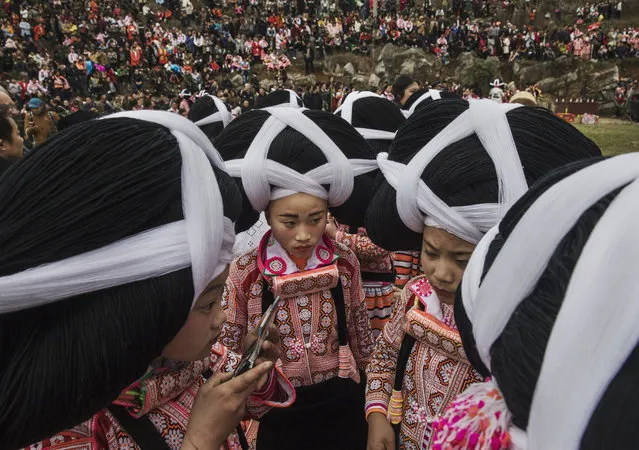
Girls of the Long Horn Miao ethnic minority group wear headdresses as they prepare gather for Tiaohua or Flower Festival as part of the Lunar New Year on February 6, 2017 in Longga village, Guizhou province, southern China. The Long Horn Miao are recognized for their declining practice of wrapping a blend of linen, wool, and the hair of their ancestors around animal horns or a wooden clip to make headdresses. Many young women say they now wear the headdresses only for special occasions and festivals, as the ornaments, which are attached by the horns to their real hair, have proved impractical for modern daily life in a fast changing world. China officially recognizes 56 different ethnic minorities, and statistics show over 7 million Chinese identifying themselves as Miao. But the small Long Horn Miao community counts only around 5000 people living in 12 villages, whose age-old traditions, language, and culture are fading. It is increasingly difficult in a modernizing China, as young people are drawn from remote rural villages to opportunities in bigger cities amongst wide-scale urbanization. Farming and labour remain the mainstays of life for the Long Horn Miao, leaving the area relatively poor in comparison with many parts of China. The government has invested significant amounts into local infrastructure and the tourism industry to try to bolster the local economy. (Photo by Kevin Frayer/Getty Images)

Girls of the Long Horn Miao ethnic minority group wear headdresses as they prepare gather for Tiaohua or Flower Festival as part of the Lunar New Year on February 6, 2017 in Longga village, Guizhou province, southern China. (Photo by Kevin Frayer/Getty Images)
Details
13 Feb 2017 00:01:00
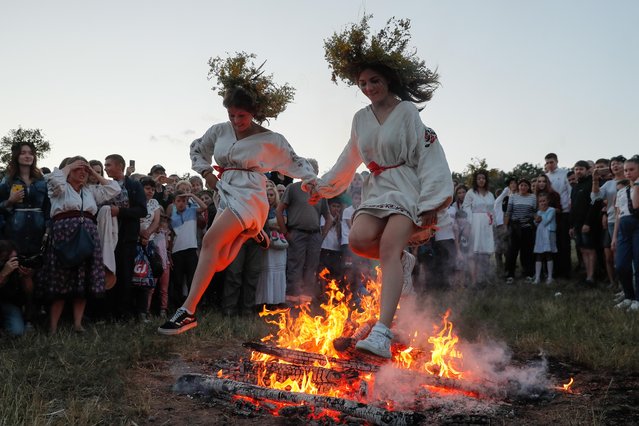
Ukrainians jump over a bonfire in Kiev, Ukraine, 06 July 2019, as they celebrate the traditional pagan holiday of Ivana Kupala. Ivana Kupala is celebrated, during the summer solstice, on the shortest night of the year, marking the beginning of summer and is celebrated in Ukraine, Belarus, Poland and Russia. People sing and dance around bonfires, play games and perform traditional rituals. Young people jump over bonfires in order to test their bravery. Couples holding hands jump over the flames to test their love. If the couple does not succeed it is predicted to split up. Traditionally, children and young unmarried women wear wreaths of wild flowers on their heads to symbolize purity. (Photo by Sergey Dolzhenko/EPA/EFE)

Ukrainians jump over a bonfire in Kiev, Ukraine, 06 July 2019, as they celebrate the traditional pagan holiday of Ivana Kupala. Ivana Kupala is celebrated, during the summer solstice, on the shortest night of the year, marking the beginning of summer and is celebrated in Ukraine, Belarus, Poland and Russia. People sing and dance around bonfires, play games and perform traditional rituals. Young people jump over bonfires in order to test their bravery. Couples holding hands jump over the flames to test their love. If the couple does not succeed it is predicted to split up. Traditionally, children and young unmarried women wear wreaths of wild flowers on their heads to symbolize purity. (Photo by Sergey Dolzhenko/EPA/EFE)
Details
13 Jan 2020 00:05:00
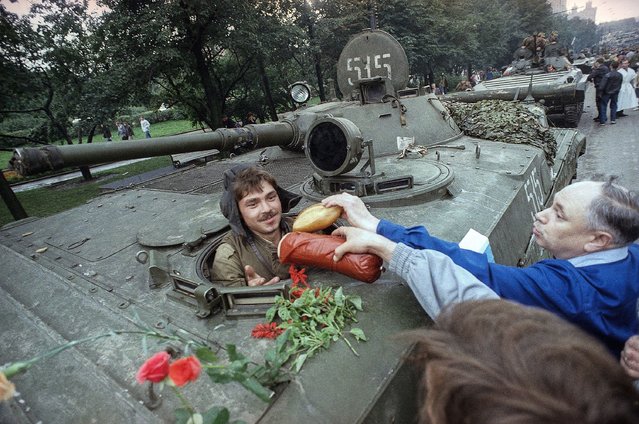
In this Wednesday, August 21, 1991 file photo, appreciative muscovites hand bread, sausages and flowers to a Soviet tank's driver who helped stop the failed hardline coup in Moscow, Russia. When a group of top Communist officials ousted Soviet leader Mikhail Gorbachev 30 years ago and flooded Moscow with tanks, the world held its breath, fearing a rollback on liberal reforms and a return to the Cold War confrontation. But the August 1991 coup collapsed in just three days, precipitating the breakup of the Soviet Union that plotters said they were trying to prevent. (Photo by Czarek Sokolowski/AP Photo/File)

In this Wednesday, August 21, 1991 file photo, appreciative muscovites hand bread, sausages and flowers to a Soviet tank's driver who helped stop the failed hardline coup in Moscow, Russia. When a group of top Communist officials ousted Soviet leader Mikhail Gorbachev 30 years ago and flooded Moscow with tanks, the world held its breath, fearing a rollback on liberal reforms and a return to the Cold War confrontation. But the August 1991 coup collapsed in just three days, precipitating the breakup of the Soviet Union that plotters said they were trying to prevent. (Photo by Czarek Sokolowski/AP Photo/File)
Details
23 Aug 2021 03:45:00
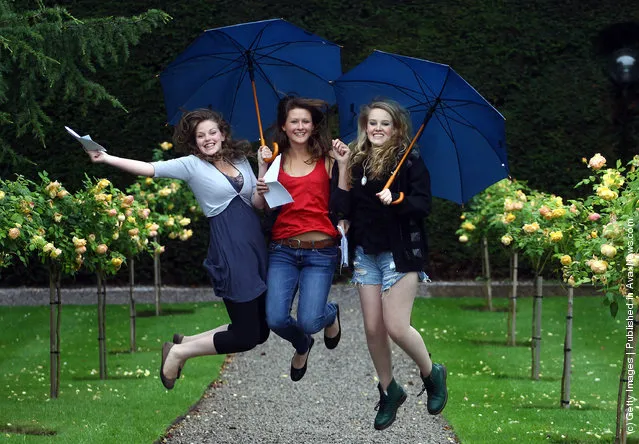
Students Throughout The UK Receive Their A Level Results

Badminton School sixth form pupils (L-R) Lucy Warden, who got 3 A* and is off to study English at Durham, Sam Crumpton, who got 1 A* and 2 A's and is off to study to be a vet at Cambridge and Madeline Sunter, who got 2 A* and 1 B, and is off to study fashion at St. Martins, celebrate their A-level results on August 18, 2011 in Bristol, England. With another record year for A-level results, sixth-form students face a scramble for university places in the final year before tuition fees rise. According to the examination bodies the pass rate rose for the 29th successive year to hit 97.8 percent, while around one in 12 exams achieved the top A* grade. (Photo by Matt Cardy/Getty Images)
Details
19 Aug 2011 09:00:00
“Hippo Chase”. As we approached the camp the Selinda Reserve of northern Botswana our boat passed by a hippo resting in the water. I turned around to look back at the boat's wake and saw the hippo charging after us! The hippo must've been tired from an all-nighter because he was angry. (Photo and caption by Curtis Simmons/National Geographic Photo Contest)

“Hippo Chase”. As we approached the camp the Selinda Reserve of northern Botswana our boat passed by a hippo resting in the water. I turned around to look back at the boat's wake and saw the hippo charging after us! The hippo must've been tired from an all-nighter because he was angry. He rose way up out of the water three times trying to chase our boat! He was coming at us with such force that he created a wake of his own. Photo location: Selinda Reserve of northern Botswana. (Photo and caption by Curtis Simmons/National Geographic Photo Contest)
Details
06 Nov 2014 08:59:00
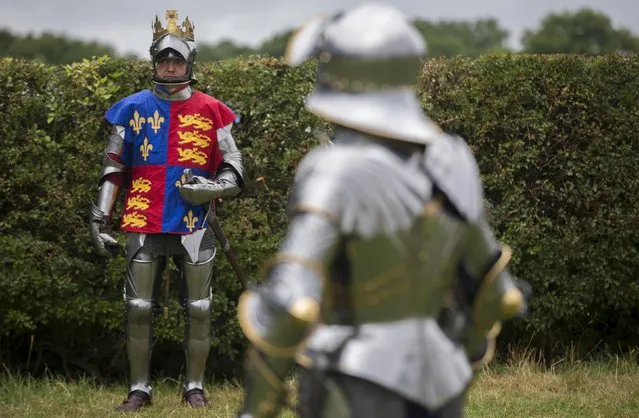
Historical re-enactor Andreas Wenzell dresses as Britain's King Richard the third in a living history camp during an anniversary event for the Battle of Bosworth near Market Bosworth in central Britain, August 23, 2015. (Photo by Neil Hall/Reuters)

Historical re-enactor Andreas Wenzell dresses as Britain's King Richard the third in a living history camp during an anniversary event for the Battle of Bosworth near Market Bosworth in central Britain, August 23, 2015. The Battle of Bosworth took place in 1485 during the War of the Roses between the House of Lancaster and the House of York. King Richard III was defeated by Henry Tudor marking the end of Plantagenet rule and the beginning of the Tudor dynasty. (Photo by Neil Hall/Reuters)
Details
24 Aug 2015 13:11:00
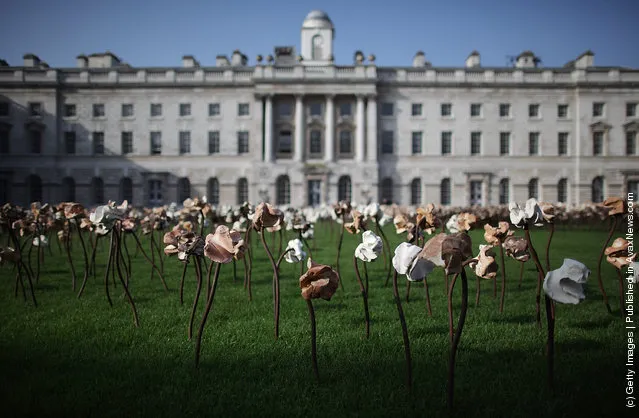
London based Chilean artist Fernando Casasempere poses with his 'Out of Sync' art installation on a grass meadow at Somerset Housein London

In spring sunsunshine the “Out of Sync” art installation is unveiled on a grass meadow at Somerset House on March 15, 2012 in London, England. Chilean artist Fernando Casasempere hand crafted the 10,000 clay flowers that dominate the Edmond J. Safra Fountain Court. The installation is open to the public at Somerset House from March 16th to April 27th 2012. (Photo by Peter Macdiarmid/Getty Images for Somerset House Trust)
Details
17 Mar 2012 11:51:00