Loading...
Done
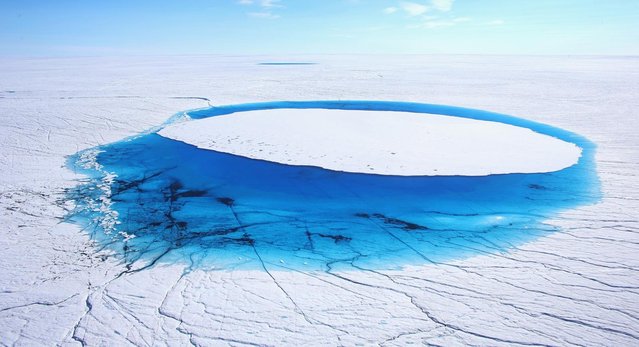
Water is seen on part of the glacial ice sheet that covers about 80 percent of the country is seen on July 17, 2013 on the Glacial Ice Sheet, Greenland. (Photo by Joe Raedle/Getty Images via The Atlantic)

Water is seen on part of the glacial ice sheet that covers about 80 percent of the country is seen on July 17, 2013 on the Glacial Ice Sheet, Greenland. As the sea levels around the globe rise, researchers affilitated with the National Science Foundation and other organizations are studying the phenomena of the melting glaciers and its long-term ramifications. The warmer temperatures that have had an effect on the glaciers in Greenland also have altered the ways in which the local populace farm, fish, hunt and even travel across land. In recent years, sea level rise in places such as Miami Beach has led to increased street flooding and prompted leaders such as New York City Mayor Michael Bloomberg to propose a $19.5 billion plan to boost the citys capacity to withstand future extreme weather events by, among other things, devising mechanisms to withstand flooding. (Photo by Joe Raedle)
Details
02 Aug 2013 10:51:00
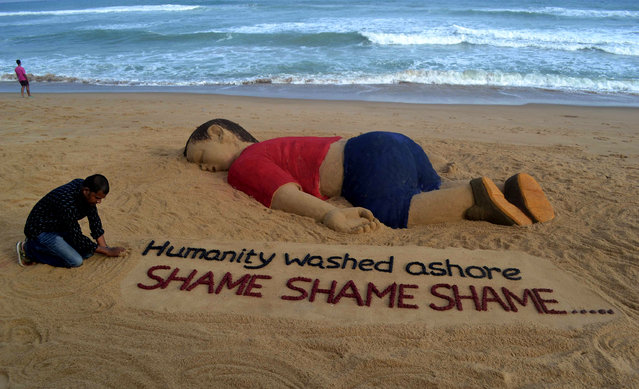
Indian artist Sudarsan Pattnaik works on a sand sculpture depicting drowned Syrian boy Aylan Kurdi at Puri beach, some 65 kilometers away from Bhubaneswar, on September 4, 2015. Charities helping refugees saw a surge in donations on September 4 across Europe as people shocked by the heart-rending images of a drowned Syrian boy on a Turkish beach dug deep to help out. (Photo by Asit Kumar/AFP Photo)

Indian artist Sudarsan Pattnaik works on a sand sculpture depicting drowned Syrian boy Aylan Kurdi at Puri beach, some 65 kilometers away from Bhubaneswar, on September 4, 2015. Charities helping refugees saw a surge in donations on September 4 across Europe as people shocked by the heart-rending images of a drowned Syrian boy on a Turkish beach dug deep to help out. The photos of the lifeless body of three-year-old Aylan Kurdi, lying on a beach in Bodrum, Turkey, have triggered a wave of emotion across the continent, despite deep divisions among European governments on how to deal with the crisis. (Photo by Asit Kumar/AFP Photo)
Details
05 Sep 2015 12:59:00
Afghan Dog Fighting

“Dog fighting is a form of blood sport in which game dogs are made to fight, sometimes to the death. It is illegal in most developed countries. Dog fighting is used for entertainment and may also generate revenue from stud fees, admission fees and gambling”. – Wikipedia

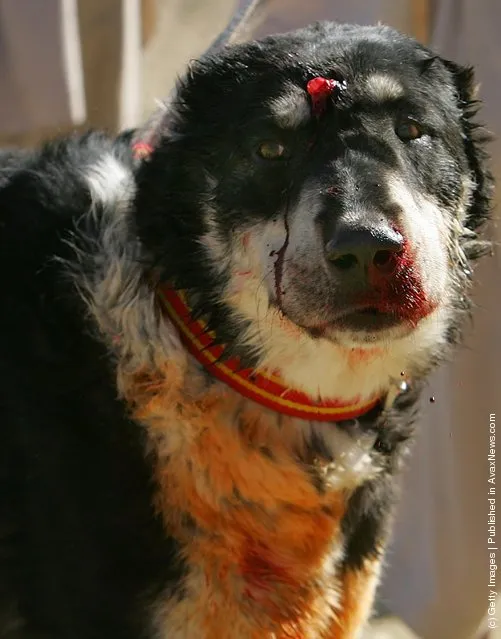
Photo: A bloody Afghan dog is bleeding with many wounds after he lost a dog fight November 24, 2006 in Kabul, Afghanistan. While the Afghan government is trying to ban the violent use of dogs for fighting, the unofficial sport remains a regular weekly event. Afghan dog fighting is popular among Afghan men who gamble on the dogs making upwards of 15,000 Afghanie (300 USD). (Photo by Paula Bronstein/Getty Images)
Details
07 Aug 2011 11:47:00


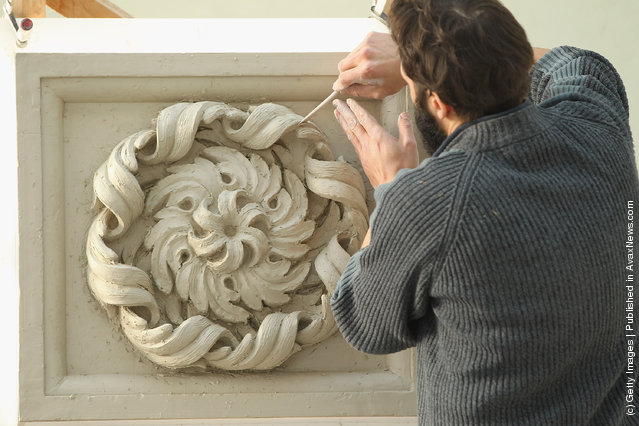
BERLIN, GERMANY - NOVEMBER 11: Sculptor Oleg Bessonov creates a rosette from clay at the Schlossbauhuette studio where a team of sculptors is creating decorative elements for the facade of the Berliner Schloss city palace on November 11, 2011 in Berlin, Germany. The Berliner Schloss was the residence of the Prussian Kaiser and was among the major architectural landmarks of Berlin until it was heavily damaged by Allied bombing in 1945. The communist authorities of East Berlin demolished the building in the 1950s, and today's Berlin government is pursuing an ambitious project to rebuild the palace according to a design by Italian architect Franco Stella, which will recreate the facade of the building but with a modern interior at a cost of approximately EUR 590 million. The Humboldt Forum, the foundation leading the project, has given the Schlossbauhuette sculptors the formidable task of recreating the hundreds of architectural elements that decorated the facade, and though some original pieces were saved, more often the sculptors have only old black and white photos as reference. (Photo by Sean Gallup/Getty Images)
Details
21 Nov 2011 11:22:00
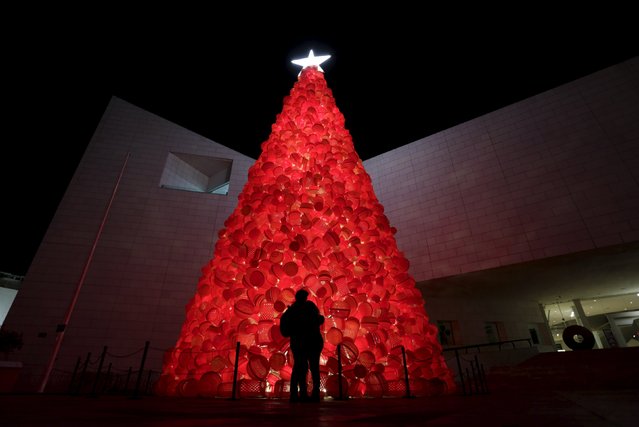
A couple hugs while standing near a Christmas tree made out of plastic bins and plastic hampers outside the Museum of History in Monterrey, Mexico, December 4, 2015. (Photo by Daniel Becerril/Reuters)

A couple hugs while standing near a Christmas tree made out of plastic bins and plastic hampers outside the Museum of History in Monterrey, Mexico, December 4, 2015. The humble Christmas tree has a rich history, from evergreen trees used to symbolise eternal life in Ancient Egypt to tree worship among pagan Europeans. The modern version has its origins in Germany, where the song “O Tannenbaum” is still a festive favourite. Today the traditional tree with lights and decorations appears in cities including Washington, Moscow and Beirut. Alternative constructions range from recycled rubbish in Mexico City to old window frames in Rakvere, Estonia. Whatever the shape or size, the message is the same: Merry Christmas. (Photo by Neil Hall/Reuters)
Details
23 Dec 2015 08:01:00
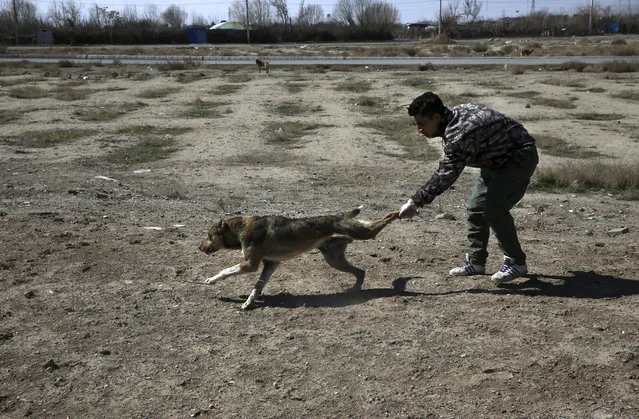
In this picture taken on Sunday, March 5, 2017, a Tehran's urban animal control worker catches a stray dog after being shot with his anesthetic dart on the outskirts of the capital Tehran, Iran. (Photo by Vahid Salemi/AP Photo)

In this picture taken on Sunday, March 5, 2017, a Tehran's urban animal control worker catches a stray dog after being shot with his anesthetic dart on the outskirts of the capital Tehran, Iran. The shelter has been hired by the Tehran city government to take a new, more humane approach to deal with the burgeoning problem of stray dogs in the capital. It’s a sign of changing attitudes among officials in a country where Islamic authorities long saw dogs as “un-Islamic” and would at times confiscate them from people who kept them as pets. (Photo by Vahid Salemi/AP Photo)
Details
17 Mar 2017 00:03:00
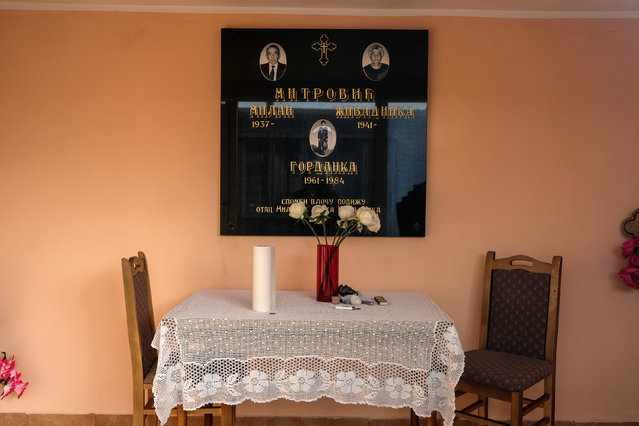
Pictures of deceased people are seen inside a chapel at a cemetery in the village of Smoljinac, Serbia, October 25, 2016. (Photo by Marko Djurica/Reuters)

Pictures of deceased people are seen inside a chapel at a cemetery in the village of Smoljinac, Serbia, October 25, 2016. From a distance, the cemetery in the eastern Serbian village of Smoljinac looks like a residential neighbourhood eerily placed among graves. But once inside the grounds, after passing a section with the usual stone slabs, visitors find rows of small bungalows painted in pastel colours. They have one or two rooms, large windows and ornate plaques – some inside, some outside – memorialising the deceased. These are the burial chapels of Smoljinac, cosy cabins with a furnished room inside, a storage place for wreaths and funeral paraphernalia, and the family crypt below. Some even have electric power inside. (Photo by Marko Djurica/Reuters)
Details
12 Nov 2016 10:37:00


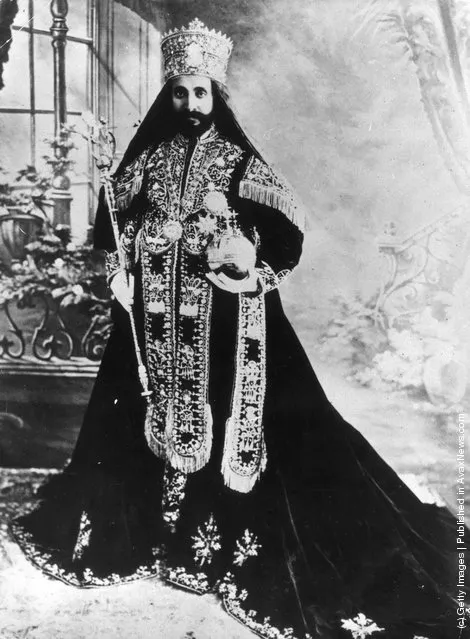
“Haile Selassie I (23 July 1892 – 27 August 1975), born Tafari Makonnen, was Ethiopia's regent from 1916 to 1930 and Emperor of Ethiopia from 1930 to 1974. The heir to a dynasty that traced its origins to the 13th century, and from there by tradition back to King Solomon and Queen Makeda, Empress of Axum, known in the Abrahamic tradition as the Queen of Sheba. Haile Selassie is a defining figure in both Ethiopian and African history.

Haile Selassie is revered as the returned Messiah of the Bible, God incarnate, among the Rastafari movement, the number of followers of which is estimated between 200,000 and 800,000. Begun in Jamaica in the 1930s, the Rastafari movement perceives Haile Selassie as a messianic figure who will lead a future golden age of eternal peace, righteousness, and prosperity. He himself remained an Ethiopian Orthodox Christian throughout his life”. – Wikipedia

Photo: Negusa Negasti, Emperor of Ethiopia Haile Selassie I, known as “Lord of Lords”, “The Conquering Lion of the tribe of Judah”, “Light of the world”, “Elect of God”, in full ceremonial regalia following his coronation. (Photo by Hulton Archive/Getty Images)
Details
21 Jun 2011 11:04:00