Loading...
Done


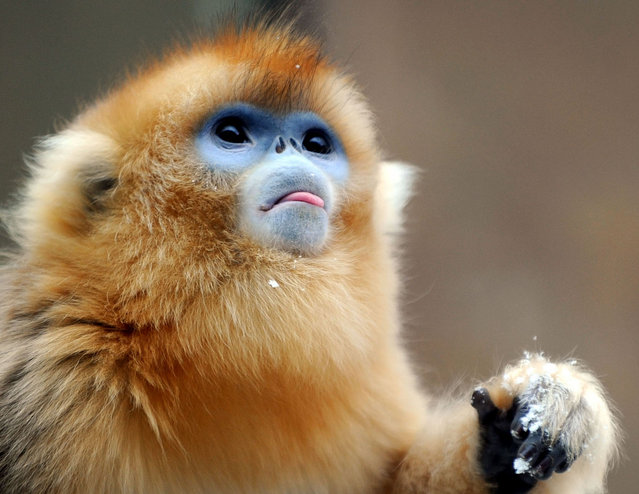
The golden monkey (Cercopithecus kandti) is a species of Old World monkey found in the Virunga volcanic mountains of Central Africa, including four national parks: Mgahinga, in south-west Uganda; Volcanoes, in north-west Rwanda; and Virunga and Kahuzi-Biéga, in the eastern Democratic Republic of Congo. It is restricted to highland forest, especially near bamboo.
Details
07 May 2012 04:39:00
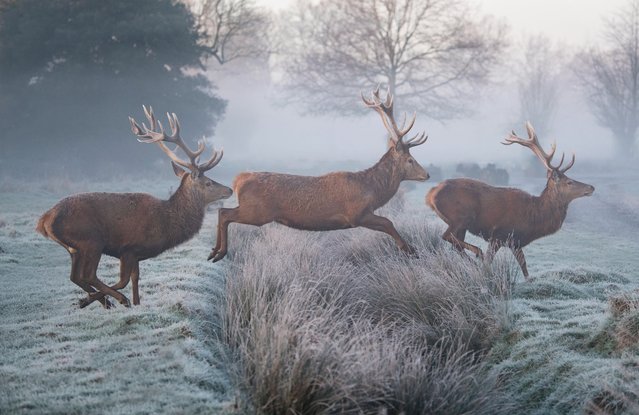
A group of stags charge across a frosty field in Bushy Park, London, leaping in near-perfect formation as the early morning mist hangs low in the second decade of December 2025. (Photo by Max Ellis/The Times)

A group of stags charge across a frosty field in Bushy Park, London, leaping in near-perfect formation as the early morning mist hangs low in the second decade of December 2025. (Photo by Max Ellis/The Times)
Details
28 Dec 2025 13:49:00
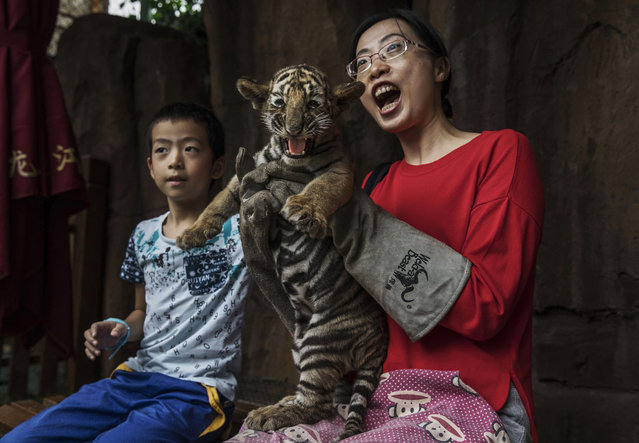
A Chinese tourist wears protective gloves as she holds a baby Siberian tiger as they pose for pictures at the Heilongjiang Siberian Tiger Park on August 16, 2017 in Harbin, northern China. (Photo by Kevin Frayer/Getty Images)

A Chinese tourist wears protective gloves as she holds a baby Siberian tiger as they pose for pictures at the Heilongjiang Siberian Tiger Park on August 16, 2017 in Harbin, northern China. The center is one of two Siberian tiger parks in the Chinese province of Heilongjiang, about 500 kilometers (300 miles) from the border with Russia. It is considered the world's largest for breeding the Siberian, or Amur, tiger which is listed as endangered by the World Wildlife Federation. (Photo by Kevin Frayer/Getty Images)
Details
23 Aug 2017 08:29:00
Women sunbath as Ferrari's Brazilian driver Felipe Massa drives past during the third practice session at the Circuit de Monaco in Monte Carlo on May 25, 2013 ahead of the Monaco Formula One Grand Prix. (Photo by Alexander Klein/AFP Photo)

Women sunbath as Ferrari's Brazilian driver Felipe Massa drives past during the third practice session at the Circuit de Monaco in Monte Carlo on May 25, 2013 ahead of the Monaco Formula One Grand Prix. (Photo by Alexander Klein/AFP Photo)
Details
23 Dec 2013 08:49:00
This close-up image – of a Holi Festival celebrant in Vrindivan, India, coated in neon-colored powder – was submitted to National Geographic’s Your Shot in the last week of March. On April 1 we published it on our Daily News site, along with seven other bright scenes captured during the Hindu spring Festival of Colors. (Photo by Tinto Alencherry/National Geographic)

This close-up image – of a Holi Festival celebrant in Vrindivan, India, coated in neon-colored powder – was submitted to National Geographic’s Your Shot in the last week of March. On April 1 we published it on our Daily News site, along with seven other bright scenes captured during the Hindu spring Festival of Colors. (Photo by Tinto Alencherry/National Geographic)
Details
06 Jan 2014 12:30:00
Wide-angle category winner. Part of the Illusion by Marcus Blatchford (UK). Location: National Dive & Activity Centre, Chepstow, Wales. “This is the deepest inland dive centre in the UK. The dive plan was to explore the deep end, but this time I dived ‘unplugged’ (without my strobes). With the exception of this change to my camera technique, there were no planned shots I wanted to achieve – just a fun dive with ad-hoc photos along the way. Shortly after this photo was captured, in 6C water and two hours of decompression ahead of us, we turned and started the long ascent back to the surface”. (Photo by Marcus Blatchford/Underwater Photographer of the Year 2016)

Wide-angle category winner. Part of the Illusion by Marcus Blatchford (UK). Location: National Dive & Activity Centre, Chepstow, Wales. “This is the deepest inland dive centre in the UK. The dive plan was to explore the deep end, but this time I dived ‘unplugged’ (without my strobes). With the exception of this change to my camera technique, there were no planned shots I wanted to achieve – just a fun dive with ad-hoc photos along the way. Shortly after this photo was captured, in 6C water and two hours of decompression ahead of us, we turned and started the long ascent back to the surface”. (Photo by Marcus Blatchford/Underwater Photographer of the Year 2016)
Details
18 Feb 2016 13:44:00
Tardigrades (commonly known as waterbears or moss piglets). (Photo by SPL/East News)

“Tardigrades (commonly known as waterbears or moss piglets) are small, water-dwelling, segmented animals with eight legs. Tardigrades were first discovered in 1773 by Johann August Ephraim Goeze, who called them kleiner Wasserbär, meaning “little water bear” in German. The name Tardigrada means “slow walker” and was given by Lazzaro Spallanzani in 1777. The name water bear comes from the way they walk, reminiscent of a bear's gait. The biggest adults may reach a body length of 1.5 millimetres (0.059 in), the smallest below 0.1 mm. Freshly hatched tardigrades may be smaller than 0.05 mm”. – Wikipedia. Photo: Tardigrades. (Photo by SPL/East News)
Details
26 Sep 2012 09:55:00
Migrating gray cranes fly over the Hula Lakes in in northern Israel

Migrating gray cranes, on November 30, 2009 around the Hula Lakes in northern Israel. (Photo by Uriel Sinai/Getty Images)
Details
01 Dec 2011 12:49:00