Loading...
Done
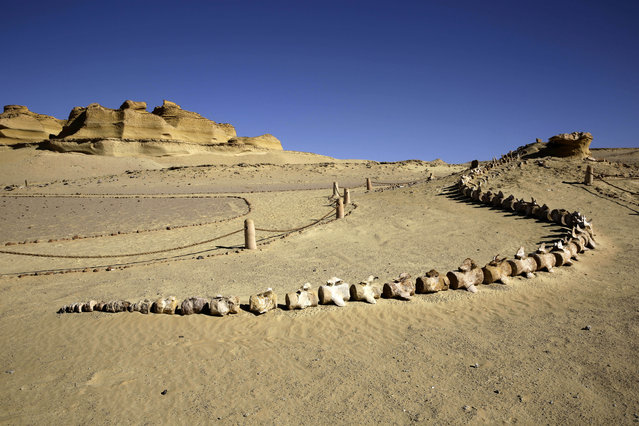
Fossilized whale bones are on display  outside the Wati El Hitan Fossils and Climate Change Museum, a UNESCO natural World Heritage site, on the opening day, in the Fayoum oasis, Egypt, Thursday, January 14, 2016. Egypt has cut the ribbon on the Middle East's first fossil museum housing the world's largest intact skeleton of a "walking whale" in an attempt to attract much-needed tourists driven off by recent militant attacks. The construction of the much-hyped Fossils and Climate Change Museum was covered a 2 billion euros (2. 17 billion dollars) grant from Italy, according to Italian Ambassador Maurizio Massari. (Photo by Thomas Hartwell/AP Photo)

Fossilized whale bones are on display outside the Wati El Hitan Fossils and Climate Change Museum, a UNESCO natural World Heritage site, on the opening day, in the Fayoum oasis, Egypt, Thursday, January 14, 2016. Egypt has cut the ribbon on the Middle East's first fossil museum housing the world's largest intact skeleton of a "walking whale" in an attempt to attract much-needed tourists driven off by recent militant attacks. The construction of the much-hyped Fossils and Climate Change Museum was covered a 2 billion euros (2. 17 billion dollars) grant from Italy, according to Italian Ambassador Maurizio Massari. Its centerpiece is an intact, 37-million-year-old and 20-meter-long skeleton of a legged form of whale that testifies to how modern-day whales evolved from land mammals. The sand-colored, dome-shaped museum is barely discernible in the breathtaking desert landscape that stretches all around. (Photo by Thomas Hartwell/AP Photo)
Details
16 Jan 2016 08:06:00
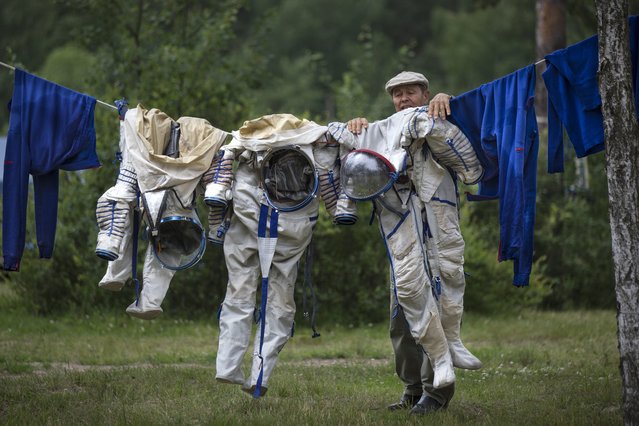
An employe of Russian Space Training Center hangs out to dry space suits of Russian cosmonaut Anatoly Ivanishin, NASA's U.S. flight engineer Kathleen Rubins, and Japanese space agency's flight engineer Takuya Onishi, right, after their undergoing  training near in Noginsk, 60 km (38 miles) east of Moscow, Russia, Wednesday, July 2, 2014. (Photo by Alexander Zemlianichenko/AP Photo)

An employe of Russian Space Training Center hangs out to dry space suits of Russian cosmonaut Anatoly Ivanishin, NASA's U.S. flight engineer Kathleen Rubins, and Japanese space agency's flight engineer Takuya Onishi, right, after their undergoing training near in Noginsk, 60 km (38 miles) east of Moscow, Russia, Wednesday, July 2, 2014. The training was intended to simulate the capsule landing on water. Russian cosmonaut Anatoly Ivanishin, Japanese space agency's flight engineer Takuya Onishi, and NASA's U.S. flight engineer Kathleen Rubins are being trained for a future mission to the International Space Station. (Photo by Alexander Zemlianichenko/AP Photo)
Details
05 Jul 2014 11:47:00
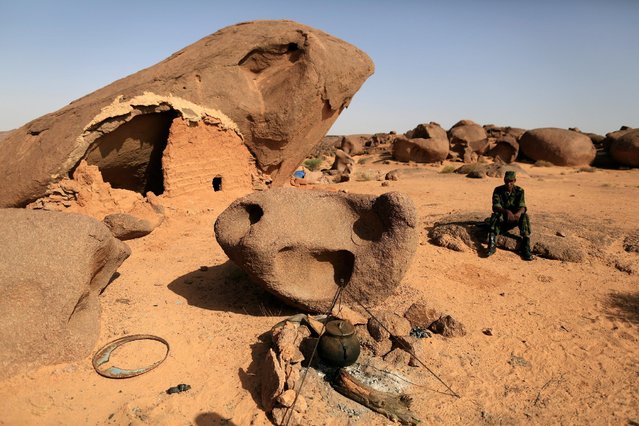
A Polisario fighter sits on a rock at a forward base on the outskirts of Tifariti, Western Sahara, September 9, 2016. At a rocky outpost in Western Sahara, a new generation of soldiers who have never known war are mobilising as tensions resurface in one of Africa's oldest disputes after a quarter century of uneasy peace. Young Sahrawi troops man new desert posts for the Polisario Front, which for more than 40 years has sought independence for the vast desert region - first in a guerrilla war against Morocco and then politically since a ceasefire deal in 1991. Now a standoff with Morocco, which controls the majority of Western Sahara, is renewing pressure for a diplomatic solution to ensure foot soldiers don't return to fighting as the last generation of commanders once did. The standoff since August has brought Moroccan and Polisario forces within 200 metres of each other in a narrow strip of land near the Mauritanian border. Rich in phosphate, Western Sahara has been contested since 1975 when Spanish colonial powers left. Morocco claimed the territory and fought the 16-year war with Polisario. (Photo by Zohra Bensemra/Reuters)

A Polisario fighter sits on a rock at a forward base on the outskirts of Tifariti, Western Sahara, September 9, 2016. At a rocky outpost in Western Sahara, a new generation of soldiers who have never known war are mobilising as tensions resurface in one of Africa's oldest disputes after a quarter century of uneasy peace. (Photo by Zohra Bensemra/Reuters)
Details
04 Nov 2016 12:09:00
A model slips on the runway while parading an outfit by Australian designer Toni Maticevski at Fashion Week Australia in Sydney on May 15, 2016. (Photo by William West/AFP Photo)

A model slips on the runway while parading an outfit by Australian designer Toni Maticevski at Fashion Week Australia in Sydney on May 15, 2016. (Photo by William West/AFP Photo)
Details
18 May 2016 14:26:00
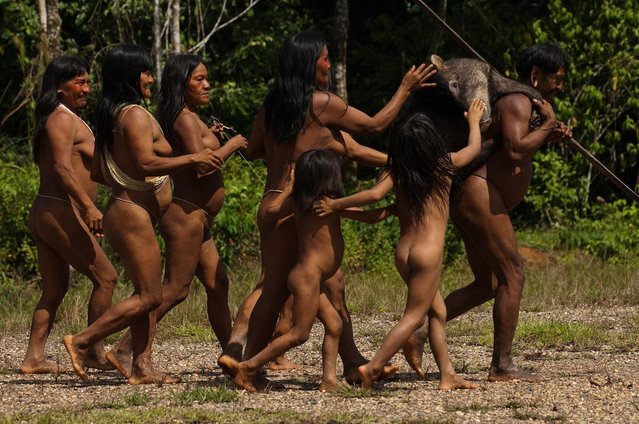
Spectacular images offering insight into the lives of the Huaorani people in the Ecuadorian Amazon have been revealed showing how they use traditional methods to hunt monkeys for food. The stunning pictures were taken by conservation photographer Pete Oxford from Torquay, Devon in the Ecuadorian Amazon. “The Huaorani Indians are a forest people highly in tune with their environment. Many are now totally acculturated since the 1950s by missionaries”, said Pete. “Today they face radical change to their culture to the proximity of oil exploration within their territory and the Yasuni National Park and Biosphere Reserve, they are vastly changed. Some still live very traditionally and for this shoot, through my Huaorani friend, a direct relative of those photographed he wanted to depict them as close to their original culture as possible. They still largely hunt with blow pipes and spears eating a lot of monkeys and peccaries”. The Huaorani are also known as the Waorani, Waodani or the Waos and are native Amerindians. Their lands are located between the Curaray and Napo rivers and speak the Huaorani language. Pete says that during his visit he was welcomed into the group and hopes that ancient cultures can be saved. Here: The tribe were seen celebrating after a hunter returned to camp with a wild pig. (Photo by Pete Oxford/Mediadrumworld.com)

Spectacular images offering insight into the lives of the Huaorani people in the Ecuadorian Amazon have been revealed showing how they use traditional methods to hunt monkeys for food. The stunning pictures were taken by conservation photographer Pete Oxford from Torquay, Devon in the Ecuadorian Amazon. Here: The tribe were seen celebrating after a hunter returned to camp with a wild pig. (Photo by Pete Oxford/Mediadrumworld.com)
Details
20 Jan 2017 07:58:00
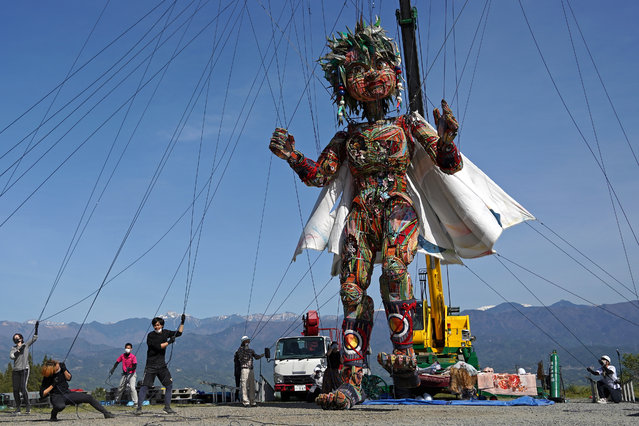
Handlers control the giant puppet MOCCO during a special training session in Takamori, Nagano prefecture, Friday, April 23, 2021. Tokyo 2020 organizers created about 10 meter-tall puppet to symbolize the spirit of the people from the regions affected by the 2011 earthquake and tsunami. The puppet will travel from Tohoku to Tokyo in May to be in place for the games scheduled to open in July. (Photo by Koji Ueda/AP Photo)

Handlers control the giant puppet MOCCO during a special training session in Takamori, Nagano prefecture, Friday, April 23, 2021. Tokyo 2020 organizers created about 10 meter-tall puppet to symbolize the spirit of the people from the regions affected by the 2011 earthquake and tsunami. The puppet will travel from Tohoku to Tokyo in May to be in place for the games scheduled to open in July. (Photo by Koji Ueda/AP Photo)
Details
24 Apr 2021 08:52:00
Women walk at lunch time along Kings Road in Chelsea during Storm Eunice, in London, Britain, February 18, 2022. (Photo by Kevin Coombs/Reuters)

Women walk at lunch time along Kings Road in Chelsea during Storm Eunice, in London, Britain, February 18, 2022. Britain put the army on standby Friday and schools closed as forecasters issued two rare “red weather” warnings of “danger to life” from fearsome winds and flooding due to the approaching storm Eunice. (Photo by Kevin Coombs/Reuters)
Details
19 Feb 2022 06:29:00
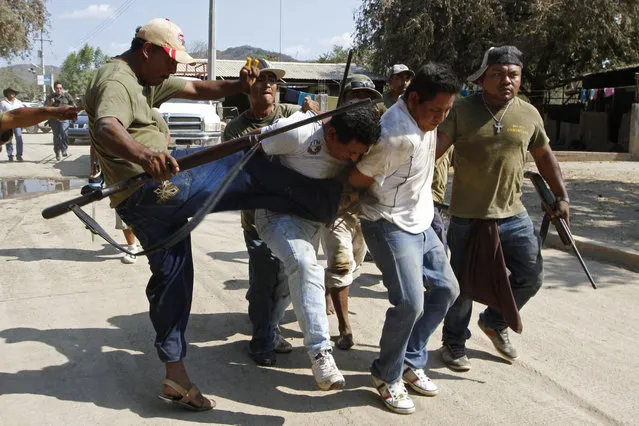
In this April 4, 2014 file photo, a community policeman kicks a man who they alledge participated in an ambush against them near the town of La Concepcion, Mexico. The vigilante force was set-up by affected communities opposed to the construction of the La Parota hydroelectric dam. Two vigilantes were injured and one died. (Photo by Bernandino Hernandez/AP Photo)

In this April 4, 2014 file photo, a community policeman kicks a man who they alledge participated in an ambush against them near the town of La Concepcion, Mexico. The vigilante force was set-up by affected communities opposed to the construction of the La Parota hydroelectric dam. Two vigilantes were injured and one died. (Photo by Bernandino Hernandez/AP Photo)
Details
16 Dec 2014 12:40:00