Loading...
Done
Pakistani truck drivers from different cities sit on the roof top of the buildings at Truck station offering Dua before breaking the fast during Holy month of Ramadan in Lahore on April 15, 2021. Ramadan is marked by daily fasting from dawn to sunset Islami's holy month of Ramadan-ul-Mubarak is celebrated by Muslims worldwide marked by fasting, abstaining from foods, sеx and smoking from dawn to dusk for soul cleansing and strengthening the spiritual bond between them and the Almighty. During the month of Ramadan Muslims enter into a period of discipline and worship: fasting during the day, and praying throughout the day and night. (Photo by Rana Sajid Hussain/Pacific Press/Rex Features/Shutterstock)

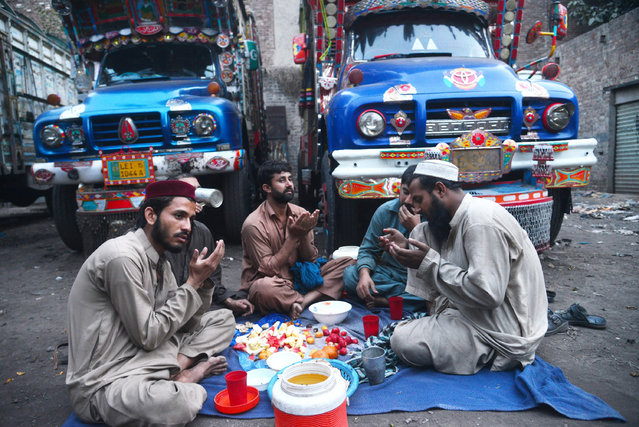
Pakistani truck drivers from different cities sit on the roof top of the buildings at Truck station offering Dua before breaking the fast during Holy month of Ramadan in Lahore on April 15, 2021. Ramadan is marked by daily fasting from dawn to sunset Islami's holy month of Ramadan-ul-Mubarak is celebrated by Muslims worldwide marked by fasting, abstaining from foods, sеx and smoking from dawn to dusk for soul cleansing and strengthening the spiritual bond between them and the Almighty. (Photo by Rana Sajid Hussain/Pacific Press/Rex Features/Shutterstock)
Details
23 Apr 2021 09:17:00


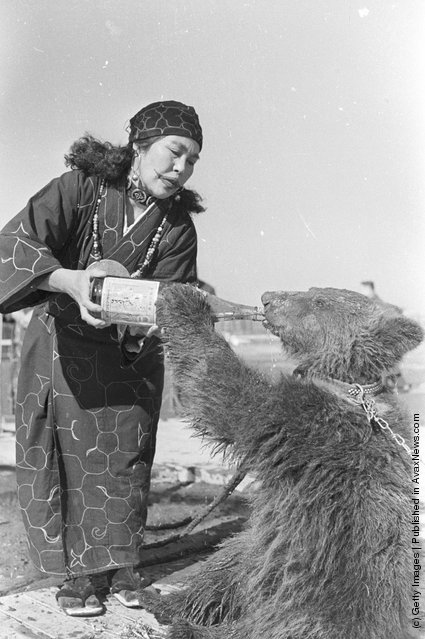
“The Ainu (アイヌ?), also called Aynu, Aino (アイノ), and in historical texts Ezo (蝦夷), are indigenous people or groups in Japan and Russia. Historically they spoke the Ainu language and related varieties and lived in Hokkaidō, the Kuril Islands, and much of Sakhalin. Most of those who identify themselves as Ainu still live in this same region, though the exact number of living Ainu is unknown. This is due to ethnic issues in Japan resulting in those with Ainu backgrounds hiding their identities and confusion over mixed heritages. In Japan, because of intermarriage over many years with Japanese, the concept of a 'pure Ainu' ethnic group is no longer feasible. Official estimates of the population are of around 25,000, while the unofficial number is upwards of 200,000 people”. – Wkipedia

Photo: A captive bear drinking from a large bottle held by an Ainu tribeswoman. (Photo by Evans/Three Lions/Getty Images). Circa 1955
Details
24 Mar 2011 14:01:00
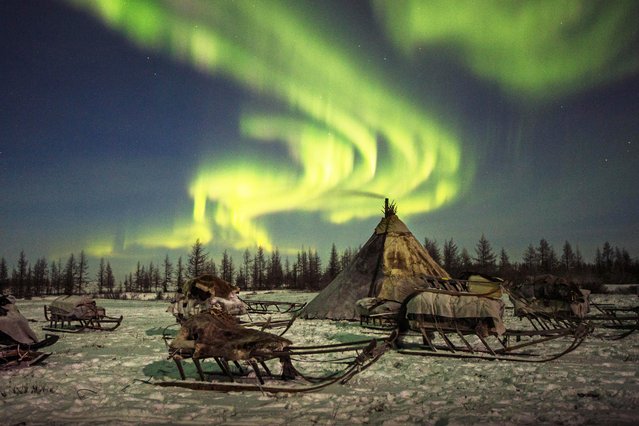
An empty camp is shown beneath a colourful sky in Siberia, December 2016. (Photo by Timothy Allen/Barcroft Productions)

A British photographer has captured life at the “edge of the world”. Timothy Allen, best known for his work on BBC's Human Planet, trekked through the freezing Siberian wilderness for 16 days as he joined part of an 800km migration of reindeer in the Yamal-Nenets region – a name that roughly translates to “edge of the world”. The stunning pictures feature the nomadic Nenets tribe, who drink blood to survive in -45°C temperatures. Timothy's epic journey, which will be revealed in an eight-minute documentary on Animal Planet USA, saw him travel across the bleak terrain of the frozen Ob River with the Nenets people in December last year. Here: An empty camp is shown beneath a colourful sky in Siberia, December 2016. (Photo by Timothy Allen/Barcroft Productions)
Details
19 Sep 2017 07:48:00
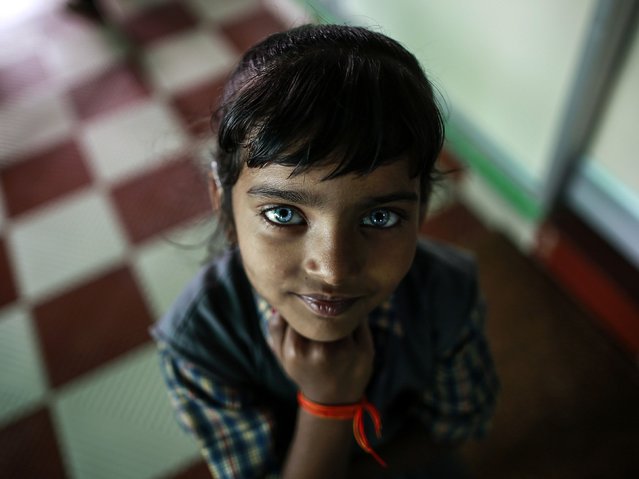
A girl who suffers from hearing and speech disorders reacts to the camera at a rehabilitation centre supported by Bhopal Medical Appeal, for children who were born with mental and physical disabilities, in Bhopal November 11, 2014.(Photo by Danish Siddiqui/Reuters)

A girl who suffers from hearing and speech disorders reacts to the camera at a rehabilitation centre supported by Bhopal Medical Appeal, for children who were born with mental and physical disabilities, in Bhopal November 11, 2014. The rehabilitation centre only treats families they believe have been affected by the Union Carbide gas leak 30 years ago. Human rights groups say that thousands of tonnes of hazardous waste remain buried underground, and the government has conceded it is contaminated. There has, however, been no long-term epidemiological research which conclusively proves that birth defects are directly related to the drinking of the contaminated water. (Photo by Danish Siddiqui/Reuters)
Details
30 Nov 2014 12:00:00
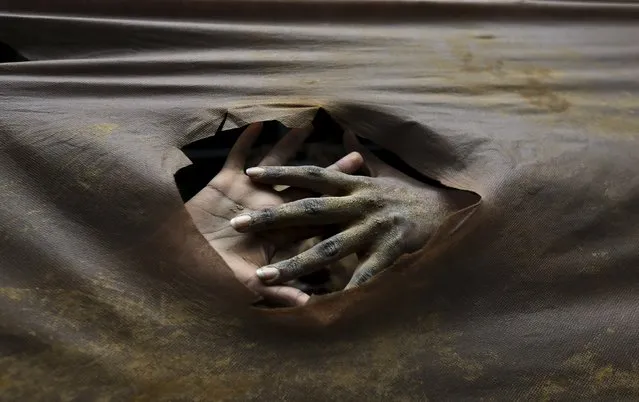
An environmental activist performs during a protest in front of the headquarters of Brazilian mining company Vale SA in downtown Rio de Janeiro, Brazil, November 16, 2015. (Photo by Sergio Moraes/Reuters)

An environmental activist performs during a protest in front of the headquarters of Brazilian mining company Vale SA in downtown Rio de Janeiro, Brazil, November 16, 2015. The collapse of two dams at a Brazilian mine, owned by Vale SA and BHP Billiton Ltd, has cut off drinking water for quarter of a million people and saturated waterways downstream with dense orange sediment that could wreck the ecosystem for years to come. Nine people were killed, 19 are still listed as missing and 500 people were displaced from their homes when the dams burst at an iron ore mine in southeastern Brazil on November 5. (Photo by Sergio Moraes/Reuters)
Details
18 Nov 2015 08:00:00
Spectators pose for a photo upon entry for Derby Day at Flemington Racecourse on October 30, 2021 in Melbourne, Australia. Victoria's COVID-19 restrictions have eased to allow spectators to return to Flemington racecourse for the first time since 2019. Up to 5,500 fully vaccinated fans are permitted to attend Derby Day, while the remainder of the Melbourne Cup Carnival Race days will have a spectator limit of 10,000 people. Under COVID-19 restrictions, all patrons to the Melbourne Cup Carnival will be separated into three zones, with allocated seats for the service of food and drink. Spectators will be required to wear masks at Flemington, despite Victoria's outdoor mask mandate easing on Friday. (Photo by Asanka Ratnayake/Getty Images)

Spectators pose for a photo upon entry for Derby Day at Flemington Racecourse on October 30, 2021 in Melbourne, Australia. Victoria's COVID-19 restrictions have eased to allow spectators to return to Flemington racecourse for the first time since 2019. (Photo by Asanka Ratnayake/Getty Images)
Details
18 Jun 2022 04:34:00
Dynam employees say a greeting message as they receive customer-care training ahead of the grand opening of the company's pachinko parlour in Fukaya, north of Tokyo July 29, 2014. (Photo by Issei Kato/Reuters)

Dynam employees say a greeting message as they receive customer-care training ahead of the grand opening of the company's pachinko parlour in Fukaya, north of Tokyo July 29, 2014. Japan's once-booming pachinko industry, grappling with a greying customer base and the threat of new competition from casinos, is adopting a softer touch and smoke-free zones to lure a new generation of players, particularly women. Pachinko, a modified version of pinball, is a fading national obsession, with about 12,000 parlours nation-wide and one in thirteen people playing the game. But that figure is declining as the population shrinks and younger people prefer games on their mobile phones. (Photo by Issei Kato/Reuters)
Details
25 Aug 2014 10:18:00
Hindu holy man, or sadhu, applies paint to his forehead at his ashram on the premises of Pashupatinath Temple in Kathmandu February 15, 2015. Hindu holy men from Nepal and India come to this temple to take part in the Maha Shivaratri festival. Celebrated by Hindu devotees all over the world, Shivaratri is dedicated to Lord Shiva. (Photo by Navesh Chitrakar/Reuters)

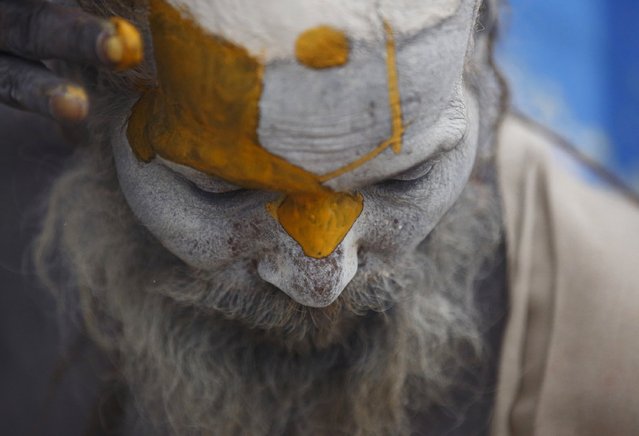
Hindu holy man, or sadhu, applies paint to his forehead at his ashram on the premises of Pashupatinath Temple in Kathmandu February 15, 2015. Hindu holy men from Nepal and India come to this temple to take part in the Maha Shivaratri festival. Celebrated by Hindu devotees all over the world, Shivaratri is dedicated to Lord Shiva, and holy men mark the occasion by praying, smoking marijuana or smearing their bodies with ashes. (Photo by Navesh Chitrakar/Reuters)
Details
16 Feb 2015 13:12:00