Loading...
Done
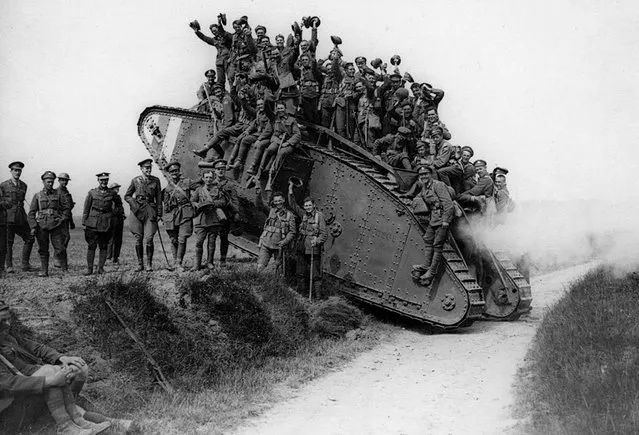
These black-and-white photos are taken from the new book “Armoured Warfare in the First World War 1916 – 1918” by Anthony Tucker-Jones and published by Pen & Sword Military. “Interestingly the British, French and Germans took completely different approaches with varying results”. The British military produced “Little Willie” in Autumn 1915 weighing 18 tonnes, which had a crew of two plus four gunners. “Inspired by a tracked artillery tractor “Little Willie” was referred to as a water tank – hence the name tank – to ensure secrecy”, said Anthony. “This led to the strange looking Mark I with its peculiar rhomboid shape, designed to cross trenches with guns in sponsons on either side. The Germans saw the tank as unchivalrous and were slow to grasp its utility. They favoured the Stormtrooper (specialist soldiers used to infiltrate enemy trenches) and artillery, not the tank”, said Anthony. “However, they didn’t hesitate to make use of captured British tanks. Although the tank helped secure victory and German soldiers dubbed it “Germany’s Downfall” the country was ultimately brought to its knees by the Allies blockade”. Here: British troops hitch a ride on a Mark IV after the massed tank fleet spearheading attack at Cambrai on November 20, 1917. (Photo by Anthony Tucker-Jones/Mediadrumworld.com)

These black-and-white photos are taken from the new book “Armoured Warfare in the First World War 1916 – 1918” by Anthony Tucker-Jones and published by Pen & Sword Military. Here: British troops hitch a ride on a Mark IV after the massed tank fleet spearheading attack at Cambrai on November 20, 1917. (Photo by Anthony Tucker-Jones/Mediadrumworld.com)
Details
23 Feb 2017 00:02:00
Hostesses pose in front of a Suzuki Ignis car at the European Motor Show in Brussels, Belgium, January 13, 2017. (Photo by Francois Lenoir/Reuters)

Hostesses pose in front of a Suzuki Ignis car at the European Motor Show in Brussels, Belgium, January 13, 2017. (Photo by Francois Lenoir/Reuters)
Details
14 Jan 2017 13:02:00
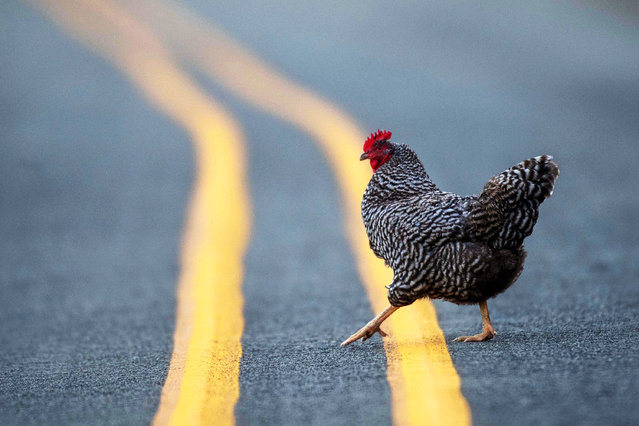
A chicken gingerly crosses the double yellow line of a country road near Roseburg in western Oregon, USA on July 16, 2018. (Photo by Robin Loznak/ZUMA Wire/Alamy Live News)

A chicken gingerly crosses the double yellow line of a country road near Roseburg in western Oregon, USA on July 16, 2018. (Photo by Robin Loznak/ZUMA Wire/Alamy Live News)
Details
22 Jul 2018 00:03:00
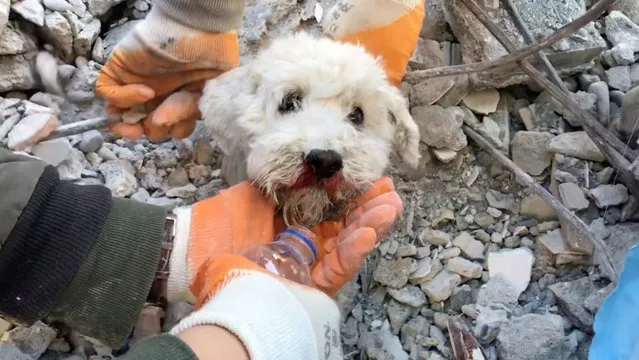
People work to rescue a dog from under rubble, in the aftermath of a deadly earthquake, in Iskenderun, Turkey February 8, 2023, in this screengrab obtained from a social media video. (Photo by Gurcan Ozturk via Reuters)

People work to rescue a dog from under rubble, in the aftermath of a deadly earthquake, in Iskenderun, Turkey February 8, 2023, in this screengrab obtained from a social media video. (Photo by Gurcan Ozturk via Reuters)
Details
19 Feb 2023 04:26:00
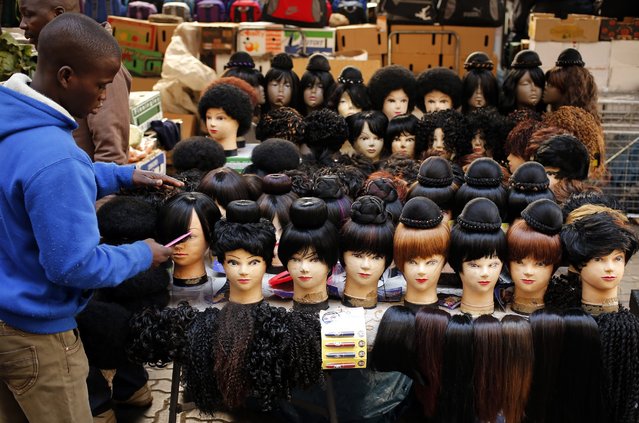
Man prepares wigs as he waits for customers in downtown Johannesburg. Some estimates put Africa's dry hair industry at as much as $6 billion a year; Nigerian singer Muma Gee recently boasted that she spends 500,000 naira ($3,100) on a single hair piece made of 11 sets of human hair. (Photo by Siphiwe Sibeko/Reuters)

Man prepares wigs as he waits for customers in downtown Johannesburg, on August 5, 2014. Some estimates put Africa's dry hair industry at as much as $6 billion a year; Nigerian singer Muma Gee recently boasted that she spends 500,000 naira ($3,100) on a single hair piece made of 11 sets of human hair. (Photo by Siphiwe Sibeko/Reuters)
Details
15 Aug 2014 09:08:00
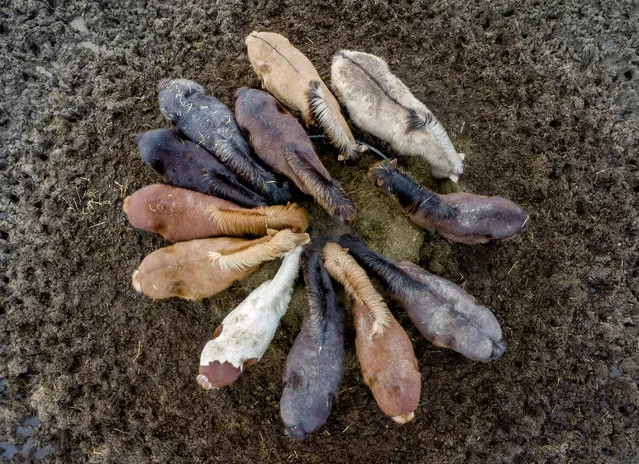
Icelandic stallions eat hay from a box at a stud farm in Wehrheim near Frankfurt, Germany, Wednesday, March 2, 2022. (Photo by Michael Probst/AP Photo)

Icelandic stallions eat hay from a box at a stud farm in Wehrheim near Frankfurt, Germany, Wednesday, March 2, 2022. (Photo by Michael Probst/AP Photo)
Details
20 Apr 2022 05:32:00
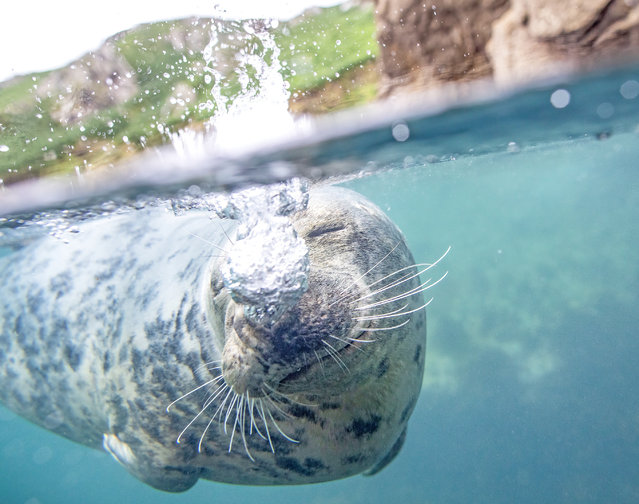
A curious grey seal investigates photographer Brian Matthews at Lundy Island off the north Devon coast, July 2024. *Photo by Brian Matthews/Solent News)

A curious grey seal investigates photographer Brian Matthews at Lundy Island off the north Devon coast, July 2024. *Photo by Brian Matthews/Solent News)
Details
23 Dec 2024 03:00:00
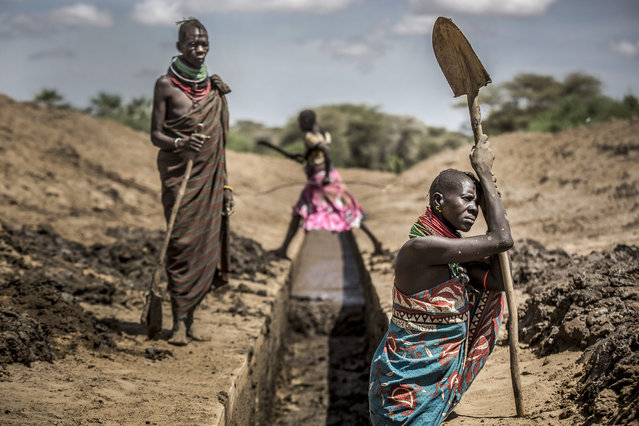
Members of the Turkana community work unblocking an irrigation canal to provide water to their sorghum crops in an arid dry area in Nanyee, near Lodwar, Turkana County, Kenya, on October 1, 2019. Turkana is a vast, dry area in the north-west of Kenya that is on the frontline of climate change. With regular searing temperatures the Turkana people are suffering from recurring and prolonged droughts. (Photo by Luis Tato/AFP Photo)

Members of the Turkana community work unblocking an irrigation canal to provide water to their sorghum crops in an arid dry area in Nanyee, near Lodwar, Turkana County, Kenya, on October 1, 2019. Turkana is a vast, dry area in the north-west of Kenya that is on the frontline of climate change. With regular searing temperatures the Turkana people are suffering from recurring and prolonged droughts. (Photo by Luis Tato/AFP Photo)
Details
28 Oct 2019 00:05:00