Loading...
Done


“Sektor gaza” (Russian: Сектор газа) was a Russian rock band formed on 5 December 1987 in the city of Voronezh, Russia. Despite only semi-officially existing (due to obscene lyrics), the group remains popular in Russia today. The group name was taken from an eponymous industrial district of Voronezh (itself named for high levels of environmental contamination). Their music style could be defined as Russian punk, integrated with elements of different musical genres such as rock, rap, and Russian folk. On 4 July 2000, group leader Yuri “Hoy” Klinskih complained of strong pains in his stomach and the left side of his chest. He suffered heart failure shortly thereafter. Klinskikh died in Voronezh (Russia)at the age of 35. He is buried in the Levoberezhniy Cemetery. The group ceased to exist.

About the music video: The First Chechen War, also known as the War in Chechnya, was a conflict between the Russian Federation and the Chechen Republic of Ichkeria, fought from December 1994 to August 1996. After the initial campaign of 1994 – 1995, culminating in the devastating Battle of Grozny, Russian federal forces attempted to seize control of the mountainous area of Chechnya but were set back by Chechen guerrilla warfare and raids on the flatlands in spite of Russia's overwhelming manpower, weaponry, and air support...
Details
24 May 2012 14:38:00
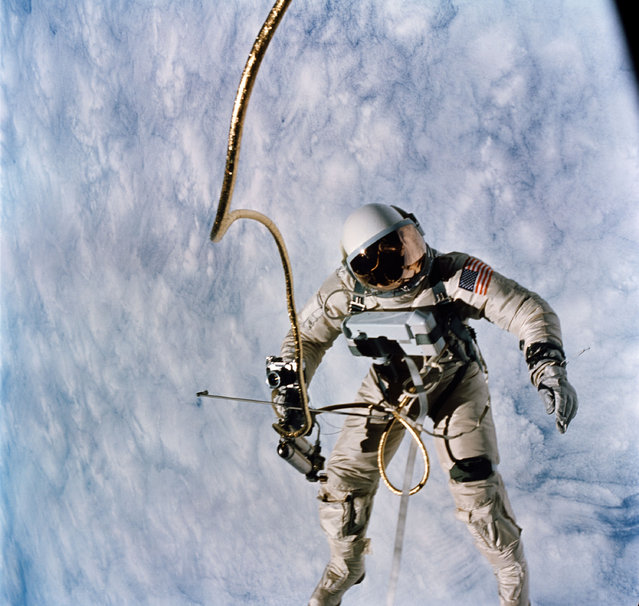
Astronaut Edward H. White II, pilot for the Gemini-Titan 4 (GT-4) spaceflight, floats in the zero-gravity of space during the third revolution of the GT-4 spacecraft on June 3, 1965. White wears a specially designed spacesuit. His face is shaded by a gold-plated visor to protect him from unfiltered rays of the sun. (Photo by NASA)

Astronaut Edward H. White II, pilot for the Gemini-Titan 4 (GT-4) spaceflight, floats in the zero-gravity of space during the third revolution of the GT-4 spacecraft on June 3, 1965. White wears a specially designed spacesuit. His face is shaded by a gold-plated visor to protect him from unfiltered rays of the sun. In his right hand he carries a Hand-Held Self-Maneuvering Unit (HHSMU) that gives him control over his movements in space. White also wears an emergency oxygen chest pack; and he carries a camera mounted on the HHSMU for taking pictures of the sky, Earth and the GT-4 spacecraft. He is secured to the spacecraft by a 25-feet umbilical line and a 23-feet tether line. Both lines are wrapped together in gold tape to form one cord. Astronaut James A. McDivitt, command pilot, remained inside the spacecraft during the extravehicular activity (EVA). Astronaut White died in the Apollo/Saturn 204 fire at Cape Kennedy on January 27, 1967. (Photo by NASA)
Details
22 Jul 2014 12:05:00
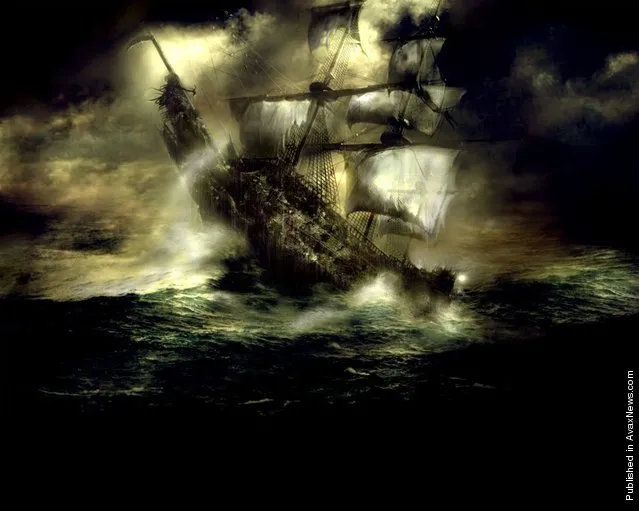
Ocean voyage

Do you think that history is a science? Well, not exactly. First, and foremost, history is the state's “legend of wars”, it’s official regalia. Of course, public historians are not interested in scientific truth – quite the opposite. In this respect, any attempt to present a state’s history as altruistic and benevolent as possible is welcomed and encouraged – as opposed to any revisionism attempts that may be more accurate. In this matter, Chinese have surpassed us all – they revised in highly creative manner (but rather shamelessly) the technology already invented by Europeans, a process that resulted in oldest state on the planet. Here is an interesting paradox: ask any sinologist about the Middle Kingdom during second century B.C., and he will describe it to you in such a vivid manner as if he has been living there all his life – but as soon as you will ask him to describe Chinese history in the 19-20th centuries… let's say, his eagerness will be greatly diminished. However, we will discuss China in a different article, and in the meantime we will try to understand how exactly historic “legend of wars” is formed and functions – based on a specific and well-known example. A great example is Ferdinand Magellan's first voyage around the world.
Details
14 Nov 2011 09:11:00
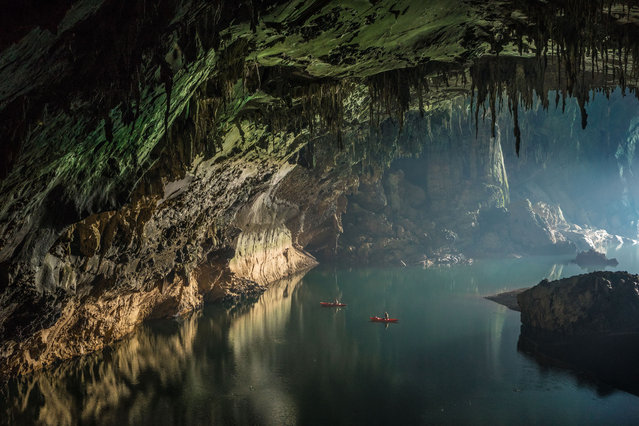
Floating on clear deep water and reflections near the cave entrance. Visitors can either bring their own kayaks or rent boats from the local community to paddle deep inside the cave and marvel at its wonders on March 2015 at Tham Khoun Ex, Laos. Tham Khoun Xe, commonly known as the Xe Bang Fai River Cave, in Laos, has over 15km of passages filled with awe-inspiring views and wide expanses of water. (Photo by John Spies/Barcroft Media/ABACAPress)

Floating on clear deep water and reflections near the cave entrance. Visitors can either bring their own kayaks or rent boats from the local community to paddle deep inside the cave and marvel at its wonders on March 2015 at Tham Khoun Ex, Laos. Tham Khoun Xe, commonly known as the Xe Bang Fai River Cave, in Laos, has over 15km of passages filled with awe-inspiring views and wide expanses of water. Photographer, John Spies, 59, captured scenes from the entrances of the huge underground river passages, intricate cave formations and views from a passage high above the water. The cave is formed by the Xe Bang Fai river, a major tributary of the Mekong and in the dry season can be traversed using inflatable kayaks. (Photo by John Spies/Barcroft Media/ABACAPress)
Details
11 Apr 2015 09:56:00
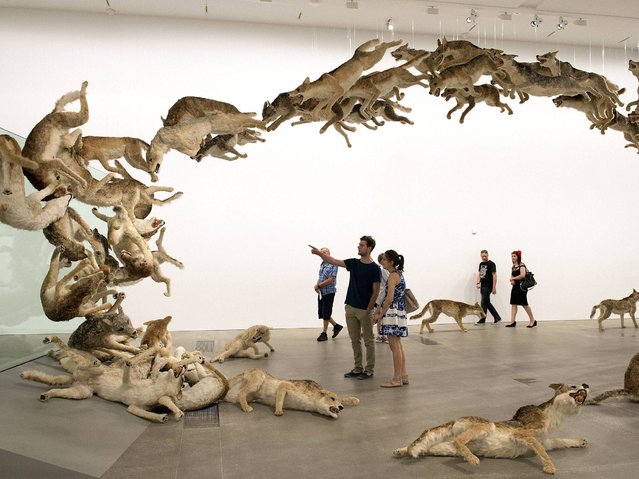
“Falling Back To Earth” promises to be both spectacular and meditative, and presents a beautiful, thought-provoking vision of our relationship with the earth and with each other. (Photo by Dave Hunt/EPA)

“Falling Back To Earth” promises to be both spectacular and meditative, and presents a beautiful, thought-provoking vision of our relationship with the earth and with each other. (Photo by Dave Hunt/EPA)
Details
14 Feb 2014 09:31:00
Runner-up; Hon Yen marine ecosystem. Phu Yen, Vietnam. Every year between May and August, the coral of this rich and diverse ecosystem becomes exposed at low tide. (Photo by Truong Hoai Vu/Royal Society of Biology Photography Competition)

Runner-up; Hon Yen marine ecosystem. Phu Yen, Vietnam. Every year between May and August, the coral of this rich and diverse ecosystem becomes exposed at low tide. (Photo by Truong Hoai Vu/Royal Society of Biology Photography Competition)
Details
31 Oct 2021 05:12:00
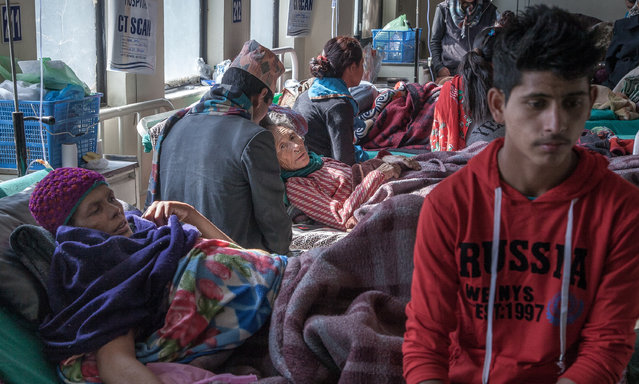
One of the most significant challenges related to cancer in Nepal is the lack of awareness around the prognosis of the disease, as many patients, their families and even healthcare professionals consider cancer to be an incurable disease at any stage. This results in significant delays in bringing patients to hospitals, and high rates of advanced stage cancers and mortality. (Photo by Omar Havana)

One of the most significant challenges related to cancer in Nepal is the lack of awareness around the prognosis of the disease, as many patients, their families and even healthcare professionals consider cancer to be an incurable disease at any stage. This results in significant delays in bringing patients to hospitals, and high rates of advanced stage cancers and mortality. (Photo by Omar Havana)
Details
06 Mar 2016 09:44:00
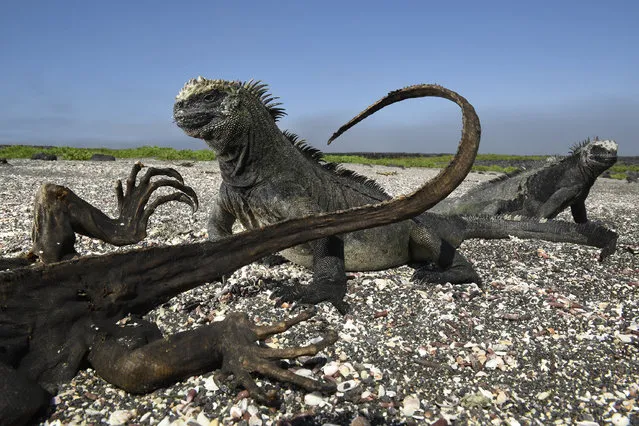
Galapagos – Rocking the Cradle: Four major ocean currents converge along the Galapagos archipelago, creating the conditions for an extraordinary diversity of animal life, April 25, 2016. The islands are home to at least 7,000 flora and fauna species, of which 97 percent of the reptiles, 80 percent of the land birds, 50 percent of the insects and 30 percent of the plants are endemic. The local ecosystem is highly sensitive to the changes in temperature, rainfall and ocean currents that characterize the climatic events known as El Niño and La Niña. These changes cause marked fluctuations in weather and food availability. Many scientists expect the frequency of El Niño and La Niña to increase as a result of climate change, making the Galapagos a possible early-warning location for its effects. (Photo by Thomas P. Peschak for National Geographic/World Press Photo)

Galapagos – Rocking the Cradle: Four major ocean currents converge along the Galapagos archipelago, creating the conditions for an extraordinary diversity of animal life, April 25, 2016. The islands are home to at least 7,000 flora and fauna species, of which 97 percent of the reptiles, 80 percent of the land birds, 50 percent of the insects and 30 percent of the plants are endemic. (Photo by Thomas P. Peschak for National Geographic/World Press Photo)
Details
16 Apr 2018 00:01:00