Loading...
Done
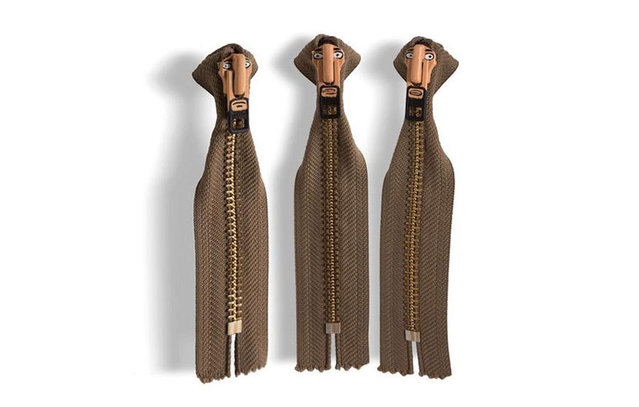
Everyday Objects Into Cute Characters By Gilbert Legrand Part 1

French artist Gilbert Legrand’s new series takes everyday objects like corkscrews, tape measures, and more and turns them into hilariously cute characters that almost make you forget their original purpose. Skillfully using each object’s natural shape, he crafts a character full of whimsy and personality. Each is painted to detail, with even the tiniest of characters bearing an expression which leaves no doubt as to their feelings about the situation. It truly takes a talented hand and imagination to turn paint brushes and zippers into humorous characters with surprisingly huge personalities.


See Also: Psrt 2 _ Part 3
Details
08 Jul 2014 10:29:00
Tridacna Gigas, or Giant Clams

“The giant clam, Tridacna gigas (known as pā’ua in Cook Islands Māori), is the largest living bivalve mollusc. T. gigas is one of the most endangered clam species. It was mentioned as early as 1825 in scientific reports. One of a number of large clam species native to the shallow coral reefs of the South Pacific and Indian oceans, they can weigh more than 200 kilograms (440 lb) measure as much as 120 cm (47 in) across, and have an average lifespan in the wild of 100 years or more”. – Wikipedia

Photo: Tridacna Gigas, or Giant Clams spew water as a traditional fisherman passes by a small sanctuary on January 23, 2004 near Bolinao in the Northern Philippines. The clams, prime builders for coral reefs and providing shelter for spawning fish and other marine life, are exposed by low tides in the sanctuary. Overfishing and pollution throughout the country are not only threatening food security, but are also starting to choke one of the few working clam sanctuaries in the world. (Photo by David Greedy/Getty Images)
Details
01 Oct 2011 13:10:00
Aliia Nasyrova laying her hair on the couch to show her hair's length on March 5, 2017 in Riga, Latvia. (Photo by  Eduard Kolik/Barcroft Media)

Aliia Nasyrova laying her hair on the couch to show her hair's length on March 5, 2017 in Riga, Latvia. Real-life Rapunzel Aliia Nasyrova has hair so long that her husband admits he thinks of it as another member of the family. Aliia, 27, who lives in Riga, Latvia, took 20 years to grow out her hair, which measures 90 inches to the floor – and even has its own space in the marital bed. And while her massive mane attracts stares when out in public, her husband Ivan Balaban says he loves it and is proud of her for not cutting it. Weighing in at 4.5lbs (2kg), Aliia says her lengthy locks weigh as much as the family cat. (Photo by Eduard Kolik/Barcroft Media)
Details
18 Mar 2017 10:46:00
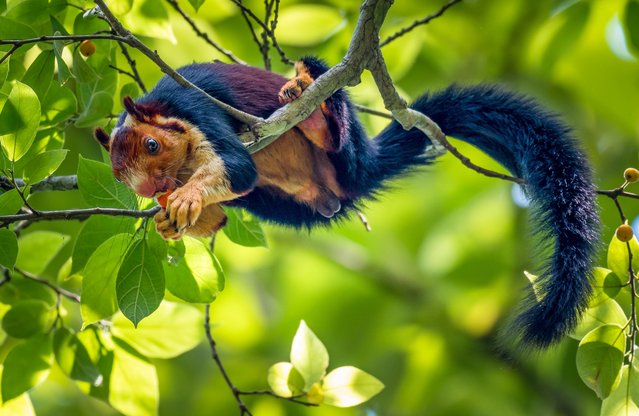
Its main predators are the birds of prey and the leopard. The Giant Squirrel is mostly active in the early hours of the morning and in the evening, resting in the midday. They are typically solitary animals that only come together for breeding. (Photo by Kaushik Vijayan/South West News Service)

The Malabar Giant squirrel – double the size of their grey relatives and measuring up to 36 inches (91.5 cm) from head to tail – lives deep in the forests of India. The athletic animals can leap an incredible 20 feet (6 m) between trees. Photographer Kaushik Vijayan, 39, snapped the animals in their native habit to produce these stunning images. Kaushik, from Kerala State, India, said: “Up until that point I had never heard about a squirrel like that or seen one. The sight was an absolute feast for my eyes. The squirrels fascinated me and I got excited to capture this beauty on my camera”. (Photo by Kaushik Vijayan/South West News Service)
Details
04 Apr 2019 00:03:00
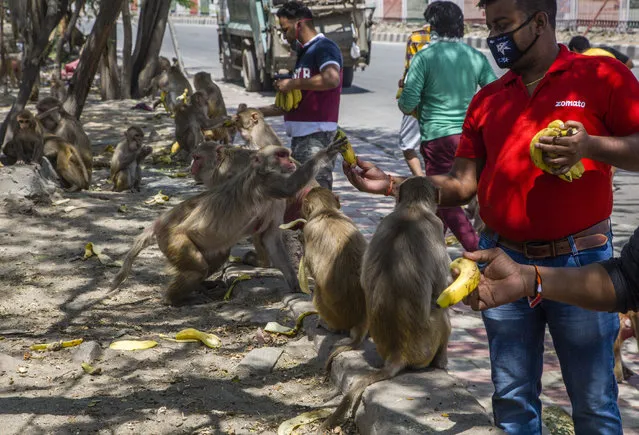
Men give bananas to monkeys gathered on the side of the road as India remains under an unprecedented lockdown over the highly contagious coronavirus (COVID-19) on April 08, 2020 in New Delhi, India. Wild animals, including monkeys, are roaming human settlements in India as people are staying indoors due to the 21-day lockdown. With India's 1.3 billion population and tens of millions of cars off the roads, wildlife is moving towards areas inhabited by humans. Wild animals in many countries have been seen roaming streets. A study says some 60 percent of the new diseases found around the globe every year are zoonotic, meaning they originate in animals and are passed on to humans. COVID-19 is a zoonotic disease that is suspected to have come from the wet markets of Wuhan, China. (Photo by Yawar Nazir/Getty Images)

Men give bananas to monkeys gathered on the side of the road as India remains under an unprecedented lockdown over the highly contagious coronavirus (COVID-19) on April 08, 2020 in New Delhi, India. Wild animals, including monkeys, are roaming human settlements in India as people are staying indoors due to the 21-day lockdown. (Photo by Yawar Nazir/Getty Images)
Details
12 Apr 2020 00:05:00
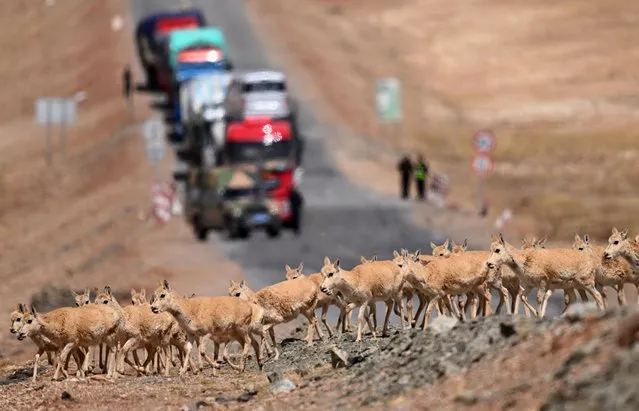
Pregnant Tibetan antelopes move across the Qinghai-Tibet highway in Hoh Xil, northwest China's Qinghai Province, May 29, 2023. A growing number of pregnant Tibetan antelopes are migrating to the heart of northwest China's Hoh Xil National Nature Reserve to give birth, according to the reserve's management office. Every year, tens of thousands of pregnant Tibetan antelopes start their migration to Hoh Xil in around May to give birth and leave with their offspring in late July. Under the first-class state protection in China, the once-endangered species is found in Tibet Autonomous Region, Qinghai Province, and Xinjiang Uygur Autonomous Region. Their population has increased over the past three decades thanks to the ban on illegal hunting and other measures implemented to improve its habitat. (Photo by Xinhua News Agency/Rex Features/Shutterstock)

Pregnant Tibetan antelopes move across the Qinghai-Tibet highway in Hoh Xil, northwest China's Qinghai Province, May 29, 2023. A growing number of pregnant Tibetan antelopes are migrating to the heart of northwest China's Hoh Xil National Nature Reserve to give birth, according to the reserve's management office. Every year, tens of thousands of pregnant Tibetan antelopes start their migration to Hoh Xil in around May to give birth and leave with their offspring in late July. (Photo by Xinhua News Agency/Rex Features/Shutterstock)
Details
08 Jun 2023 02:20:00
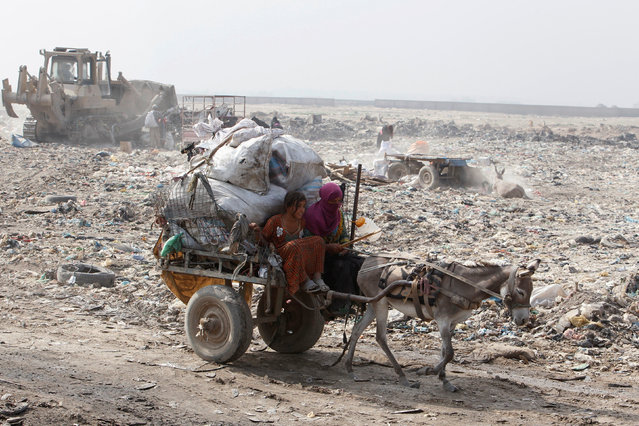
Garbage pickers collect ride on donkey cart while looking for recyclable materials at a rubbish dump in the outskirts of Baghdad, Iraq, August 23, 2016. Despite its huge untapped oil and gas reserves and steadily rising oil output and revenue, 23 percent of the population live below the poverty line, according to the Ministry of Planning. Eg, for 12-year-old Mohammed, life in Sadr City means long days during his school holidays scrabbling through the refuse in the scorching summer heat before selling his daily haul to a middleman. He sells each kilogram (2.2 lb) of plastic bottles or soda cans for 250 Iraqi dinars (around 20 U.S. cents), earning between 2,000 to 4,000 dinars ($1.50–$3) a day. A International Labor Organization report listing dangerous jobs in which children are engaged across the world mentioned collecting garbage as one of the activities in which minors risked suffering violence and injury. (Photo by Khalid al Mousily/Reuters)

Garbage pickers collect ride on donkey cart while looking for recyclable materials at a rubbish dump in the outskirts of Baghdad, Iraq, August 23, 2016. Despite its huge untapped oil and gas reserves and steadily rising oil output and revenue, 23 percent of the population live below the poverty line, according to the Ministry of Planning. (Photo by Khalid al Mousily/Reuters)
Details
24 Aug 2016 11:52:00
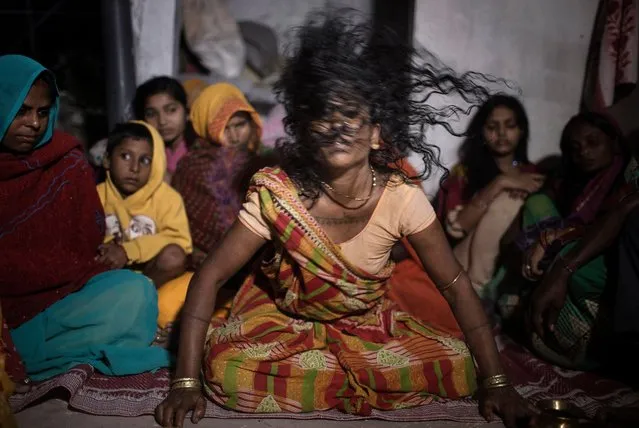
Marani Devi Chaudhary (C), aged 40, performs a ritual in front of shaman Paltan Yadav (unseen) at her home in Rajaur village in Dhanusha district, Nepal, 02 November 2017. The shaman identified Marani Devi to be possessed by their lineage god who was dissatisfied by their worship is thought by the family to have caused them misfortune and is even feared lead to their death. Therefore Marani Devi spent 1,500 USD to perform a healing ritual at the Ghost Festival held at the banks of Kamala River in Dhanusha district two days later. Every family or community has their own sacred god, called 'Kuldevta' in Nepali which means family deity or lineage god. Only family members or people within communities of the same caste can worship to the deity. They have their own rules and regulations of worship which varies from one family and community to another. Being unable to follow the rules and regulations or carry out worship is believed to cause misfortune. (Photo by Narendra Shrestha/EPA/EFE)

Marani Devi Chaudhary (C), aged 40, performs a ritual in front of shaman Paltan Yadav (unseen) at her home in Rajaur village in Dhanusha district, Nepal, 02 November 2017. The shaman identified Marani Devi to be possessed by their lineage god who was dissatisfied by their worship is thought by the family to have caused them misfortune and is even feared lead to their death. (Photo by Narendra Shrestha/EPA/EFE)
Details
17 Nov 2017 06:53:00