Loading...
Done
English fashion model Daisy Lowe seen at Christopher Kane at Tate Britain on Day 4 of London Fashion Week February 2017 on February 20, 2017 in London, England. (Photo by SAV/GC Images)

English fashion model Daisy Lowe seen at Christopher Kane at Tate Britain on Day 4 of London Fashion Week February 2017 on February 20, 2017 in London, England. (Photo by SAV/GC Images)
Details
05 Jan 2018 07:06:00
A visitor tries the Segway “S-Pod” motorized chair on the manufacturer's booth during the 2020 International Consumer Electronics Show (CES) at the Las Vegas Convention Center in Las Vegas, Nevada, USA, 08 January 2020. (Photo by Etienne Laurent/EPA/EFE)

A visitor tries the Segway “S-Pod” motorized chair on the manufacturer's booth during the 2020 International Consumer Electronics Show (CES) at the Las Vegas Convention Center in Las Vegas, Nevada, USA, 08 January 2020. (Photo by Etienne Laurent/EPA/EFE)
Details
11 Jan 2020 00:05:00
Female Afghan National Police (ANP) officers aim their weapons during a drill at a training centre near the German Bundeswehr army camp Marmal in Mazar-e-Sharif, northern Afghanistan on December 11, 2012. (Photo by Fabrizio Bensch/Reuters/File Photo)

Female Afghan National Police (ANP) officers aim their weapons during a drill at a training centre near the German Bundeswehr army camp Marmal in Mazar-e-Sharif, northern Afghanistan on December 11, 2012. (Photo by Fabrizio Bensch/Reuters/File Photo)
Details
19 Aug 2021 09:25:00
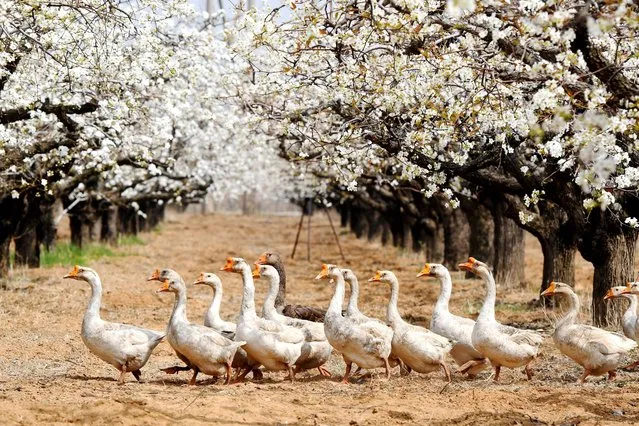
Geese are walking under pear trees in full bloom in Shiliangliu village, West Coast New District, in Qingdao, China, on April 8, 2024. (Photo by Costfoto/NurPhoto/Rex Features/Shutterstock)

Geese are walking under pear trees in full bloom in Shiliangliu village, West Coast New District, in Qingdao, China, on April 8, 2024. (Photo by Costfoto/NurPhoto/Rex Features/Shutterstock)
Details
25 Apr 2024 03:23:00
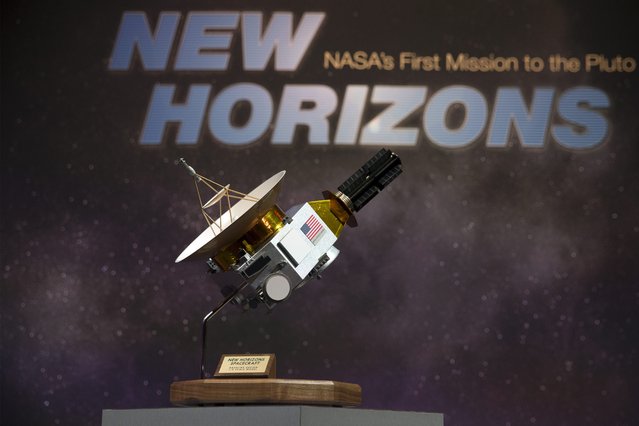
A model of the New Horizons spacecraft is seen at a live television program on NASA television celebrating the spacecraft's closest proximity to Pluto, at Johns Hopkins University Applied Physics Laboratory, site of the mission operations center, in Laurel, Maryland, USA, 14 July 2015. (Photo by Michael Reynolds/EPA)

A model of the New Horizons spacecraft is seen at a live television program on NASA television celebrating the spacecraft's closest proximity to Pluto, at Johns Hopkins University Applied Physics Laboratory, site of the mission operations center, in Laurel, Maryland, USA, 14 July 2015. At approximately 7:49 am ET (11:49 am GMT), 14 July, New Horizons was scheduled to be as close to Pluto as the spacecraft will get; about 7,800 miles (12,500 kilometers) above the surface, following a journey of more than nine years and three billion miles. This is the first mission to the Pluto System and the Kuiper Belt. (Photo by Michael Reynolds/EPA)

Details
15 Jul 2015 10:08:00
Brazilian model Izabel Goulart for the screening of the film “Sink Or Swim (Le Grand Bain)” at the 71st Cannes Film Festival, France on May 13, 2018. (Photo by Stephane Mahe/Reuters)

Brazilian model Izabel Goulart for the screening of the film “Sink Or Swim (Le Grand Bain)” at the 71st Cannes Film Festival, France on May 13, 2018. (Photo by Stephane Mahe/Reuters)
Details
16 May 2018 00:05:00
The Leshan Giant Buddha, a 71-metre tall stone statue, is carved out of a cliff face in the southern part of Sichuan province in China. (Photo by Suchet Suwanmongkol/500px)

The Leshan Giant Buddha, a 71-metre tall stone statue, is carved out of a cliff face in the southern part of Sichuan province in China. (Photo by Suchet Suwanmongkol/500px)
Details
06 Oct 2016 09:51:00
On August 31, 2012, a long filament of solar material that had been hovering in the sun's atmosphere, the corona, erupted out into space at 4:36 p.m. EDT. The coronal mass ejection, or CME, traveled at over 900 miles per second. The CME did not travel directly toward Earth, but did connect with Earth's magnetic environment, or magnetosphere, causing aurora to appear on the night of Monday, September 3. (Photo by NASA/GSFC/SDO)

On August 31, 2012, a long filament of solar material that had been hovering in the sun's atmosphere, the corona, erupted out into space at 4:36 p.m. EDT. The coronal mass ejection, or CME, traveled at over 900 miles per second. The CME did not travel directly toward Earth, but did connect with Earth's magnetic environment, or magnetosphere, causing aurora to appear on the night of Monday, September 3. (Photo by NASA/GSFC/SDO via The Atlantic)
Details
14 Sep 2012 09:01:00