Loading...
Done
A donkey savors warming temperatures after a long winter at the zoo in Warsaw, Poland, on Wednesday, April 8, 2015. (Photo by Czarek Sokolowski/AP Photo)

A donkey savors warming temperatures after a long winter at the zoo in Warsaw, Poland, on Wednesday, April 8, 2015. (Photo by Czarek Sokolowski/AP Photo)
Details
11 Apr 2015 11:12:00
A walruses at Hagenbeck Zoo in Hamburg, Germany on  July, 7, 2015. (Photo by Werner Struss/Startraks action)

A walruses at Hagenbeck Zoo in Hamburg, Germany on July, 7, 2015. (Photo by Werner Struss/Startraks action)
Details
12 Jul 2015 13:06:00
Riot police stand guard behind a fire as refinery workers hold a blockade of the oil depot of Douchy-Les-Mines to protest against the government's proposed labour reforms, on May 25, 2016. Refinery workers stepped up strikes that threaten to paralyse France weeks ahead of the Euro 2016 tournament as the government moved to break their blockades, escalating a three-month tug-of-war over labour reforms. (Photo by François L.O./AFP Photo)

Riot police stand guard behind a fire as refinery workers hold a blockade of the oil depot of Douchy-Les-Mines to protest against the government's proposed labour reforms, on May 25, 2016. Refinery workers stepped up strikes that threaten to paralyse France weeks ahead of the Euro 2016 tournament as the government moved to break their blockades, escalating a three-month tug-of-war over labour reforms. (Photo by François L.O./AFP Photo)
Details
26 May 2016 13:02:00
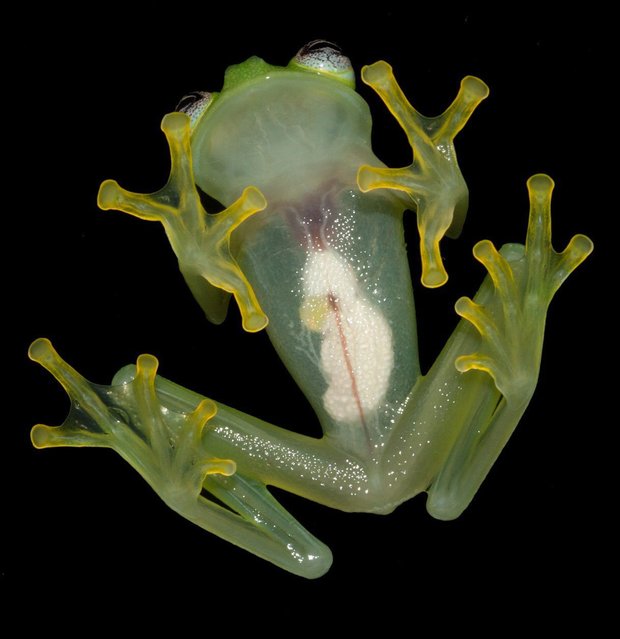
A handout photograph provided by Brian Kubicki of Costa Rican Amphibian Research Center on 26 April 2016 shows a “Crystal frog”, Hyalinobatrachium dianae (H. diane). This frog was discovered by US biologist Brian Kubicki and Costa Ricans Stanley Salazar and Robert Puschendorf in a rainy forest of Costa Rican caribbean after 40 years without notice of any new example of this kind. (Photo by Brian Kubicki/EPA/Costa Rican Amphibian Research Center)

A handout photograph provided by Brian Kubicki of Costa Rican Amphibian Research Center on 26 April 2016 shows a “Crystal frog”, Hyalinobatrachium dianae (H. diane). This frog was discovered by US biologist Brian Kubicki and Costa Ricans Stanley Salazar and Robert Puschendorf in a rainy forest of Costa Rican caribbean after 40 years without notice of any new example of this kind. (Photo by Brian Kubicki/EPA/Costa Rican Amphibian Research Center)
Details
02 May 2015 15:23:00
A Geisha girl pouring a drink for a visitor, circa 1955. (Photo by Fox Photos)

A Geisha girl pouring a drink for a visitor, circa 1955. (Photo by Fox Photos). P.S. All pictures are presented in high resolution.
Details
07 Sep 2012 11:24:00
British singer-songwriter Rita Ora visits The Empire State Building on July 09, 2024 in New York City. (Photo by Dimitrios Kambouris/Getty Images for Empire State Realty Trust)

British singer-songwriter Rita Ora visits The Empire State Building on July 09, 2024 in New York City. (Photo by Dimitrios Kambouris/Getty Images for Empire State Realty Trust)
Details
21 Jul 2024 04:59:00
Alisa, 10, gets a kiss from one of the wolves her family tamed in the village of Zacherevye, Belarus, on August 17, 2014. (Photo by Sergei Gapon/AFP Photo)

Alisa, 10, gets a kiss from one of the wolves her family tamed in the village of Zacherevye, Belarus, on August 17, 2014. (Photo by Sergei Gapon/AFP Photo)
Details
23 Aug 2014 12:15:00
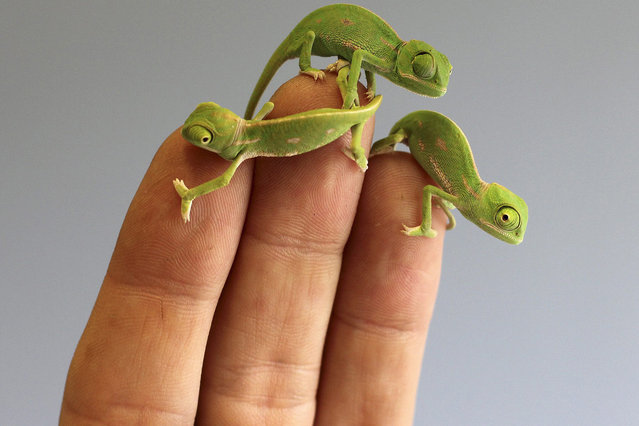
A handout image released by the Taronga Zoo shows Veiled Chameleon hatchlings at Taronga Zoo in Sydney, Australia, 11 March 2015. Taronga has welcomed more than 20 baby chameleons, with the last of three clutches of eggs hatching this week. Veiled Chameleons, or Chamaeleo calyptratus, are native to Saudi Arabia and Yemen and can live up to five years. (Photo by EPA/Taronga Zoo)


A handout image released by the Taronga Zoo shows Veiled Chameleon hatchlings at Taronga Zoo in Sydney, Australia, 11 March 2015. Taronga has welcomed more than 20 baby chameleons, with the last of three clutches of eggs hatching this week. Veiled Chameleons, or Chamaeleo calyptratus, are native to Saudi Arabia and Yemen and can live up to five years. (Photo by EPA/Taronga Zoo)

Details
21 Mar 2015 13:13:00