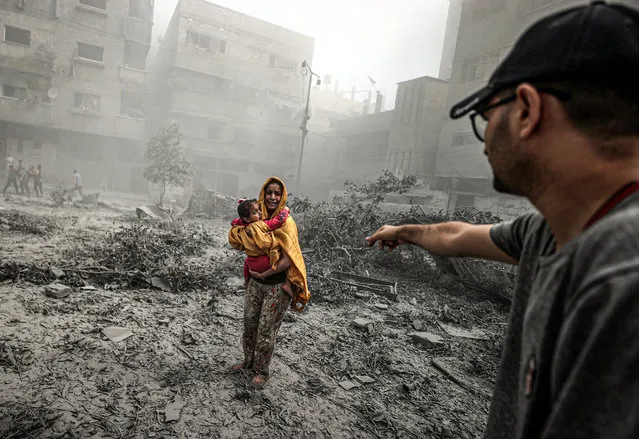
A man looks out of a window as Palestinians inspect the site and search for casualties of an overnight Israeli air strike on a house at al-Shati (Beach) refugee camp, in Gaza City, on July 15, 2025. (Photo by Mahmoud Issa/Reuters)
People take part in a lowrider car show celebrating lowriding culture and supporting immigration, in San Francisco, California, U.S., September 20, 2025. (Photo by Manuel Orbegozo/Reuters)
An England fan poses for a photo outside the stadium before their international friendly match against Bosnia and Herzegovina in Newcastle, Britain on June 3, 2024. (Photo by Lee Smith/Action Images via Reuters)
Models and Caroline Scheufele, Artistic Director and Co-President of Chopard (C) pose during a photocall ahead of the Chopard Gold Party during the 68th Cannes Film Festival in Cannes, southern France, May 18, 2015. (Photo by Yves Herman/Reuters)
Pakistani street performers sit around fire waiting for customers on a chilly evening in Rawalpindi, Pakistan, Wednesday, February 10, 2016. (Photo by B.K. Bangash/AP Photo)
Women in yukatas, or casual summer kimonos, take their selfie in front of paper lanterns during the annual Mitama Festival at the Yasukuni Shrine, where more than 2.4 million war dead are enshrined, in Tokyo, Japan July 13, 2017. (Photo by Kim Kyung-Hoon/Reuters)
The War in Abkhazia from 1992 to 1993 was fought between Georgian government forces for the most part, and Abkhaz separatist forces, Russian armed forces and North Caucasian militants. Ethnic Georgians who lived in Abkhazia fought largely on the side of Georgian government forces. Ethnic Armenians and Russians within Abkhazia's population largely supported the Abkhazians, and many fought on their side. The separatists received support from thousands of North Caucasus and Cossack militants and from the Russian Federation forces stationed in and near Abkhazia. Here: Abkhazia. Sukhumi, 1993. A house-to-house combat. (Photo by Andrei Solovyov/ITAR-TASS)