Aerialists of the Hungarian troupe Vincze Tunde Production perform on the opening night of Strand Festival in Zamardi, Hungary, 20 August 2025. (Photo by Tamas Vasvari/EPA)
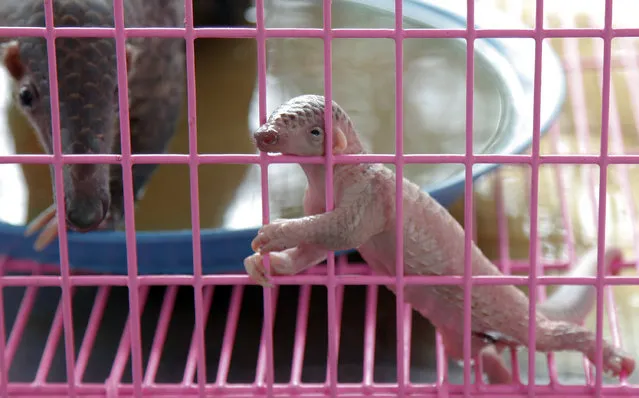
A newborn baby pangolin climbs the walls of a cage in Bangkok, Thailand April 20, 2011. The Thai custom office showed 175 pangolins they found hidden in a truck heading into Bangkok. (Photo by Damir Sagolj/Reuters)
A man is seen wrapped with pythons, some which include the Albino Burmese Python, as part of a show celebrating the coming Year of the Snake in the Chinese calendar, while spectators look on, in Malabon city, north of Manila, Philippines, December 28, 2012. (Photo by Romeo Ranoco/Reuters)
An alleged albino cub of Jaguarundi (Herpailurus yagouaroundi) plays at the Conservation Park in Medellin, Colombia, on December 23, 2021. According to environmentalists of the Conservation Park of Medellin, the little Jaguarundi will have to live in captivity as its albinism prevents it to hunt, camouflage, and protect itself from predators in the wild. (Photo by Fredy Builes/AFP Photo)
A conductor (C) collects fares from candy floss sellers as they travel in a tram to a marketplace early morning in Kolkata, India, December 23, 2015. (Photo by Rupak De Chowdhuri/Reuters)
A mudlark uses a torch to look for items on the bank of the River Thames in London, Britain June 06, 2016. Mudlarking is believed to trace its origins to the 18th and 19th century, when scavengers searched the Thames' shores for items to sell. These days, history and archaeology fans are the ones hoping to find old relics such as coins, ceramics, artifacts or everyday items from across centuries. their finds with the Portable Antiquities Scheme. Any item over 300 years old must be recorded. (Photo by Neil Hall/Reuters)