Loading...
Done
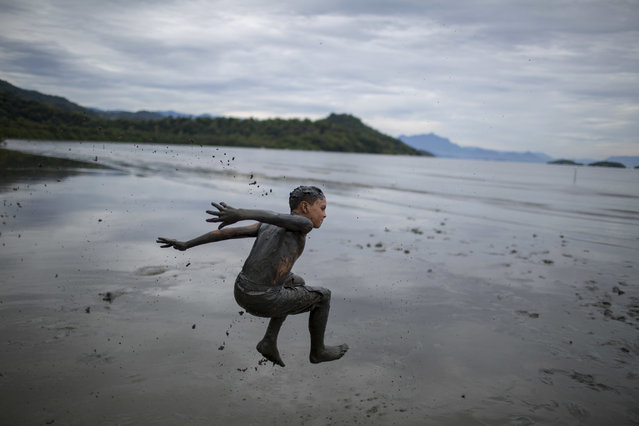
A boy jumps into a pool of mud during the traditional “Bloco da Lama” or “Mud Street” carnival party, in Paraty, Brazil, Saturday, February 25, 2017. Legend has it the “bloco” was born in 1986 after local teens hiking in a nearby mangrove forest smeared themselves with mud to discourage mosquitoes and then wandered through Paraty. The party grew year after year, but revelers eventually were banned from parading in the colonial downtown after shopkeepers complained pristine white walls were stained with the hard-to-remove mud. (Photo by Mauro Pimentel/AP Photo)

A boy jumps into a pool of mud during the traditional “Bloco da Lama” or “Mud Street” carnival party, in Paraty, Brazil, Saturday, February 25, 2017. Legend has it the “bloco” was born in 1986 after local teens hiking in a nearby mangrove forest smeared themselves with mud to discourage mosquitoes and then wandered through Paraty. The party grew year after year, but revelers eventually were banned from parading in the colonial downtown after shopkeepers complained pristine white walls were stained with the hard-to-remove mud. (Photo by Mauro Pimentel/AP Photo)
Details
28 Mar 2017 09:07:00
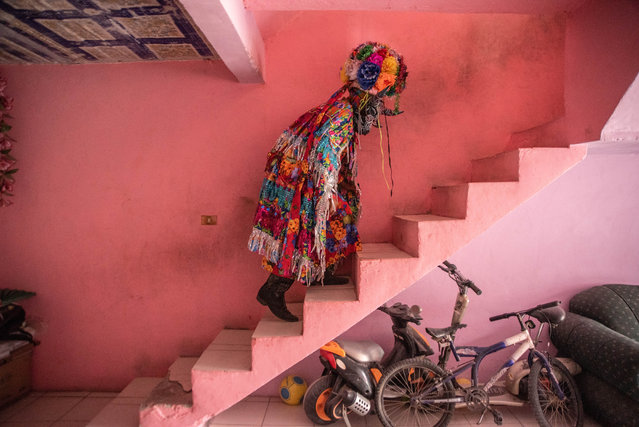
Inhabitants of the community of Coyolillo celebrate their Afro-descendant carnival in Veracruz, Mexico on February 25, 2020. This carnival has more than 100 years of history and is the heritage of the African workers who arrived in that area more than 300 years ago to work in the sugar cane fields. The event is known for the colourful robes, capes and animal masks – of bulls, deer, goats and cows – worn by participants. As such, the carnival is a unique expression of African-Mexican folk art. (Photo by Hector Adolfo Quintanar Perez/ZUMA Wire/Rex Features/Shutterstock)

Inhabitants of the community of Coyolillo celebrate their Afro-descendant carnival in Veracruz, Mexico on February 25, 2020. This carnival has more than 100 years of history and is the heritage of the African workers who arrived in that area more than 300 years ago to work in the sugar cane fields. (Photo by Hector Adolfo Quintanar Perez/ZUMA Wire/Rex Features/Shutterstock)
Details
05 Mar 2020 00:03:00
Performers on boats take part in the Qintong Boat Festival at Qin Lake National Wetland Park on April 6, 2019 in Taizhou, Jiangsu Province of China. The boat festival is held around the Qingming Festival every year, and up to 10,000 participants from nearby villages and towns, with more than 500 boats, took part in the event this year. (Photo by Tang Dehong/VCG via Getty Images)

Performers on boats take part in the Qintong Boat Festival at Qin Lake National Wetland Park on April 6, 2019 in Taizhou, Jiangsu Province of China. The boat festival is held around the Qingming Festival every year, and up to 10,000 participants from nearby villages and towns, with more than 500 boats, took part in the event this year. (Photo by Tang Dehong/VCG via Getty Images)
Details
18 May 2019 00:05:00
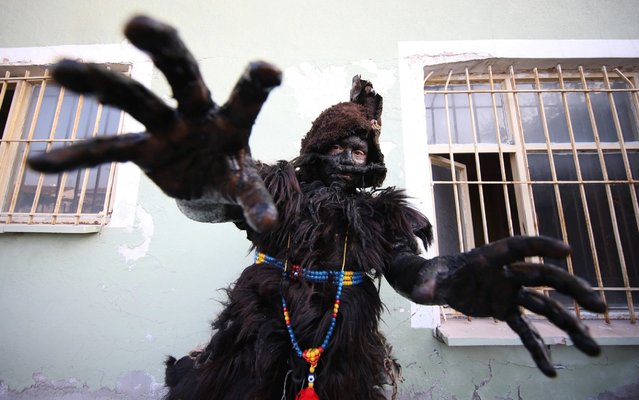
A leather worker with his frightening types of clothes prepares after painted themselves using chimney soot as they participate in a programme within the September 6 celebrations, in Balikesir, Turkey on September 06, 2019. According to the story, “Tulutabaklar” were painting themselves with ash and wearing goatskin or sheep skin to frighten the Greek soldiers occupying Balikesir during the National Struggle period. Every year on September 6, Tulutabaklar perform this ritual as part of the celebration of liberation of the city for 96 years. (Photo by Ali Atmaca/Anadolu Agency via Getty Images)

A leather worker with his frightening types of clothes prepares after painted themselves using chimney soot as they participate in a programme within the September 6 celebrations, in Balikesir, Turkey on September 06, 2019. According to the story, “Tulutabaklar” were painting themselves with ash and wearing goatskin or sheep skin to frighten the Greek soldiers occupying Balikesir during the National Struggle period. Every year on September 6, Tulutabaklar perform this ritual as part of the celebration of liberation of the city for 96 years. (Photo by Ali Atmaca/Anadolu Agency via Getty Images)
Details
09 Sep 2019 00:05:00
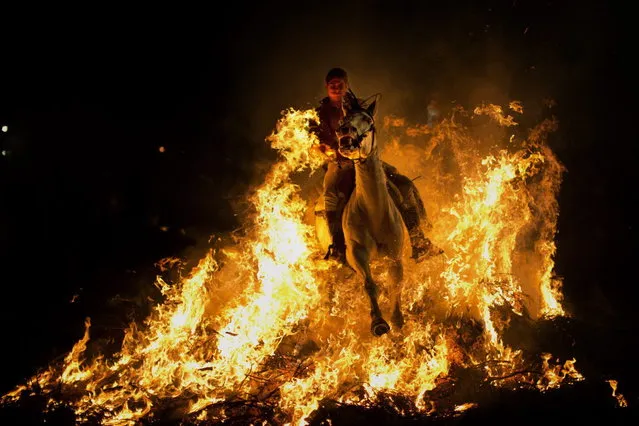
A man rides a horse through a bonfire as part of a ritual in honor of Saint Anthony, the patron saint of animals, in San Bartolome de Pinares, about 100 km west of Madrid, Spain on Thursday, January 16, 2014. On the eve of Saint Anthony's Day, hundreds ride their horses through the narrow cobblestone streets of the small village of San Bartolome during the “Luminarias”, a tradition that dates back 500 years and is meant to purify the animals with the smoke of the bonfires and protect them for the year to come. (Photo by Emilio Morenatti/AP Photo)

A man rides a horse through a bonfire as part of a ritual in honor of Saint Anthony, the patron saint of animals, in San Bartolome de Pinares, about 100 km west of Madrid, Spain on Thursday, January 16, 2014. On the eve of Saint Anthony's Day, hundreds ride their horses through the narrow cobblestone streets of the small village of San Bartolome during the “Luminarias”, a tradition that dates back 500 years and is meant to purify the animals with the smoke of the bonfires and protect them for the year to come. (Photo by Emilio Morenatti/AP Photo)
Details
24 Jan 2014 11:56:00
The Songkran festival

“The Songkran festival is celebrated in Thailand as the traditional New Year's Day from 13 to 15 April. It coincides with the New Year of many calendars of South and Southeast Asia. The most obvious celebration of Songkran is the throwing of water upon others. Thais roam the streets with containers of water or water guns. In addition, many Thais will have small bowls of beige colored talc sold cheaply and mixed with water which is then smeared on the faces and bodies of random passerbys as a blessing for the new year” – Wikipedia. (Photo by Seua Yai)
Details
23 Oct 2013 12:00:00
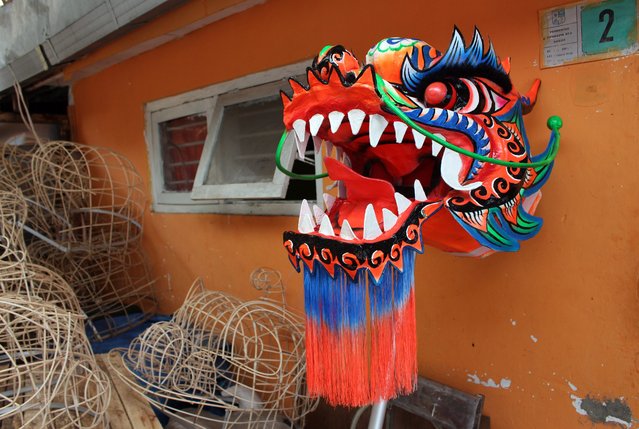
A dragon mask for the upcoming Lunar New Year hangs on the wall  at Lily Hambali's and lion masks and custome maker in Bogor, Indonesia, 02 February 2015. (Photo by Adi Weda/EPA)

A dragon mask for the upcoming Lunar New Year hangs on the wall at Lily Hambali's and lion masks and custome maker in Bogor, Indonesia, 02 February 2015. The Chinese Lunar New Year, known here as Imlek, is only three weeks away. The whole city is getting decked out to celebrate the event on 19 February 2015. (Photo by Adi Weda/EPA)
Details
06 Feb 2015 12:46:00
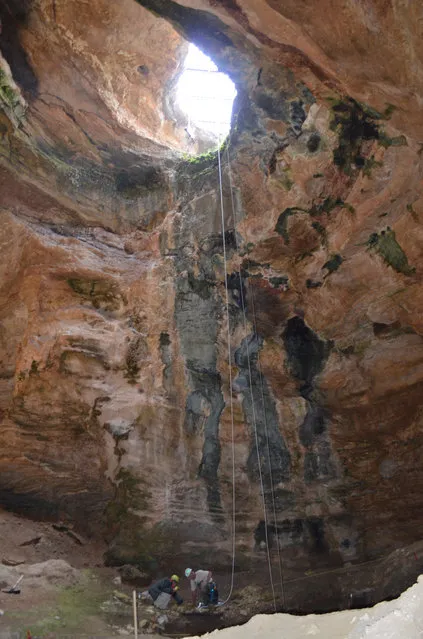
This July 2014 image provided by the Bureau of Land Management shows the interior of the Natural Trap Cave in north-central Wyoming. The cave holds the remains of tens of thousands of animals, including many now-extinct species, from the late Pleistocene period tens of thousands of years ago. Scientists have resumed digging for the first time in more than 30 years. (Photo by AP Photo/Bureau of Land Management)

This July 2014 image provided by the Bureau of Land Management shows the interior of the Natural Trap Cave in north-central Wyoming. The cave holds the remains of tens of thousands of animals, including many now-extinct species, from the late Pleistocene period tens of thousands of years ago. Scientists have resumed digging for the first time in more than 30 years. (Photo by AP Photo/Bureau of Land Management)
Details
10 Aug 2014 10:35:00