Loading...
Done
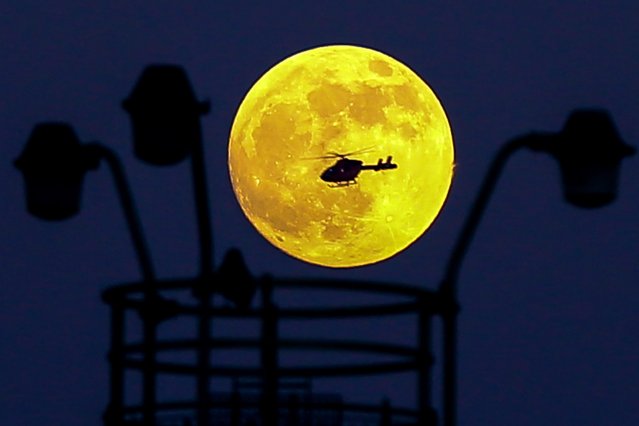
A helicopter flies in front of the Wolf Moon as it rises over London, England on January 20, 2019. The Wolf Moon, the Full Moon on January 20-21, 2019, is a Supermoon, making it look bigger and brighter than usual during the total lunar eclipse. (Photo by Dinendra Haria/Rex Features/Shutterstock)

A helicopter flies in front of the Wolf Moon as it rises over London, England on January 20, 2019. The Wolf Moon, the Full Moon on January 20-21, 2019, is a Supermoon, making it look bigger and brighter than usual during the total lunar eclipse. (Photo by Dinendra Haria/Rex Features/Shutterstock)
Details
22 Jan 2019 00:07:00
Cast member, American model and actress Hunter Schafer attends the world premiere of the movie “Hunger Games: The Ballad of Songbirds and Snakes”, in BFI IMAX in London, Britain on November 9, 2023. (Photo by Maja Smiejkowska/Reuters)

Cast member, American model and actress Hunter Schafer attends the world premiere of the movie “Hunger Games: The Ballad of Songbirds and Snakes”, in BFI IMAX in London, Britain on November 9, 2023. (Photo by Maja Smiejkowska/Reuters)
Details
06 Feb 2025 02:47:00
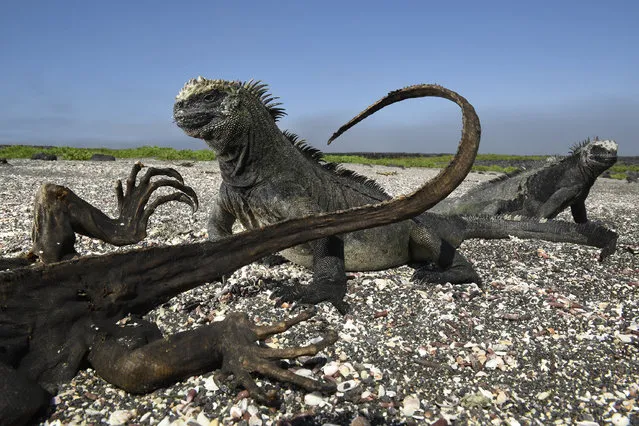
Galapagos – Rocking the Cradle: Four major ocean currents converge along the Galapagos archipelago, creating the conditions for an extraordinary diversity of animal life, April 25, 2016. The islands are home to at least 7,000 flora and fauna species, of which 97 percent of the reptiles, 80 percent of the land birds, 50 percent of the insects and 30 percent of the plants are endemic. The local ecosystem is highly sensitive to the changes in temperature, rainfall and ocean currents that characterize the climatic events known as El Niño and La Niña. These changes cause marked fluctuations in weather and food availability. Many scientists expect the frequency of El Niño and La Niña to increase as a result of climate change, making the Galapagos a possible early-warning location for its effects. (Photo by Thomas P. Peschak for National Geographic/World Press Photo)

Galapagos – Rocking the Cradle: Four major ocean currents converge along the Galapagos archipelago, creating the conditions for an extraordinary diversity of animal life, April 25, 2016. The islands are home to at least 7,000 flora and fauna species, of which 97 percent of the reptiles, 80 percent of the land birds, 50 percent of the insects and 30 percent of the plants are endemic. (Photo by Thomas P. Peschak for National Geographic/World Press Photo)
Details
16 Apr 2018 00:01:00
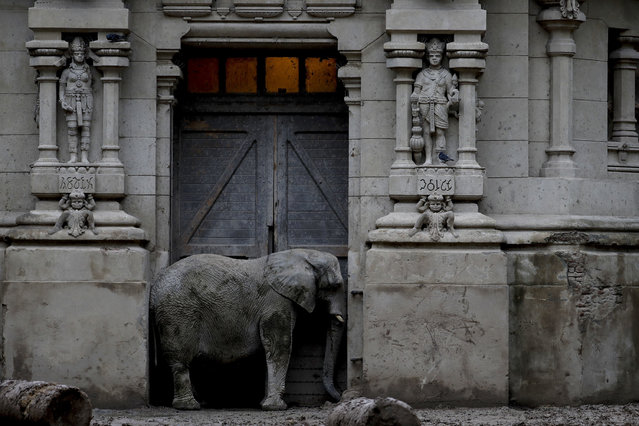
In this May 12, 2017 photo, Pupy, an African elephant, stands in the doorway of his enclosure at the former city zoo now known as Eco Parque in Buenos Aires, Argentina. A year ago the 140-year old Buenos Aires zoo closed its doors and was transformed into a park. The first director decided that the animals should be housed in buildings that reflected their countries of origin. A replica of a Hindu temple was built for the Asian elephants. (Photo by Natacha Pisarenko/AP Photo)

In this May 12, 2017 photo, Pupy, an African elephant, stands in the doorway of his enclosure at the former city zoo now known as Eco Parque in Buenos Aires, Argentina. A year ago the 140-year old Buenos Aires zoo closed its doors and was transformed into a park. The first director decided that the animals should be housed in buildings that reflected their countries of origin. A replica of a Hindu temple was built for the Asian elephants. (Photo by Natacha Pisarenko/AP Photo)
Details
25 May 2017 08:42:00
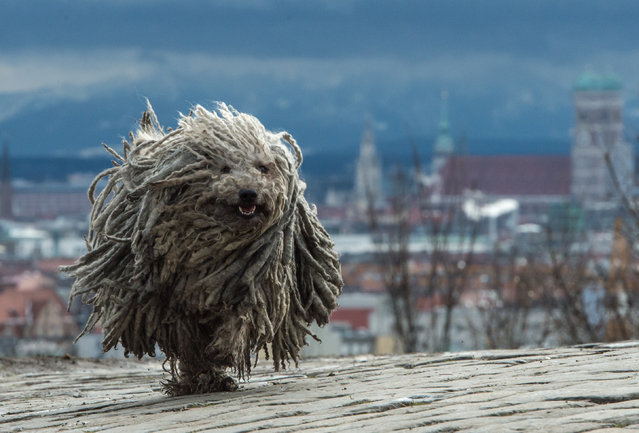
Seven year old Hungarian herding dog Derci runs along the Olympiaberg hill during stormy weather in Munich, southern Germany, Monday, January 4, 2016. (Photo by Matthias Balk/DPA via AP Photo)

Seven year old Hungarian herding dog Derci runs along the Olympiaberg hill during stormy weather in Munich, southern Germany, Monday, January 4, 2016. (Photo by Matthias Balk/DPA via AP Photo)
Details
09 Jan 2016 08:01:00
A police officer detains a woman on suspicion of collaborating with the 18th street gang during a "Safe House" operation at the Concepcion neighbourhood in San Salvador, July 2, 2015. Salvadoran police make “Safe House” operations at dangerous neighbourhoods of the capital to prevent murders, according to local media. (Photo by Jose Cabezas/Reuters)

A police officer detains a woman on suspicion of collaborating with the 18th street gang during a "Safe House" operation at the Concepcion neighbourhood in San Salvador, July 2, 2015. Salvadoran police make “Safe House” operations at dangerous neighbourhoods of the capital to prevent murders, according to local media. (Photo by Jose Cabezas/Reuters)
Details
23 Jan 2016 13:00:00
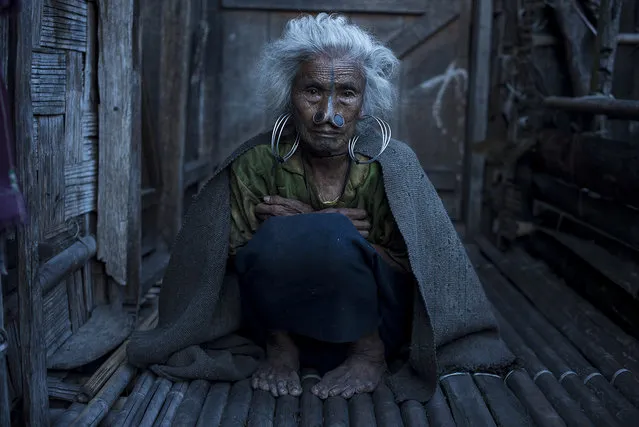
“YagYang”. The Apatani are tribal people living in north east of India in the region of Arunachal Pradesh. Tattooing and stuffing of large nose plugs is the particularity of these women. YagYang 75 years old, her husband passed away few months ago and she feels very alone, during my visit I was very fond of this woman and I wanted to spend some more time with her, so I asked her which was her favorite dish. Photo location: India. (Photo and caption by Passarini Mattia/National Geographic Photo Contest)

“YagYang”. The Apatani are tribal people living in north east of India in the region of Arunachal Pradesh. Tattooing and stuffing of large nose plugs is the particularity of these women. YagYang 75 years old, her husband passed away few months ago and she feels very alone, during my visit I was very fond of this woman and I wanted to spend some more time with her, so I asked her which was her favorite dish. The next day i returned with the fresh fish, as she mentioned, and when she saw me she was very happy and welcomed me with a big smile. Photo location: India. (Photo and caption by Passarini Mattia/National Geographic Photo Contest)
Details
05 Nov 2014 11:55:00
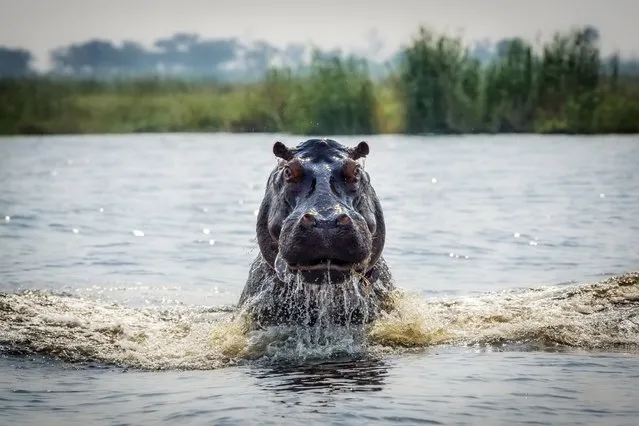
“Hippo Chase”. As we approached the camp the Selinda Reserve of northern Botswana our boat passed by a hippo resting in the water. I turned around to look back at the boat's wake and saw the hippo charging after us! The hippo must've been tired from an all-nighter because he was angry. (Photo and caption by Curtis Simmons/National Geographic Photo Contest)

“Hippo Chase”. As we approached the camp the Selinda Reserve of northern Botswana our boat passed by a hippo resting in the water. I turned around to look back at the boat's wake and saw the hippo charging after us! The hippo must've been tired from an all-nighter because he was angry. He rose way up out of the water three times trying to chase our boat! He was coming at us with such force that he created a wake of his own. Photo location: Selinda Reserve of northern Botswana. (Photo and caption by Curtis Simmons/National Geographic Photo Contest)
Details
06 Nov 2014 08:59:00