Loading...
Done
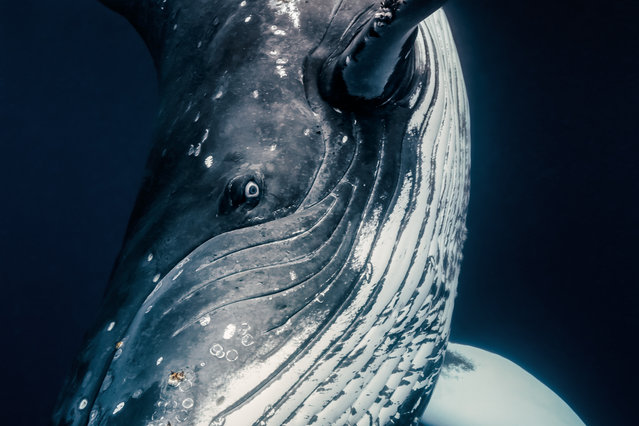
“To look into a whale’s eye is life-changing and humbling. Well, it’s the same with dolphins but they are mostly very fast in the water. A whale’s eye is unexpectedly looking, just like a human eye, kinda checking you out”. (Photo by Rita Kluge/The Guardian)

With the humpback calving season drawing to a close, here’s a look at some of Rita Kluge’s distinctive marine photos from the south Pacific. The Sydney-based photographer fell in love with whales after witnessing southern rights from the New South Wales coastline as they travelled to and from their feeding grounds in the Antarctic. She has since been to Tonga, where humpbacks breed and calf in winter months, to photograph them in the water. (Photo by Rita Kluge/The Guardian)
Details
26 Oct 2016 11:09:00
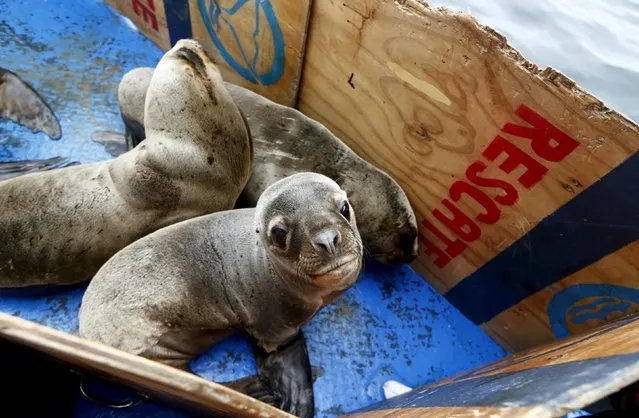
Sea lions wait on the deck of the boat before being released in front of Palomino island, in Callao, Peru September 12, 2015. (Photo by Mariana Bazo/Reuters)

Sea lions wait on the deck of the boat before being released in front of Palomino island, in Callao, Peru September 12, 2015. Four young sea lions returned to the wild after being rescued by marine biologists and treated for various illnesses. The sea lions are survivors of various illnesses which they contracted off the coast of Peru caused by the elevated temperatures in the water because of the El Nino phenomenon, according to Carlos Yaipen, Director of Animal Science and Well-being Organization (ORCA). (Photo by Mariana Bazo/Reuters)
Details
14 Sep 2015 13:37:00
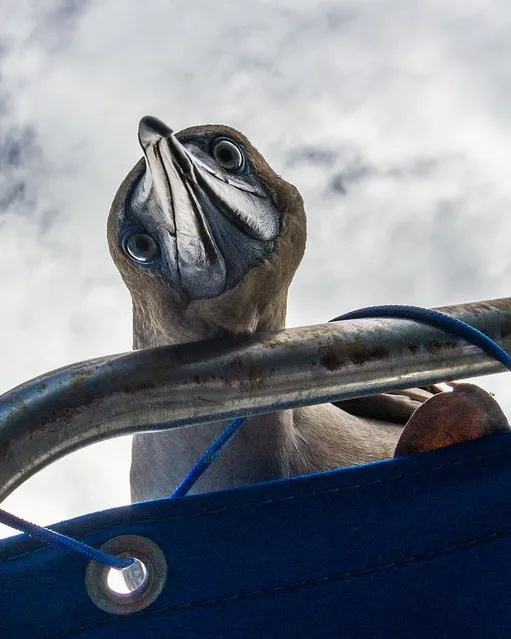
“Close-up. We had a juvenile Red-Footed Booby come visit us on the sun deck. I got some closeups with my ultrawide 11-16mm Tokina”. (Photo by Carl Fredrickson)

Situated in the Pacific Ocean some 620 miles (1,000 km) from the South American continent, these 19 islands and the surrounding marine reserve have been called a unique “living museum and showcase of evolution”. Photo: “Close-up. We had a juvenile Red-Footed Booby come visit us on the sun deck. I got some closeups with my ultrawide 11-16mm Tokina”. (Photo by Carl Fredrickson)
Details
04 Sep 2013 11:49:00
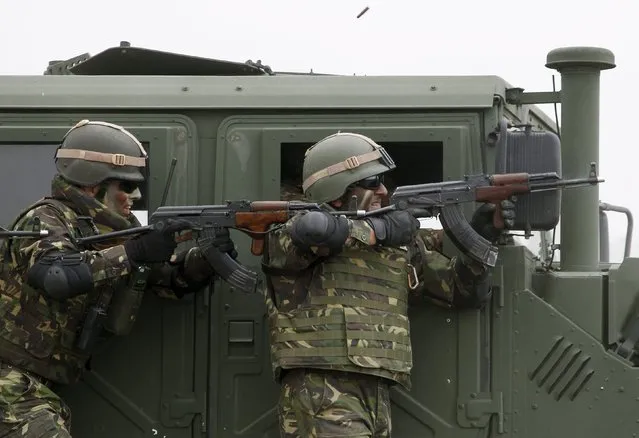
Romanian soldiers take part in a joint military exercise with NATO members, called “Agile Spirit 2015” at the Vaziani military base outside Tbilisi, Georgia, July 21, 2015. (Photo by David Mdzinarishvili/Reuters)

Romanian soldiers take part in a joint military exercise with NATO members, called “Agile Spirit 2015” at the Vaziani military base outside Tbilisi, Georgia, July 21, 2015. Georgian soldiers along with U.S. marines and platoon-size units from Bulgaria, Latvia, Lithuania and Romania are taking part in the exercises at the Vaziani military base outside Tbilisi. (Photo by David Mdzinarishvili/Reuters)
Details
22 Jul 2015 11:32:00
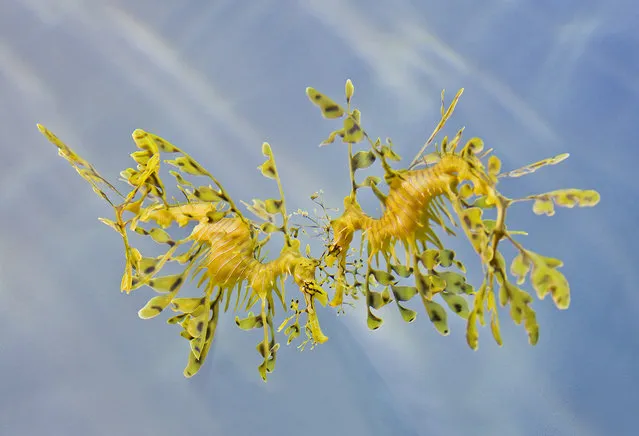
Leafy sea dragon

The leafy seadragon or Glauert's seadragon, Phycodurus eques, is a marine fish in the family Syngnathidae, which also includes the seahorses. It is the only member of the genus Phycodurus. It is found along the southern and western coasts of Australia. The name is derived from the appearance, with long leaf-like protrusions coming from all over the body. These protrusions are not used for propulsion; they serve only as camouflage. The leafy seadragon propels itself by means of a pectoral fin on the ridge of its neck and a dorsal fin on its back closer to the tail end. These small fins are almost completely transparent and difficult to see as they undulate minutely to move the creature sedately through the water, completing the illusion of floating seaweed.
Details
05 Sep 2012 08:51:00
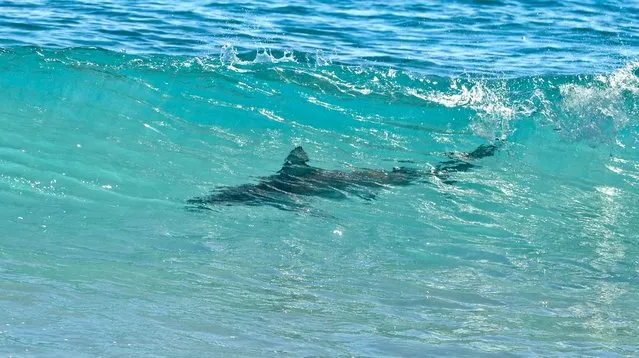
A spinner shark swims just offshore on Midtown Beach in Palm Beach on Tuesday. (Photo by Jeffrey Langlois/Palm Beach Daily News)

Several beaches along South Florida's Atlantic coast line were closed after thousands of sharks were seen migrating in the waters. The sharks were migrating from Boca Raton to Jupiter since the beginning of March, marine biologists told NBC Miami. Photo: A spinner shark swims just offshore on Midtown Beach in Palm Beach on Tuesday. (Photo by Jeffrey Langlois/Palm Beach Daily News)
Details
10 Mar 2013 09:39:00


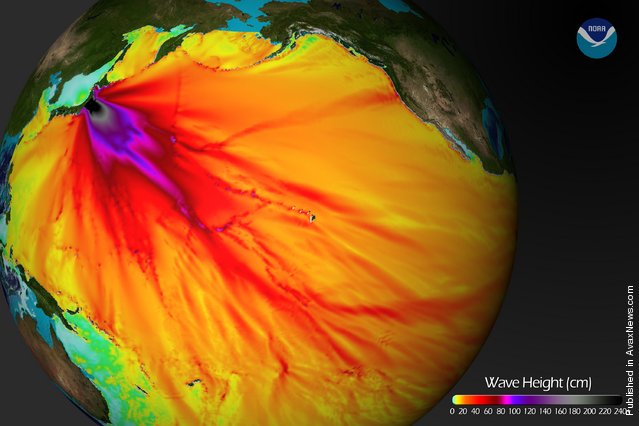
In this handout image provided by the National Oceanic and Atmospheric Administration (NOAA), model runs from the Center for Tsunami Research at the NOAA Pacific Marine Environmental Laboratory show the expected wave heights of the tsunami as it travels across the Pacific basin March 11, 2011. The largest wave heights are expected near the earthquake epicenter, off Japan. The wave will decrease in height as it travels across the deep Pacific but grow taller as it nears coastal areas. In general, as the energy of the wave decreases with distance, the near shore heights will also decrease (e.g., coastal Hawaii will not expect heights of that encountered in coastal Japan). (Photo by NOAA via Getty Images)
Details
13 Mar 2011 14:29:00


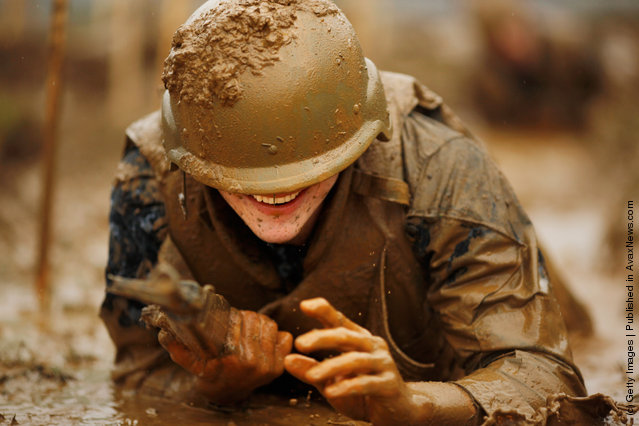
A member of the United States Naval Academy freshman class wears body armor, helmet and carries a rifle through a mud-filled ditch as part of the “Wet and Sandy” challenge during the rigorous Sea Trials May 17, 2011 in Annapolis, MD. Under strict safety supervision, about 900 freshmen, or “Plebes”, faced 14 hours of 32 rigorous physical and mental challenges during the trials, a daylong, action-oriented event modeled after the Marine Corps 54-hour Crucible and the Navy's Battle Stations. (Photo by Chip Somodevilla/Getty Images)
Details
18 May 2011 07:51:00