Loading...
Done
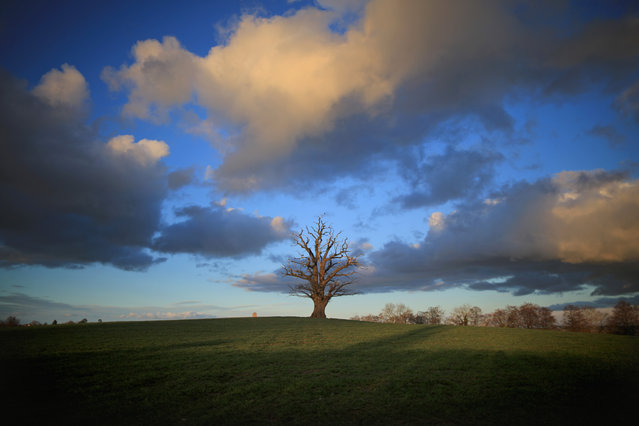
An ancient oak tree sits in a Shropshire field as the first signs of Spring begin to show across the United Kingdom on February 19, 2014 in Bridgnorth, England. (Photo by Christopher Furlong/Getty Images)

An ancient oak tree sits in a Shropshire field as the first signs of Spring begin to show across the United Kingdom on February 19, 2014 in Bridgnorth, England. (Photo by Christopher Furlong/Getty Images)
Details
24 Feb 2014 10:51:00
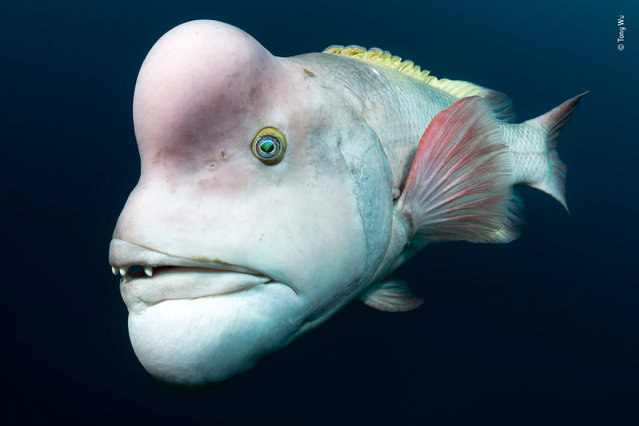
Looking for love by Tony Wu, USA. Highly commended, Animal Portraits. “Accentuating his mature appearance with pastel colours, protruding lips and an outstanding pink forehead, this Asian sheepshead wrasse sets out to impress females and see off rivals, which he will head-butt and bite, near Japan’s remote Sado Island. Individuals start out as females, and when they reach a certain age and size – up to a metre (more than 3 feet) long – can transform into males. Long-lived and slow-growing, the species is intrinsically vulnerable to overfishing”. (Photo by Tony Wu/2018 Wildlife Photographer of the Year)

Looking for love by Tony Wu, USA. Highly commended, Animal Portraits. “Accentuating his mature appearance with pastel colours, protruding lips and an outstanding pink forehead, this Asian sheepshead wrasse sets out to impress females and see off rivals, which he will head-butt and bite, near Japan’s remote Sado Island. Individuals start out as females, and when they reach a certain age and size – up to a metre (more than 3 feet) long – can transform into males. Long-lived and slow-growing, the species is intrinsically vulnerable to overfishing”. (Photo by Tony Wu/2018 Wildlife Photographer of the Year)
Details
03 Sep 2018 08:17:00
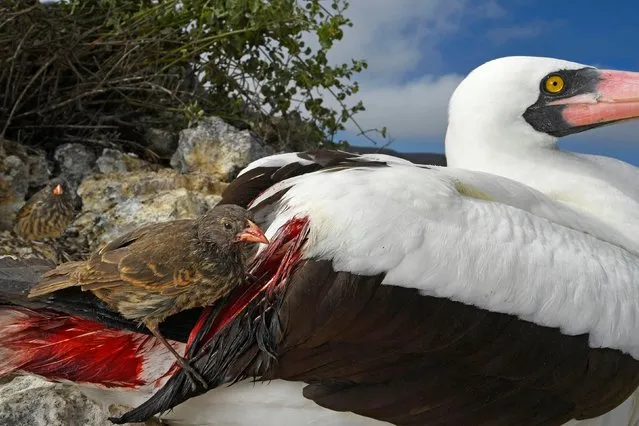
Bloodthirsty by Thomas P Peschak, Germany/South Africa — winner, Behaviour: birds. When rations run short on Wolf Island, in the remote northern Galápagos, the sharp-beaked ground finches become vampires. Their sitting targets are Nazca boobies and other large birds. The finches rely on a scant diet of seeds and insects, which regularly dries up, so they drink blood to survive. ‘I’ve seen more than half a dozen finches drinking from a single Nazca booby,’ says Tom. Rather than leave their nests the boobies tolerate the vampires, and the blood loss doesn’t seem to cause permanent harm. (Photo by Thomas P Peschak/2018 Wildlife Photographer of the Year)
Bloodthirsty by Thomas P. Peschak, Germany/South Africa — winner, Behaviour: birds. When rations run short on Wolf Island, in the remote northern Galápagos, the sharp-beaked ground finches become vampires. Their sitting targets are Nazca boobies and other large birds. The finches rely on a scant diet of seeds and insects, which regularly dries up, so they drink blood to survive. ‘I’ve seen more than half a dozen finches drinking from a single Nazca booby,’ says Tom. Rather than leave their nests the boobies tolerate the vampires, and the blood loss doesn’t seem to cause permanent harm. (Photo by Thomas P. Peschak/2018 Wildlife Photographer of the Year)

Details
19 Oct 2018 00:05:00
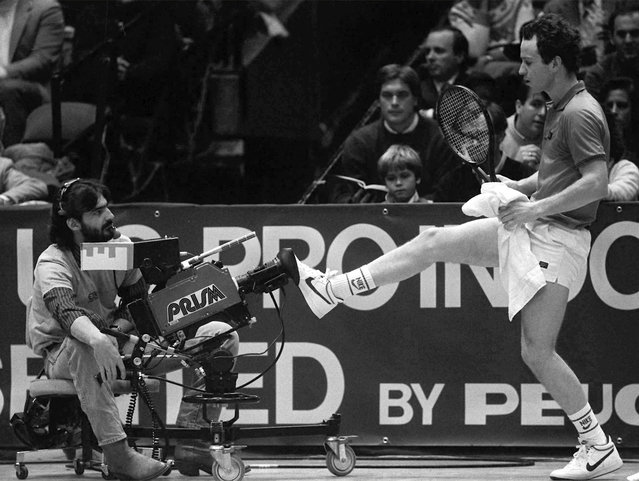
John McEnroe kicks back a television camera that he felt was crowding him on the court during the finals of the U.S. Pro Indoor Tennis Championships in Philadelphia January 27, 1985. McEnroe defeated Czech Miroslav Mecir to win the tournament. (Photo by Amy Sancetta/AP Photo)

John McEnroe kicks back a television camera that he felt was crowding him on the court during the finals of the U.S. Pro Indoor Tennis Championships in Philadelphia January 27, 1985. McEnroe defeated Czech Miroslav Mecir to win the tournament. (Photo by Amy Sancetta/AP Photo)
Details
14 Dec 2018 00:05:00
Students of the Krasnoyarsk choreographic college Anastasia Shevtsova (R) and Yulia Lyakhovykh do leg-splits as they study for an exam and a performance by the graduates at the State Theatre of Opera and Ballet, at the college's campus in the Siberian city of Krasnoyarsk, Russia, May 4, 2017. (Photo by Ilya Naymushin/Reuters)

Students of the Krasnoyarsk choreographic college Anastasia Shevtsova (R) and Yulia Lyakhovykh do leg-splits as they study for an exam and a performance by the graduates at the State Theatre of Opera and Ballet, at the college's campus in the Siberian city of Krasnoyarsk, Russia, May 4, 2017. (Photo by Ilya Naymushin/Reuters)
Details
28 Dec 2017 07:48:00
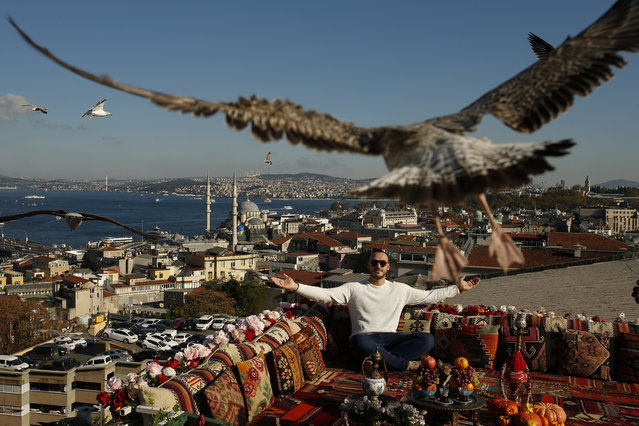
A seagull files over a man sitting at a coffee shop backdropped by the Bosporus Strait in Istanbul, Tuesday, November 17, 2020. (Photo by Emrah Gurel/AP Photo)

A seagull files over a man sitting at a coffee shop backdropped by the Bosporus Strait in Istanbul, Tuesday, November 17, 2020. (Photo by Emrah Gurel/AP Photo)
Details
05 Dec 2020 00:05:00
Street vendosr prepare grilled pigs to sell for the Chinese New Year celebrations at a market in Phnom Penh, Cambodia, 11 February 2021. Chinese people around the world celebrate the Lunar New Year, also known as the Spring Festival, which marks the year of the Ox. (Photo by Kith Serey/EPA/EFE)

Street vendosr prepare grilled pigs to sell for the Chinese New Year celebrations at a market in Phnom Penh, Cambodia, 11 February 2021. Chinese people around the world celebrate the Lunar New Year, also known as the Spring Festival, which marks the year of the Ox. (Photo by Kith Serey/EPA/EFE)
Details
12 Feb 2021 10:08:00
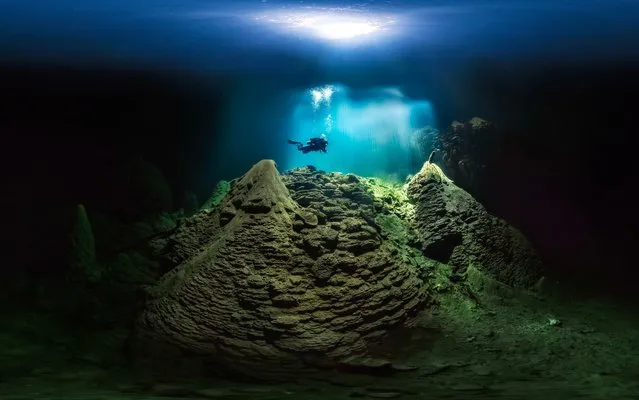
Cave Diver, Anhumas Abyss, Bonito, Brazil: The Anhumas Abyss is an underground cavern with a crystal-clear lake below, more than 260 feet (79 m) deep. A visitor must enter through a narrow opening at the top of the chamber and rappel into the cave. Snorkeling and scuba diving in the lake reveal amazing scenery. Distinctive, conical limestone stalagmites and stalactites occupy the lake and the surrounding area, some reaching 65 feet (20 m) high. “One must rappel about 235 feet (72 m) to get down into this deep lake. The photo was taken at a depth of 50 feet (15 m). It was a challenge to create the image because of the high contrast, plus the diver could not see into the darkness, making communication impossible”. (Photo by Marcio Cabral/Nature’s Best Photography Awards 2017)

Cave Diver, Anhumas Abyss, Bonito, Brazil: The Anhumas Abyss is an underground cavern with a crystal-clear lake below, more than 260 feet (79 m) deep. A visitor must enter through a narrow opening at the top of the chamber and rappel into the cave. Snorkeling and scuba diving in the lake reveal amazing scenery. Distinctive, conical limestone stalagmites and stalactites occupy the lake and the surrounding area, some reaching 65 feet (20 m) high. (Photo by Marcio Cabral/Nature’s Best Photography Awards 2017)
Details
26 Oct 2017 08:10:00