Loading...
Done
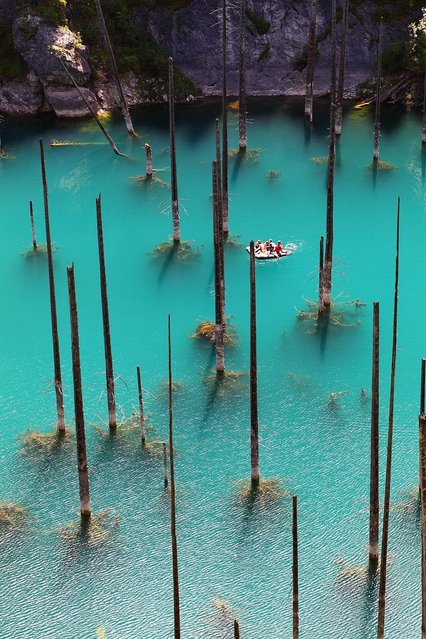
Kaindy Lake in Kazakhstan

Kaindy Lake (Kazakh: Қайыңды көлі, Qayındı köli) is a 400 metre long lake in Kazakhstan that reaches depths near 30 metres in some areas. It is located 129 km ESE of the city of Almaty and is 2,000 metres above sea level. It was created by the result of an enormous limestone landslide, triggered by the 1911 Kebin earthquake. The track to Kaindy lake has many scenic views to the Saty Gorge, the Chilik River valley and the Kaindy Gorge. Dried-out trunks of submerged Picea schrenkiana trees rise above the surface.
Details
06 Aug 2012 09:58:00
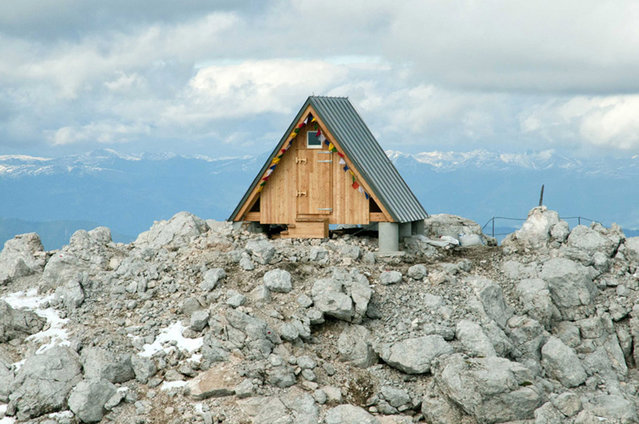
Camping Luca Vuerich By Giovanni Pesamosca

Italian architect Giovanni Pesamosca’s work is reaching scenic new heights. His cabin is perched on the edge of Foronon Buinz in Italy’s Julian Alps. The pre fabricated structure was placed at the spectacular location in memory of deceased climber Luka Vuerich, and is now providing free accommodation complete with jaw dropping panoramic views for up to nine people… the intrepid kind willing to make a long trek to 8303 feet (2531 meters) above sea level.
Details
12 Oct 2014 10:26:00
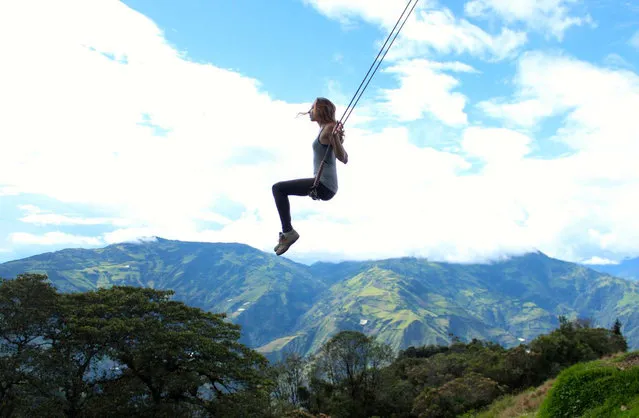
The Crazy Swing At Casa Del Arbol in Ecuador

Located at La Casa Del Arbol or “The Treehouse” in Baños, Ecuador, this small house was built for the stunning view on the Tungurahua Volcano it offers. But the real attraction is the swing attached to one of the tree's branches. It is far from your average swing, and it is surnamed the "Swing at the End of the World" for a good reason. Located off a giant cliff at over 2,600 meters above sea level and with absolutely no safety features, this swing promises a serious thrill to whoever is brave enough to ride it.
Details
10 Mar 2014 13:49:00
Lush green rice terraces sprawl over 2,200 hectares of mountainside ready to be harvested. These stunning images, captured by photographer Saravut Whanset, show the incredible terraces throughout the course of the day, including at sunrise and sunset. Workers tend to the fields, with each terrace between 1 and 1.5 metres wide, while wooden huts stand on stilts on the mountainside. The beautiful panoramic pictures were taken in Mu Cang Chai, Vietnam, with the fields located at the foot of the Hoang Lien Son mountain range, 1,000 metres above sea level. (Photo by Saravut Whanset/Solent News and Photo Agency)

Lush green rice terraces sprawl over 2,200 hectares of mountainside ready to be harvested. These stunning images, captured by photographer Saravut Whanset, show the incredible terraces throughout the course of the day, including at sunrise and sunset. Workers tend to the fields, with each terrace between 1 and 1.5 metres wide, while wooden huts stand on stilts on the mountainside. The beautiful panoramic pictures were taken in Mu Cang Chai, Vietnam, with the fields located at the foot of the Hoang Lien Son mountain range, 1,000 metres above sea level. (Photo by Saravut Whanset/Solent News and Photo Agency)
Details
13 Nov 2017 07:21:00
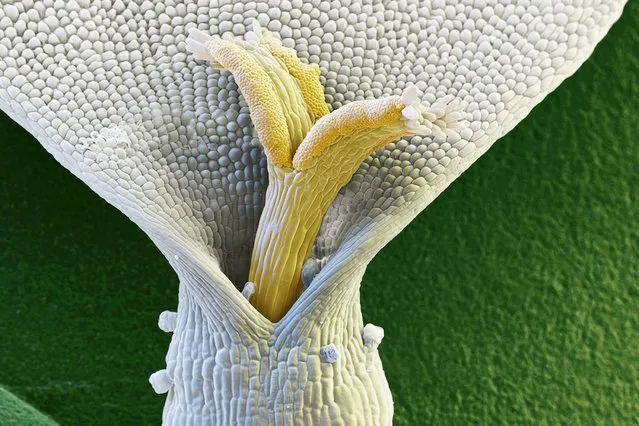
The floret of a Chamomile flower up close and personal. (Photo by Oliver Meckes/Barcroft Media)

These images have been created using a colour scanning electron microscope (SEM) by the award-winning Eye of Science, comprised of snapper Oliver Meckes and biologist Nicole Ottawa. For a decade the pair, based in Reutlingen in the south of Germany, worked with an old SEM they saved from the scrapheap, but for the last five years they have used a £250,000 FEI Quanta Series Field Emission SEM. Oliver said: “Flowers are beautiful in 'normal' view, but when you look closer, some parts get very bizarre and unexpected structures appear – flowers within flowers, worlds within worlds”. Photo: The floret of a Chamomile flower up close and personal. (Photo by Oliver Meckes/Barcroft Media)
Details
26 May 2014 13:51:00
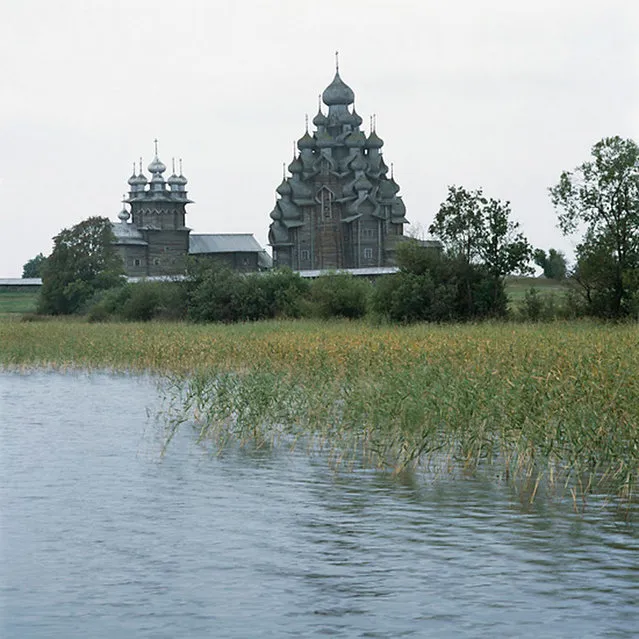
Wooden Churches - Travelling In The Russian North By Richard Davies Part 1

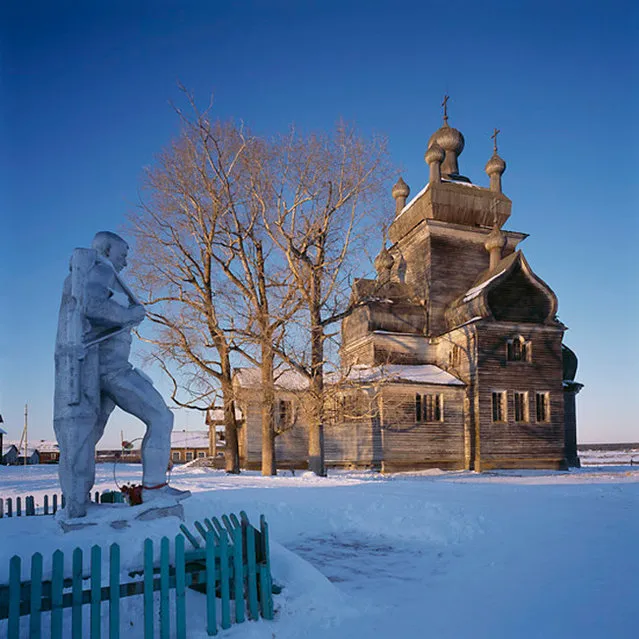
While communism, collectivism, worms, dry rot and casual looting failed to destroy the majestic wooden churches of Russia, it may be ordinary neglect that finally does them in. Dwindled now to several hundred remaining examples, these glories of vernacular architecture lie scattered amid the vastness of the world’s largest country. Just over a decade ago, Richard Davies, a British architectural photographer, struck out on a mission to record the fragile and poetic structures. Austerely beautiful and haunting, “Wooden Churches: Traveling in the Russian North” (White Sea Publishing; $132) is the result. Covering thousands of miles, Mr. Davies described how he and the writer Matilda Moreton tracked down the survivors from among the thousands of onion-domed structures built after Prince Vladimir converted to Christianity in 988.
Details
25 Nov 2013 12:47:00
Photographers: David Doubilet

“David Doubilet (born 28 November 1946) is a well known underwater photographer known primarily for his work published in National Geographic Magazine. He was born in New York and started taking photos underwater at the young age of 12. He started with a Brownie Hawkeye in a rubber anesthesiologist's bag to keep the water out of the camera. During his summer holidays, he spent his time along the New Jersey coast. He later worked as a diver and photographer for the Sandy Hook Marine Laboratories in New Jersey. He also spent much time in the Caribbean. While a dive instructor in the Bahamas he found his motivation to capture the beauty of the sea and everything in it”. – Wikipedia. (Photo by David Doubilet/National Geographic)
Details
16 May 2012 12:21:00
Wooden Churches - Travelling In The Russian North By Richard Davies Part 2

While communism, collectivism, worms, dry rot and casual looting failed to destroy the majestic wooden churches of Russia, it may be ordinary neglect that finally does them in. Dwindled now to several hundred remaining examples, these glories of vernacular architecture lie scattered amid the vastness of the world’s largest country. Just over a decade ago, Richard Davies, a British architectural photographer, struck out on a mission to record the fragile and poetic structures. Austerely beautiful and haunting, “Wooden Churches: Traveling in the Russian North” (White Sea Publishing; $132) is the result. Covering thousands of miles, Mr. Davies described how he and the writer Matilda Moreton tracked down the survivors from among the thousands of onion-domed structures built after Prince Vladimir converted to Christianity in 988.

See also: Wooden Churches Part1
Details
28 Nov 2013 12:13:00