Loading...
Done
Tim Laman - Wildlife Photojournalist

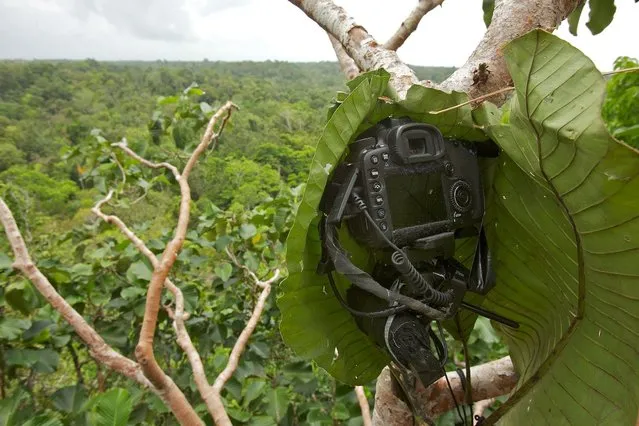
Tim Laman is a field biologist and wildlife photojournalist. His pioneering research in the rain forest canopy in Borneo led to a PhD from Harvard and his first National Geographic article in 1997. Since then, he has pursued his passion for exploring wild places and documenting little-known and endangered wildlife by becoming a regular contributor to National Geographic. He has eighteen articles to his credit to date, all of which have had a conservation message. Some have focused on endangered species such as Orangutans or Hornbills, while others, such as a series of articles on Conservation International’s Biodiversity Hotspots, have highlighted regions under intense pressure.
Details
14 Sep 2013 10:13:00
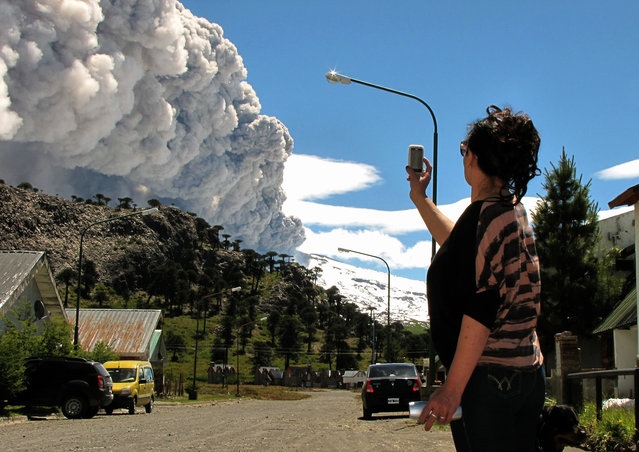
A woman takes a picture with her mobile phone from Caviahue, Neuquen province, Argentina, some 1500 km southwest of Buenos Aires, of the Copahue volcano spewing ashes on December 22, 2012. The authorities of Chile and Argentina issued yellow alerts due to the eruption of the Copahue volcano, placed in the border between both countries. (Photo by Antonio Huglich/AFP Photo)

A woman takes a picture with her mobile phone from Caviahue, Neuquen province, Argentina, some 1500 km southwest of Buenos Aires, of the Copahue volcano spewing ashes on December 22, 2012. The authorities of Chile and Argentina issued yellow alerts due to the eruption of the Copahue volcano, placed in the border between both countries. (Photo by Antonio Huglich/AFP Photo)
Details
23 Dec 2012 09:25:00
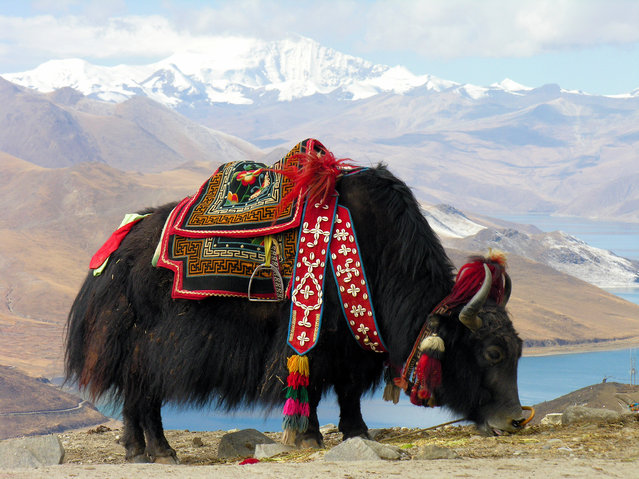
Yak near Yamdrok lake, Tibet. It is a long-haired bovinae found throughout the Himalayan region of south Central Asia, the Tibetan Plateau and as far north as Mongolia and Russia. The Tibetan economy is dominated by subsistence agriculture. Due to limited arable land, the primary occupation of the Tibetan Plateau is raising livestock, such as sheep, cattle, goats, camels, yaks, dzo, and horses. The Tibetan yak is an integral part of Tibetan life. (Photo by Dennis Jarvis)

Yak near Yamdrok lake, Tibet. It is a long-haired bovinae found throughout the Himalayan region of south Central Asia, the Tibetan Plateau and as far north as Mongolia and Russia. The Tibetan economy is dominated by subsistence agriculture. Due to limited arable land, the primary occupation of the Tibetan Plateau is raising livestock, such as sheep, cattle, goats, camels, yaks, dzo, and horses. The Tibetan yak is an integral part of Tibetan life. (Photo by Dennis Jarvis)
Details
10 Jun 2015 10:48:00
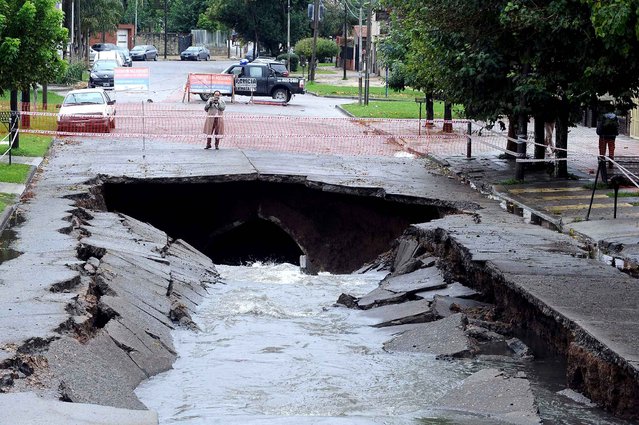
Handout picture released by Telam showing the tarmac of the Pedro Palacios Avenue in Ramos Mejia, province of Buenos Aires, Argentina, under which the channeled waters of the Maldonado stream flow, after it collapsed on April 8, 2014 leaving a 40-metre-long, 1.4-metre-deep hole. About 3000 people had to be evacuated in the Argentine provinces of Neuquen (soutwest), Catamarca (northwest), Santiago del estero (center) and Cordoba (center)due to the foods caused by heavy rain, official sources said. (Photo by Daniel Dabove/AFP Photo)

Handout picture released by Telam showing the tarmac of the Pedro Palacios Avenue in Ramos Mejia, province of Buenos Aires, Argentina, under which the channeled waters of the Maldonado stream flow, after it collapsed on April 8, 2014 leaving a 40-metre-long, 1.4-metre-deep hole. About 3000 people had to be evacuated in the Argentine provinces of Neuquen (soutwest), Catamarca (northwest), Santiago del estero (center) and Cordoba (center)due to the foods caused by heavy rain, official sources said. (Photo by Daniel Dabove/AFP Photo)
Details
12 Apr 2014 12:40:00
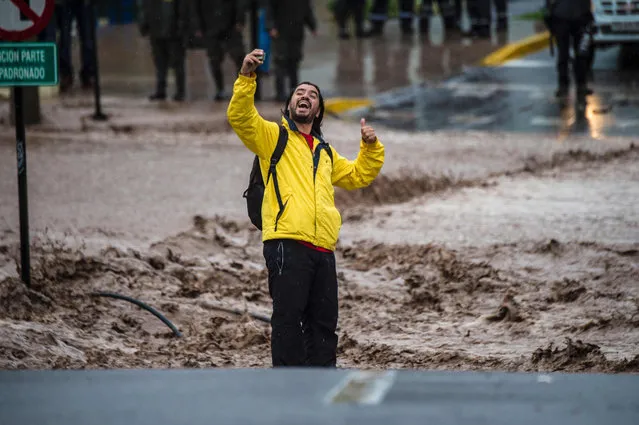
A man takes a selfie next to a flooded street due to the overflowing of the Mapocho river during heavy rains in Santiago on April 17, 2016. Four million people in Santiago were without tap water Sunday after unusually heavy rain pounding central Chile triggered landslides that fouled the city's water supply and forced the closure of the world's biggest copper mine, officials said. (Photo by Martin Bernetti/AFP Photo)

A man takes a selfie next to a flooded street due to the overflowing of the Mapocho river during heavy rains in Santiago on April 17, 2016. Four million people in Santiago were without tap water Sunday after unusually heavy rain pounding central Chile triggered landslides that fouled the city's water supply and forced the closure of the world's biggest copper mine, officials said. (Photo by Martin Bernetti/AFP Photo)
Details
18 Apr 2016 10:05:00
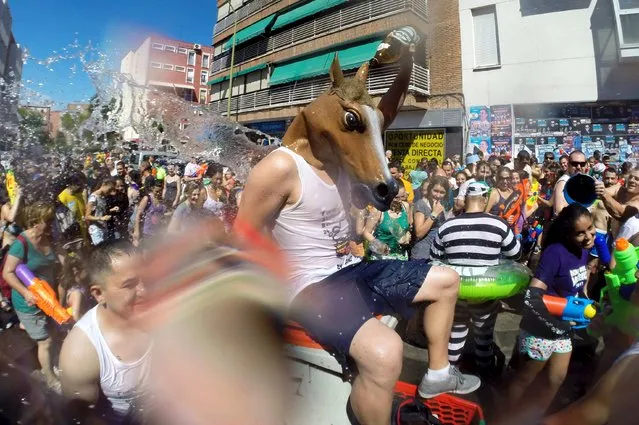
Revellers take part in the annual “Naval Battle” of Vallecas in Madrid, Spain July 19, 2015. The slogan for this year's water battle is “Get wet for Alfon, freedom for Alfon”, referring to Alfonso Fernandez Ortega, a Vallecas resident who was sentenced to four years in prison in June. The festival was started spontaneously in 1981 when some neighbours started to throw water at one another due to high temperatures during the Virgen del Carmen Festival. (Photo by Juan Medina/Reuters)

Revellers take part in the annual “Naval Battle” of Vallecas in Madrid, Spain July 19, 2015. The slogan for this year's water battle is “Get wet for Alfon, freedom for Alfon”, referring to Alfonso Fernandez Ortega, a Vallecas resident who was sentenced to four years in prison in June. The festival was started spontaneously in 1981 when some neighbours started to throw water at one another due to high temperatures during the Virgen del Carmen Festival. (Photo by Juan Medina/Reuters)
Details
20 Jul 2015 10:01:00
A person wearing a mask of Elmo walks around Times Square during the pass of the snowstorm on January 31, 2021 in New York City. New York City Mayor Bill de Blasio declared a state of emergency order due to the arriving storm that's expected to wallop New York, where airports are expected to cancel the majority if their flights. (Photo by Eduardo Munoz Alvarez/VIEWpress)

A person wearing a mask of Elmo walks around Times Square during the pass of the snowstorm on January 31, 2021 in New York City. New York City Mayor Bill de Blasio declared a state of emergency order due to the arriving storm that's expected to wallop New York, where airports are expected to cancel the majority if their flights. (Photo by Eduardo Munoz Alvarez/VIEWpress)
Details
09 Feb 2021 10:07:00
Hurricanes player Xavier Numia and Black Ferns player Marcelle Parkes train in isolation at Polo Ground Park due to the coronavirus lockdown on May 06, 2020 in Wellington, New Zealand. New Zealand has been in lockdown since Thursday 26 March following tough restrictions imposed by the government to stop the spread of COVID-19 across the country. (Photo by Hagen Hopkins/Getty Images)

Hurricanes player Xavier Numia and Black Ferns player Marcelle Parkes train in isolation at Polo Ground Park due to the coronavirus lockdown on May 06, 2020 in Wellington, New Zealand. New Zealand has been in lockdown since Thursday 26 March following tough restrictions imposed by the government to stop the spread of COVID-19 across the country. (Photo by Hagen Hopkins/Getty Images)
Details
09 May 2020 00:07:00