Loading...
Done
Gymnast Ahmad al-Sawas performs gymnastic moves near damaged buildings in the rebel-held Bustan al-Qasr neighbourhood of Aleppo, Syria March 26, 2016. As Syrian gymnast Ahmad al-Sawas watched his country fall apart, his Olympic dream collapsed too. The last national champion before the fighting began, he knew that supporting the anti-government side in the five-year-old civil war would prevent him from being selected for the Rio Games. “I chose to be an athlete who participates in the revolution”, said Ahmad, who trains where he can for two hours a day – be it on a mattress on a soccer field, in a local hall or somersaulting off a wall. (Photo by Abdalrhman Ismail/Reuters)

Gymnast Ahmad al-Sawas performs gymnastic moves near damaged buildings in the rebel-held Bustan al-Qasr neighbourhood of Aleppo, Syria March 26, 2016. As Syrian gymnast Ahmad al-Sawas watched his country fall apart, his Olympic dream collapsed too. The last national champion before the fighting began, he knew that supporting the anti-government side in the five-year-old civil war would prevent him from being selected for the Rio Games. (Photo by Abdalrhman Ismail/Reuters)
Details
05 Aug 2016 13:25:00
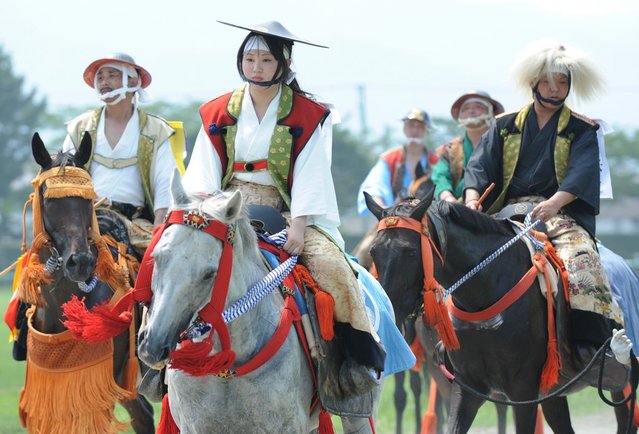
A young woman (C) clad in samurai costume leads other local poeple as she rides her horse during a parade at the annual Soma Nomaoi festival in Minamisoma, Fukushima Prefecture, on July 28, 2012.  The traditional full-scale festival kicked off for the first time after the accident of the Fukushima Dai-ichi Nuclear Power Plant following the massive earthquake and the tsunami on March 11, 2011. (Photo by Toru Yamanaka/AFP Photo)

Soma-Nomaoi is a festival that recreates a battle scene from more than 1,000 years ago. It is annually held for 4 days from July 22 to 25 in Haramachi City, Fukushima Prefecture, in the eastern part of Japan. In this historical event, 600 mounted samurai in traditional Japanese armor, with long swords at their side and ancestral flagstaffs streaming from their backs, ride across open fields. Soma-Nomaoi has been designated an Important Intangible Folk Cultural Property.

Photo: A young woman (C) clad in samurai costume leads other local poeple as she rides her horse during a parade at the annual Soma Nomaoi festival in Minamisoma, Fukushima Prefecture, on July 28, 2012. The traditional full-scale festival kicked off for the first time after the accident of the Fukushima Dai-ichi Nuclear Power Plant following the massive earthquake and the tsunami on March 11, 2011. (Photo by Toru Yamanaka/AFP Photo)
Details
02 Aug 2012 12:59:00
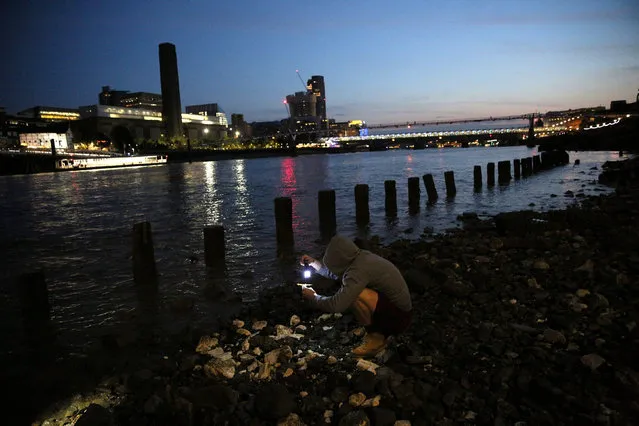
A mudlark uses a torch to look for items on the bank of the River Thames in London, Britain June 06, 2016. Mudlarking is believed to trace its origins to the 18th and 19th century, when scavengers searched the Thames' shores for items to sell. These days, history and archaeology fans are the ones hoping to find old relics such as coins, ceramics, artifacts or everyday items from across centuries. They wait for the low tide and then scour specific areas of exposed shores. "If you're in a field you could be out all day long, with the river you're restricted to about two or three hours," mudlark Nick Stevens said. While many just use the naked eye for their searches, others rely on metal detectors for which a permit from the Port of London Authority is needed. Digging also requires consent. (Photo by Neil Hall/Reuters)

A mudlark uses a torch to look for items on the bank of the River Thames in London, Britain June 06, 2016. Mudlarking is believed to trace its origins to the 18th and 19th century, when scavengers searched the Thames' shores for items to sell. These days, history and archaeology fans are the ones hoping to find old relics such as coins, ceramics, artifacts or everyday items from across centuries. their finds with the Portable Antiquities Scheme. Any item over 300 years old must be recorded. (Photo by Neil Hall/Reuters)
Details
27 Aug 2016 10:43:00
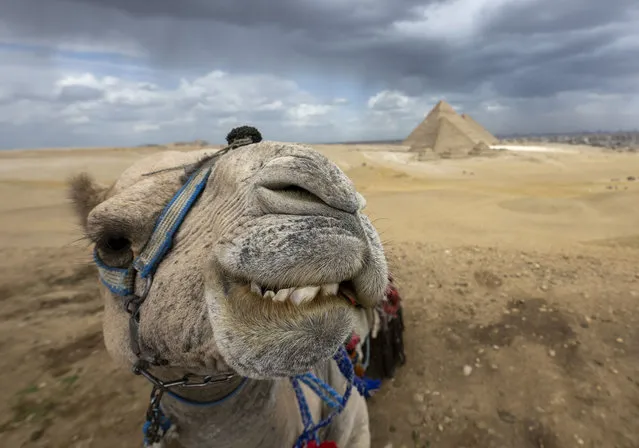
A camel is seen in front of the pyramids, which is one of the seven wonders of the world that was visited by 14.9 million tourists last year in Giza, Egypt on February 21, 2024. The pyramids were named after the tombs of fathers, sons and grandsons, including the largest pyramid Cheops (King Khufu), the middle pyramid Khafre (King Khafre) and the small pyramid Menkaure (King Menkaure). (Photo by Utku Ucrak/Anadolu via Getty Images)

A camel is seen in front of the pyramids, which is one of the seven wonders of the world that was visited by 14.9 million tourists last year in Giza, Egypt on February 21, 2024. The pyramids were named after the tombs of fathers, sons and grandsons, including the largest pyramid Cheops (King Khufu), the middle pyramid Khafre (King Khafre) and the small pyramid Menkaure (King Menkaure). (Photo by Utku Ucrak/Anadolu via Getty Images)
Details
12 Apr 2024 00:06:00
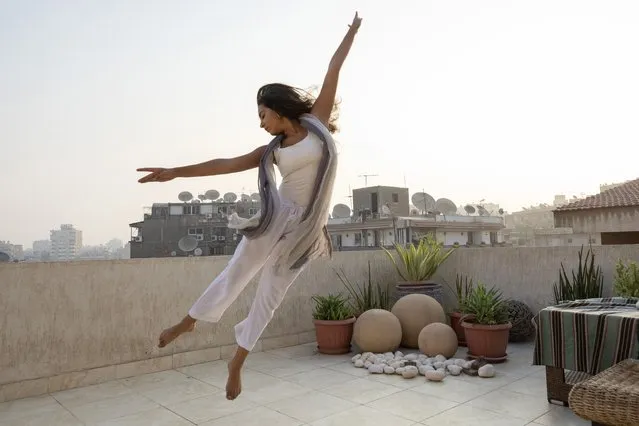
Egyptian 26-year-old dancer Nadine El Gharib, dances on the rooftop of her home in Cairo, Egypt, Monday, September 27, 2021. “Dance was crucial when COVID-19 started in terms of taking care of my well-being”, Gharib said. “When restrictions forced us to stop going to the Opera for classes I started online dance and it introduced me to a new world of dance. It was very inspiring”. (Photo by Nariman El-Mofty/AP Photo)

Egyptian 26-year-old dancer Nadine El Gharib, dances on the rooftop of her home in Cairo, Egypt, Monday, September 27, 2021. “Dance was crucial when COVID-19 started in terms of taking care of my well-being”, Gharib said. “When restrictions forced us to stop going to the Opera for classes I started online dance and it introduced me to a new world of dance. It was very inspiring”. (Photo by Nariman El-Mofty/AP Photo)
Details
03 Nov 2021 08:33:00
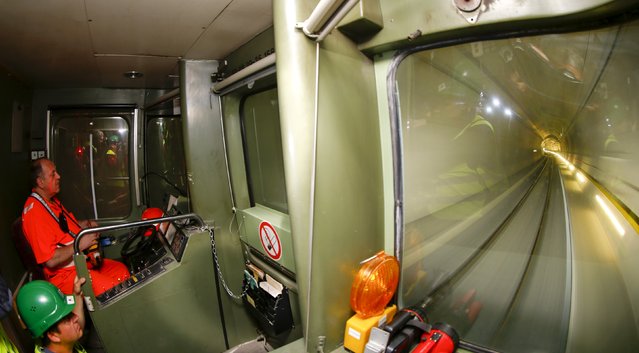
Engine driver Josef Kowatsch (top L) steers a train through the NEAT Gotthard Base Tunnel during a media visit near the town of Erstfeld August 24, 2015. (Photo by Arnd Wiegmann/Reuters)

Engine driver Josef Kowatsch (top L) steers a train through the NEAT Gotthard Base Tunnel during a media visit near the town of Erstfeld August 24, 2015. Crossing the Alps, the world's longest train tunnel should become operational at the end of 2016, consisting of two parallel single track tunnels, each of a length of 57 km (35 miles). (Photo by Arnd Wiegmann/Reuters)
Details
25 Aug 2015 10:42:00
A woman gets ready for her performance at the backstage of the Heart restaurant in Ibiza on June 29, 2015. Take the Spanish chefs Ferran and Albert Adria, the Cirque du Soleil founder French Guy Laliberte and contemporary artists such as Japanese Takashi Murakami. Put them together on the luxurious Mediterranean island of Ibiza and shake well to get “Heart” an innovative multi-sensory experience. (Photo by Jaime Reina/AFP Photo)

A woman gets ready for her performance at the backstage of the Heart restaurant in Ibiza on June 29, 2015. Take the Spanish chefs Ferran and Albert Adria, the Cirque du Soleil founder French Guy Laliberte and contemporary artists such as Japanese Takashi Murakami. Put them together on the luxurious Mediterranean island of Ibiza and shake well to get “Heart” an innovative multi-sensory experience. The idea of provoking emotions through a collision of avant-garde creativities appeared two years ago from Adria brothers and Laliberte's passion about art and cuisine. They met a decade ago at the famous restaurant El Bulli, closed in 2011. (Photo by Jaime Reina/AFP Photo)
Details
01 Jul 2015 13:50:00
Tourists walk as others relax on the beach in the Red Sea resort of Hurghada, Egypt, July 17, 2017. (Photo by Gleb Garanich/Reuters)

Tourists walk as others relax on the beach in the Red Sea resort of Hurghada, Egypt, July 17, 2017. (Photo by Gleb Garanich/Reuters)
Details
25 Jul 2017 09:25:00